 Add to Chrome
 Add to Firefox
 Add to Edge
Differentially Private Conformal Prediction
Apr 16, 2026
Conformal prediction (CP) has attracted broad attention as a simple and flexible framework for uncertainty quantification through prediction sets. In this work, we study how to deploy CP under differential privacy (DP) in a statistically efficient manner. We first introduce differential CP, a non-splitting conformal procedure that avoids the efficiency loss caused by data splitting and serves as a bridge between oracle CP and private conformal inference. By exploiting the stability properties of DP mechanisms, differential CP establishes a direct connection to oracle CP and inherits corresponding validity behavior. Building on this idea, we develop Differentially Private Conformal Prediction (DPCP), a fully private procedure that combines DP model training with a private quantile mechanism for calibration. We establish the end-to-end privacy guarantee of DPCP and investigate its coverage properties under additional regularity conditions. We further study the efficiency of both differential CP and DPCP under empirical risk minimization and general regression models, showing that DPCP can produce tighter prediction sets than existing private split conformal approaches under the same privacy budget. Numerical experiments on synthetic and real datasets demonstrate the practical effectiveness of the proposed methods.

Decentralized Federated Learning by Partial Message Exchange
Mar 02, 2026Decentralized federated learning (DFL) has emerged as a transformative server-free paradigm that enables collaborative learning over large-scale heterogeneous networks. However, it continues to face fundamental challenges, including data heterogeneity, restrictive assumptions for theoretical analysis, and degraded convergence when standard communication- or privacyenhancing techniques are applied. To overcome these drawbacks, this paper develops a novel algorithm, PaME (DFL by Partial Message Exchange). The central principle is to allow only randomly selected sparse coordinates to be exchanged between two neighbor nodes. Consequently, PaME achieves substantial reductions in communication costs while still preserving a high level of privacy, without sacrificing accuracy. Moreover, grounded in rigorous analysis, the algorithm is shown to converge at a linear rate under the gradient to be locally Lipschitz continuous and the communication matrix to be doubly stochastic. These two mild assumptions not only dispense with many restrictive conditions commonly imposed by existing DFL methods but also enables PaME to effectively address data heterogeneity. Furthermore, comprehensive numerical experiments demonstrate its superior performance compared with several representative decentralized learning algorithms.
Sparse and Low-Rank Covariance Matrices Estimation
Aug 07, 2014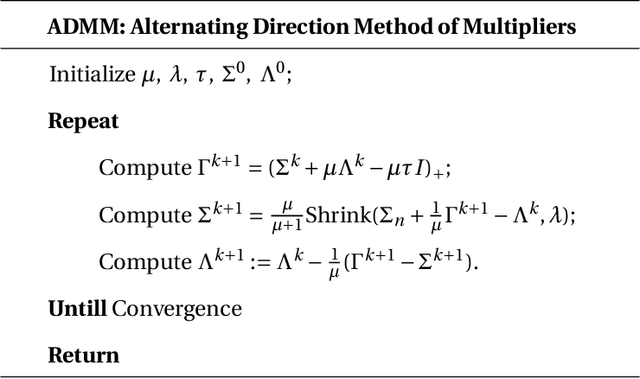
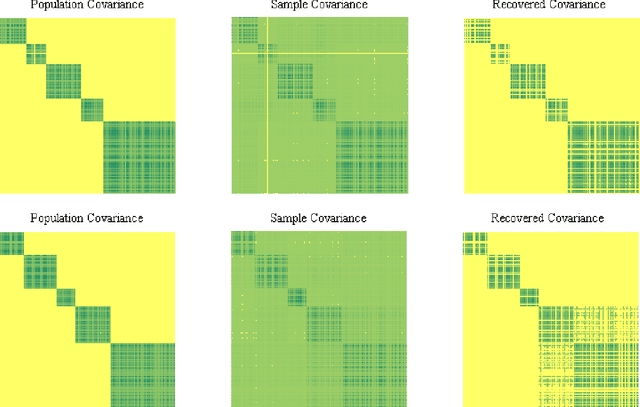
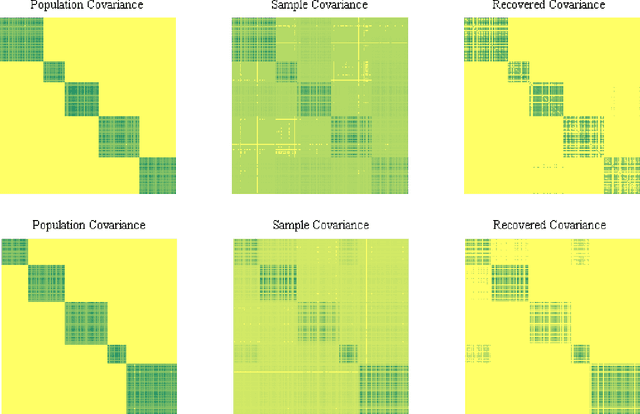
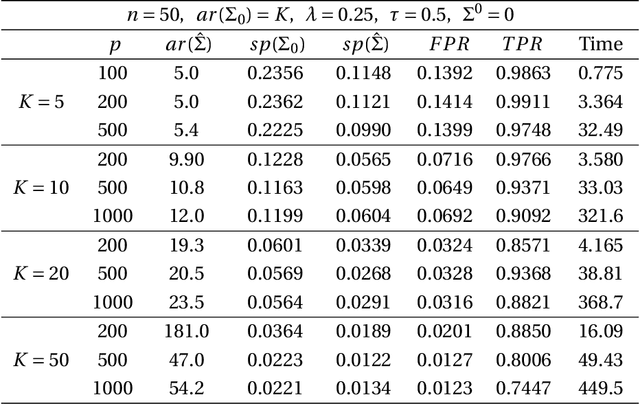
This paper aims at achieving a simultaneously sparse and low-rank estimator from the semidefinite population covariance matrices. We first benefit from a convex optimization which develops $l_1$-norm penalty to encourage the sparsity and nuclear norm to favor the low-rank property. For the proposed estimator, we then prove that with large probability, the Frobenious norm of the estimation rate can be of order $O(\sqrt{s(\log{r})/n})$ under a mild case, where $s$ and $r$ denote the number of sparse entries and the rank of the population covariance respectively, $n$ notes the sample capacity. Finally an efficient alternating direction method of multipliers with global convergence is proposed to tackle this problem, and meantime merits of the approach are also illustrated by practicing numerical simulations.