 Add to Chrome
 Add to Firefox
 Add to Edge
Automatic Landmark-Based Segmentation of Human Subcortical Structures in MRI
May 14, 2026
Precise segmentation of brain structures in magnetic resonance imaging (MRI) is essential for reliable neuroimaging analysis, yet voxel-wise deep models often yield anatomically inconsistent results that diverge from expert-defined boundaries. In this research, we propose a landmark-guided 3D brain segmentation approach that explicitly mimics the manual segmentation protocol of the Harvard--Oxford Atlas. A Global-to-Local network automatically detects 16 landmarks representing key subcortical reference points. Then, a semantic segmentation model produces a coarse segmentation of 12 anatomical labels, each grouping multiple subcortical regions. Finally, a landmark-driven post-processing step separates these 12 labels into 26 distinct structures by enforcing local anatomical constraints. Experimental results demonstrate consistent improvements in boundary accuracy. Overall, integrating learned landmarks aligns segmentations more closely with manual protocols.

Robust imaging of hippocampal inner structure at 7T: in vivo acquisition protocol and methodological choices
May 09, 2016

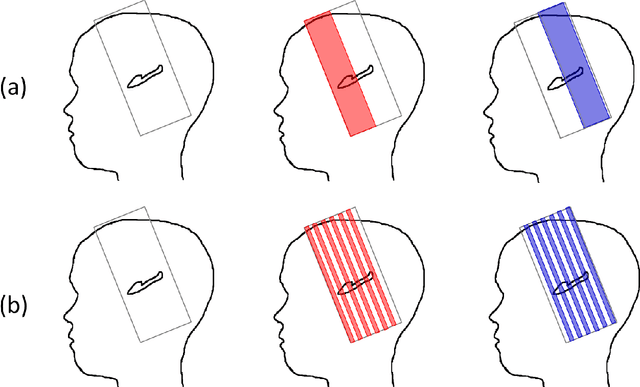
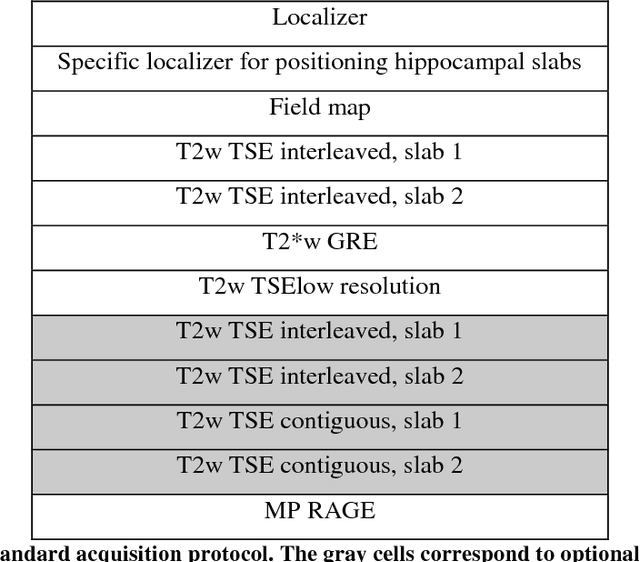
OBJECTIVE:Motion-robust multi-slab imaging of hippocampal inner structure in vivo at 7T.MATERIALS AND METHODS:Motion is a crucial issue for ultra-high resolution imaging, such as can be achieved with 7T MRI. An acquisition protocol was designed for imaging hippocampal inner structure at 7T. It relies on a compromise between anatomical details visibility and robustness to motion. In order to reduce acquisition time and motion artifacts, the full slab covering the hippocampus was split into separate slabs with lower acquisition time. A robust registration approach was implemented to combine the acquired slabs within a final 3D-consistent high-resolution slab covering the whole hippocampus. Evaluation was performed on 50 subjects overall, made of three groups of subjects acquired using three acquisition settings; it focused on three issues: visibility of hippocampal inner structure, robustness to motion artifacts and registration procedure performance.RESULTS:Overall, T2-weighted acquisitions with interleaved slabs proved robust. Multi-slab registration yielded high quality datasets in 96 % of the subjects, thus compatible with further analyses of hippocampal inner structure.CONCLUSION:Multi-slab acquisition and registration setting is efficient for reducing acquisition time and consequently motion artifacts for ultra-high resolution imaging of the inner structure of the hippocampus.