 Add to Chrome
 Add to Firefox
 Add to Edge
Longitudinal MRI template of the baboon brain from birth to adolescence
Jul 03, 2026
The baboon (Papio) is an invaluable resource within nonhuman primate research, having the advantage of being a cercopithecoid (Old World monkey) with one of the largest brains among non-hominid primates. In order to facilitate comparative developmental neuroscience research, we present the BABACOOL (BAby Brain Atlas COnstruction for Optimized Labeled segmentation) approach for creating multi-modal developmental atlases, which we used to produce BaBa21, a population-based longitudinal developmental baboon template. BaBa21 is a spatio-temporal template that consists of structural (T1- and T2-weighted) images and tissue probability maps from a population of 21 baboons (Papio anubis) scanned at 4 timepoints beginning from about 2 weeks after birth and continuing to sexual maturity (5 years). Further, his study offers a fully automatic method for generating a template at any intermediate age for future age-specific group studies. This resource is made available to provide a normalization target for baboon data across the lifespan, including intermediate timepoints, and moreover facilitate neuroimaging research in baboons, comparative research with humans and nonhuman primate species for which developmental templates are available (e.g., macaques).
* 21 pages, 6 Figures, 6 Supplementary Figures, In Press

Robust imaging of hippocampal inner structure at 7T: in vivo acquisition protocol and methodological choices
May 09, 2016

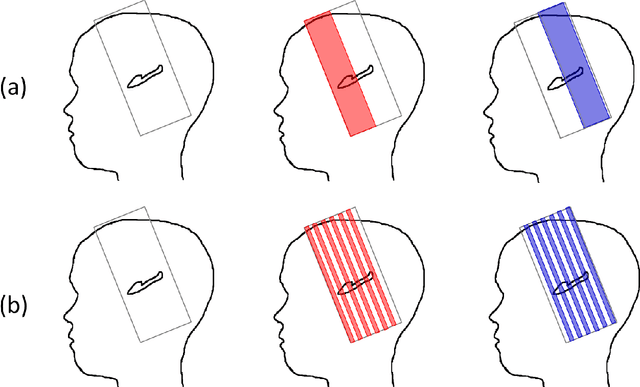
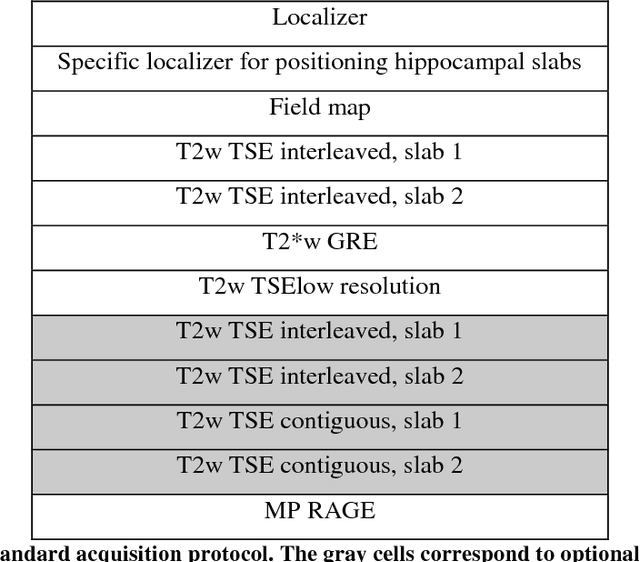
OBJECTIVE:Motion-robust multi-slab imaging of hippocampal inner structure in vivo at 7T.MATERIALS AND METHODS:Motion is a crucial issue for ultra-high resolution imaging, such as can be achieved with 7T MRI. An acquisition protocol was designed for imaging hippocampal inner structure at 7T. It relies on a compromise between anatomical details visibility and robustness to motion. In order to reduce acquisition time and motion artifacts, the full slab covering the hippocampus was split into separate slabs with lower acquisition time. A robust registration approach was implemented to combine the acquired slabs within a final 3D-consistent high-resolution slab covering the whole hippocampus. Evaluation was performed on 50 subjects overall, made of three groups of subjects acquired using three acquisition settings; it focused on three issues: visibility of hippocampal inner structure, robustness to motion artifacts and registration procedure performance.RESULTS:Overall, T2-weighted acquisitions with interleaved slabs proved robust. Multi-slab registration yielded high quality datasets in 96 % of the subjects, thus compatible with further analyses of hippocampal inner structure.CONCLUSION:Multi-slab acquisition and registration setting is efficient for reducing acquisition time and consequently motion artifacts for ultra-high resolution imaging of the inner structure of the hippocampus.