 Add to Chrome
 Add to Firefox
 Add to Edge
Conditional Multi-Event Temporal Grounding in Long-Form Video
Jun 13, 2026
Multimodal large language models have made rapid progress in video temporal grounding, yet real-world applications routinely require localizing every event that satisfies compositional temporal and spatial conditions. Existing benchmarks fall short: they localize only a single moment per query, count without temporal conditions, or treat grounding and counting as disjoint tasks. We introduce CoMET-Bench for Conditional Multi-Event Temporal Grounding in long-form video, comprising 2789 queries over 600 videos averaging 33.8 minutes across five real-world domains, with each query composed from 4 temporal conditions, 3 spatial conditions, and a dedicated negative-query subset. We further propose a unified evaluation protocol jointly measuring counting, grounding, and negative-query recognition, including a new Rejection-F1 metric that prevents trivial gaming by lazy "always-empty" models. Benchmarking a broad suite of MLLMs, agent-based, and grounding-specialized methods reveals that existing approaches remain far from solving this task. Building on these findings, we propose CoMET-Agent, a training-free agentic framework that reformulates the task as structured search-and-aggregate, improving F1@0.5 by 6.1% over GPT-5 purely through structural reasoning. Failure analysis further surfaces three open directions: fine-grained entity tracking, position-uniform retrieval, and causal event pairing.

Data-Efficient Surgical Phase Segmentation in Small-Incision Cataract Surgery: A Controlled Study of Vision Foundation Models
Apr 12, 2026Surgical phase segmentation is central to computer-assisted surgery, yet robust models remain difficult to develop when labeled surgical videos are scarce. We study data-efficient phase segmentation for manual small-incision cataract surgery (SICS) through a controlled comparison of visual representations. To isolate representation quality, we pair each visual encoder with the same temporal model (MS-TCN++) under identical training and evaluation settings on SICS-155 (19 phases). We compare supervised encoders (ResNet-50, I3D) against large self-supervised foundation models (DINOv3, V-JEPA2), and use a cached-feature pipeline that decouples expensive visual encoding from lightweight temporal learning. Foundation-model features improve segmentation performance in this setup, with DINOv3 ViT-7B achieving the best overall results (83.4% accuracy, 87.0 edit score). We further examine cataract-domain transfer using unlabeled videos and lightweight adaptation, and analyze when it helps or hurts. Overall, the study indicates strong transferability of modern vision foundation models to surgical workflow understanding and provides practical guidance for low-label medical video settings. The project website is available at: https://sl2005.github.io/DataEfficient-sics-phase-seg/
Motion-Grounded Video Reasoning: Understanding and Perceiving Motion at Pixel Level
Nov 15, 2024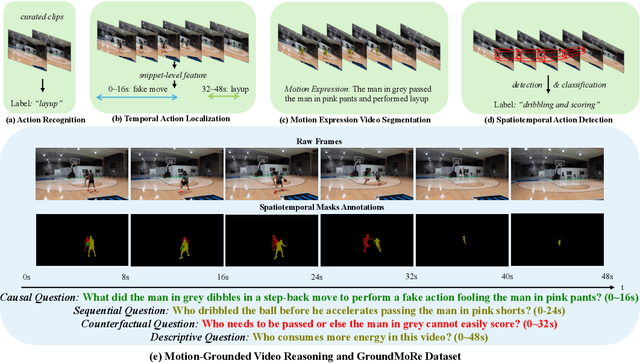

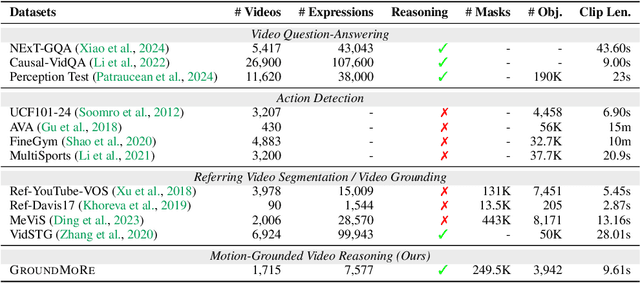
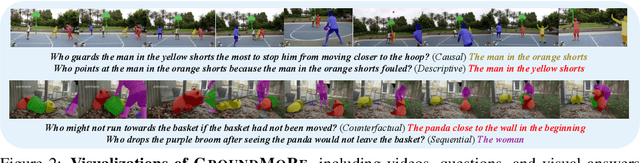
In this paper, we introduce Motion-Grounded Video Reasoning, a new motion understanding task that requires generating visual answers (video segmentation masks) according to the input question, and hence needs implicit spatiotemporal reasoning and grounding. This task extends existing spatiotemporal grounding work focusing on explicit action/motion grounding, to a more general format by enabling implicit reasoning via questions. To facilitate the development of the new task, we collect a large-scale dataset called GROUNDMORE, which comprises 1,715 video clips, 249K object masks that are deliberately designed with 4 question types (Causal, Sequential, Counterfactual, and Descriptive) for benchmarking deep and comprehensive motion reasoning abilities. GROUNDMORE uniquely requires models to generate visual answers, providing a more concrete and visually interpretable response than plain texts. It evaluates models on both spatiotemporal grounding and reasoning, fostering to address complex challenges in motion-related video reasoning, temporal perception, and pixel-level understanding. Furthermore, we introduce a novel baseline model named Motion-Grounded Video Reasoning Assistant (MORA). MORA incorporates the multimodal reasoning ability from the Multimodal LLM, the pixel-level perception capability from the grounding model (SAM), and the temporal perception ability from a lightweight localization head. MORA achieves respectable performance on GROUNDMORE outperforming the best existing visual grounding baseline model by an average of 21.5% relatively. We hope this novel and challenging task will pave the way for future advancements in robust and general motion understanding via video reasoning segmentation