 Add to Chrome
 Add to Firefox
 Add to Edge
Dynamics of Learning under User Choice: Overspecialization and Peer-Model Probing
Feb 27, 2026
In many economically relevant contexts where machine learning is deployed, multiple platforms obtain data from the same pool of users, each of whom selects the platform that best serves them. Prior work in this setting focuses exclusively on the "local" losses of learners on the distribution of data that they observe. We find that there exist instances where learners who use existing algorithms almost surely converge to models with arbitrarily poor global performance, even when models with low full-population loss exist. This happens through a feedback-induced mechanism, which we call the overspecialization trap: as learners optimize for users who already prefer them, they become less attractive to users outside this base, which further restricts the data they observe. Inspired by the recent use of knowledge distillation in modern ML, we propose an algorithm that allows learners to "probe" the predictions of peer models, enabling them to learn about users who do not select them. Our analysis characterizes when probing succeeds: this procedure converges almost surely to a stationary point with bounded full-population risk when probing sources are sufficiently informative, e.g., a known market leader or a majority of peers with good global performance. We verify our findings with semi-synthetic experiments on the MovieLens, Census, and Amazon Sentiment datasets.

Interactive Combinatorial Bandits: Balancing Competitivity and Complementarity
Jul 07, 2022
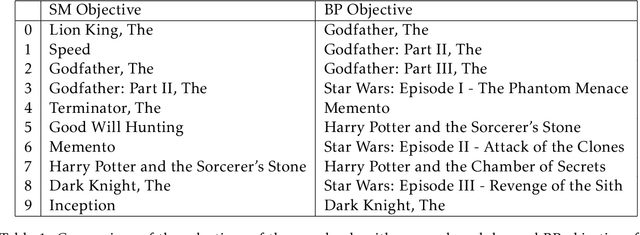
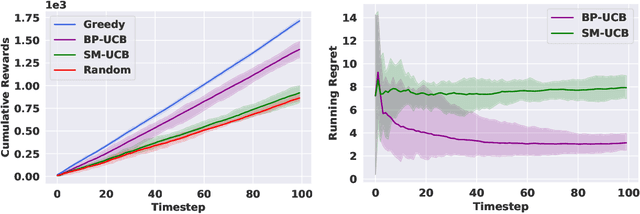
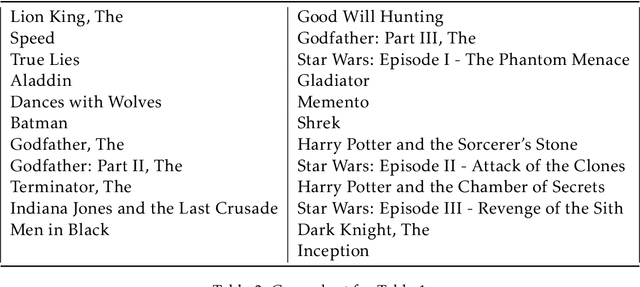
We study non-modular function maximization in the online interactive bandit setting. We are motivated by applications where there is a natural complementarity between certain elements: e.g., in a movie recommendation system, watching the first movie in a series complements the experience of watching a second (and a third, etc.). This is not expressible using only submodular functions which can represent only competitiveness between elements. We extend the purely submodular approach in two ways. First, we assume that the objective can be decomposed into the sum of monotone suBmodular and suPermodular function, known as a BP objective. Here, complementarity is naturally modeled by the supermodular component. We develop a UCB-style algorithm, where at each round a noisy gain is revealed after an action is taken that balances refining beliefs about the unknown objectives (exploration) and choosing actions that appear promising (exploitation). Defining regret in terms of submodular and supermodular curvature with respect to a full-knowledge greedy baseline, we show that this algorithm achieves at most $O(\sqrt{T})$ regret after $T$ rounds of play. Second, for those functions that do not admit a BP structure, we provide analogous regret guarantees in terms of their submodularity ratio; this is applicable for functions that are almost, but not quite, submodular. We numerically study the tasks of movie recommendation on the MovieLens dataset, and selection of training subsets for classification. Through these examples, we demonstrate the algorithm's performance as well as the shortcomings of viewing these problems as being solely submodular.