 Add to Chrome
 Add to Firefox
 Add to Edge
FDIM: A Feature-distance-based Generic Video Quality Metric for Versatile Codecs
Apr 27, 2026
Video technology is advancing toward Ultra High Definition (UHD) and High Dynamic Range (HDR), which intensifies the need for higher compression efficiency for these high-specification videos. Beyond advances in traditional codecs, neural video codecs (NVCs) have attracted significant research attention and have evolved rapidly over the past few years. The coding artifacts of NVCs often exhibit content-varying and generative characteristics, which differ from those of conventional codecs and are challenging for traditional video quality assessment (VQA) methods to capture. Therefore, VQA metrics are required to generalize across different codecs, content types, and dynamic ranges to better support video codec research and evaluation. In this paper, we propose FDIM, a feature-distance-based generic video quality metric for both traditional and neural video codecs across SDR and HDR formats. FDIM employs a hybrid architecture that integrates deep and hand-crafted features. The deep feature component learns multi-scale representations to capture distortions ranging from structural and textural fidelity degradation to high-level semantic deviations, while the hand-crafted feature component provides stable complementary cues to improve overall generalization. We trained FDIM on a large-scale subjective quality assessment dataset (DCVQA) consisting of over 16k video sequences encoded by traditional block-based hybrid video codecs and end-to-end perceptually optimized neural video codecs. Extensive experiments on ten SDR/HDR VQA datasets containing diverse, previously unseen codecs demonstrate that FDIM achieves strong generalization and high correlation with subjective assessment. The source code for FDIM and the DCVQA validation set will be released at https://github.com/MCL-ZJU/FDIM.

Registration-Enhanced Segmentation Method for Prostate Cancer in Ultrasound Images
Feb 02, 2025
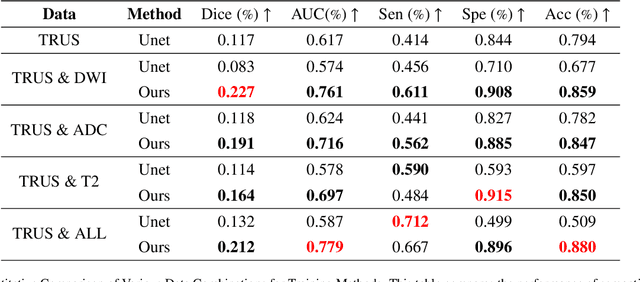

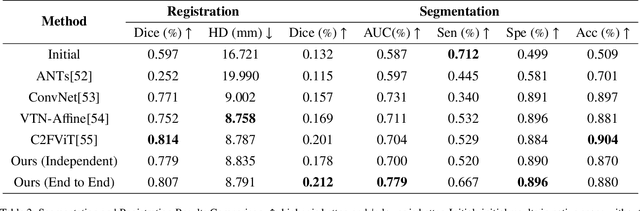
Prostate cancer is a major cause of cancer-related deaths in men, where early detection greatly improves survival rates. Although MRI-TRUS fusion biopsy offers superior accuracy by combining MRI's detailed visualization with TRUS's real-time guidance, it is a complex and time-intensive procedure that relies heavily on manual annotations, leading to potential errors. To address these challenges, we propose a fully automatic MRI-TRUS fusion-based segmentation method that identifies prostate tumors directly in TRUS images without requiring manual annotations. Unlike traditional multimodal fusion approaches that rely on naive data concatenation, our method integrates a registration-segmentation framework to align and leverage spatial information between MRI and TRUS modalities. This alignment enhances segmentation accuracy and reduces reliance on manual effort. Our approach was validated on a dataset of 1,747 patients from Stanford Hospital, achieving an average Dice coefficient of 0.212, outperforming TRUS-only (0.117) and naive MRI-TRUS fusion (0.132) methods, with significant improvements (p $<$ 0.01). This framework demonstrates the potential for reducing the complexity of prostate cancer diagnosis and provides a flexible architecture applicable to other multimodal medical imaging tasks.
Mask Enhanced Deeply Supervised Prostate Cancer Detection on B-mode Micro-Ultrasound
Dec 14, 2024


Prostate cancer is a leading cause of cancer-related deaths among men. The recent development of high frequency, micro-ultrasound imaging offers improved resolution compared to conventional ultrasound and potentially a better ability to differentiate clinically significant cancer from normal tissue. However, the features of prostate cancer remain subtle, with ambiguous borders with normal tissue and large variations in appearance, making it challenging for both machine learning and humans to localize it on micro-ultrasound images. We propose a novel Mask Enhanced Deeply-supervised Micro-US network, termed MedMusNet, to automatically and more accurately segment prostate cancer to be used as potential targets for biopsy procedures. MedMusNet leverages predicted masks of prostate cancer to enforce the learned features layer-wisely within the network, reducing the influence of noise and improving overall consistency across frames. MedMusNet successfully detected 76% of clinically significant cancer with a Dice Similarity Coefficient of 0.365, significantly outperforming the baseline Swin-M2F in specificity and accuracy (Wilcoxon test, Bonferroni correction, p-value<0.05). While the lesion-level and patient-level analyses showed improved performance compared to human experts and different baseline, the improvements did not reach statistical significance, likely on account of the small cohort. We have presented a novel approach to automatically detect and segment clinically significant prostate cancer on B-mode micro-ultrasound images. Our MedMusNet model outperformed other models, surpassing even human experts. These preliminary results suggest the potential for aiding urologists in prostate cancer diagnosis via biopsy and treatment decision-making.