 Add to Chrome
 Add to Firefox
 Add to Edge
Rethinking LoRA Memory Through the Lens of KV Cache Compression
Jun 04, 2026
Parametric retrieval augmentation encodes document information into lightweight, document-specific modules such as LoRA adapters, reducing the need to include all evidence as input context. However, it remains unclear how this parameter-side memory interacts with context-side memory stored in the KV cache. We study this interaction in document-level question answering by progressively evicting document key-value states and measuring when a document LoRA contributes beyond the retained context. We find that document LoRA adds little when the KV cache is largely intact, but becomes increasingly useful under aggressive compression, recovering 13-21 ROUGE-L points when no document context remains. The gain is largest when the base model encodes the document, and the adapter is applied only during answer generation, suggesting that document LoRA is better understood as decoding-time parametric memory than as a document encoder. Finally, QA-style supervision produces substantially stronger adapters than raw-context next-token-prediction. These results position document LoRA as a complementary memory channel whose value emerges precisely when context-side evidence is scarce.

From Knowledge to Action: Outcomes of the 2025 Large Language Model (LLM) Hackathon for Applications in Materials Science and Chemistry
May 04, 2026Large language models (LLMs) are rapidly changing how researchers in materials science and chemistry discover, organize, and act on scientific knowledge. This paper analyzes a broad set of community-developed LLM applications in an effort to identify emerging patterns in how these systems can be used across the scientific research lifecycle. We organize the projects into two complementary categories: Knowledge Infrastructure, systems that structure, retrieve, synthesize, and validate scientific information; and Action Systems, systems that execute, coordinate, or automate scientific work across computational and experimental environments. The submissions reveal a shift from single-purpose LLM tools toward integrated, multi-agent workflows that combine retrieval, reasoning, tool use, and domain-specific validation. Prominent themes include retrieval-augmented generation as grounding infrastructure, persistent structured knowledge representations, multimodal and multilingual scientific inputs, and early progress toward laboratory-integrated closed-loop systems. Together, these results suggest that LLMs are evolving from general-purpose assistants into composable infrastructure for scientific reasoning and action. This work provides a community snapshot of that transition and a practical taxonomy for understanding emerging LLM-enabled workflows in materials science and chemistry.
Process Supervision of Confidence Margin for Calibrated LLM Reasoning
Apr 25, 2026Scaling test-time computation with reinforcement learning (RL) has emerged as a reliable path to improve large language models (LLM) reasoning ability. Yet, outcome-based reward often incentivizes models to be overconfident, leading to hallucinations, unreliable confidence-based control, and unnecessary compute allocation. We introduce Reinforcement Learning with Confidence Margin (\textbf{RLCM}), a calibration-aware RL framework that jointly optimizes correctness and confidence reliability via a margin-enhanced process reward over intermediate-budget completions. Rather than aligning confidence to correctness likelihoods, RLCM encourages to widen the confidence margin between correct and incorrect steps within a single reasoning trajectory. Across mathematical, code, logic and science benchmarks, our method substantially improves calibration while maintaining or improving accuracy. We further show that, with calibrated confidence signals, the resulting models enable more efficient conformal risk control and effective confidence-weighted aggregation.
Always Tell Me The Odds: Fine-grained Conditional Probability Estimation
May 02, 2025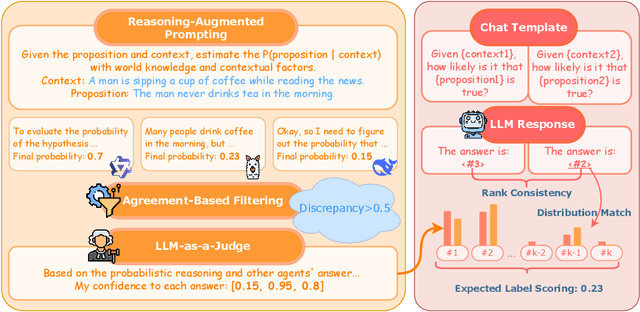
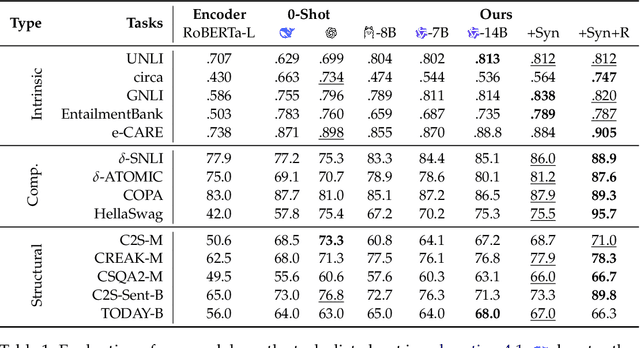

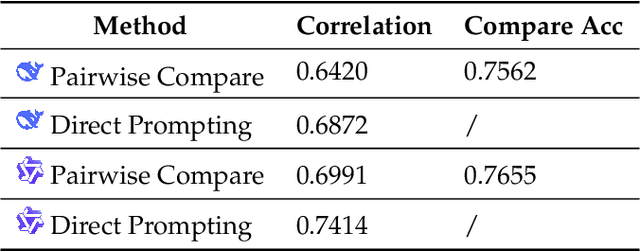
We present a state-of-the-art model for fine-grained probability estimation of propositions conditioned on context. Recent advances in large language models (LLMs) have significantly enhanced their reasoning capabilities, particularly on well-defined tasks with complete information. However, LLMs continue to struggle with making accurate and well-calibrated probabilistic predictions under uncertainty or partial information. While incorporating uncertainty into model predictions often boosts performance, obtaining reliable estimates of that uncertainty remains understudied. In particular, LLM probability estimates tend to be coarse and biased towards more frequent numbers. Through a combination of human and synthetic data creation and assessment, scaling to larger models, and better supervision, we propose a set of strong and precise probability estimation models. We conduct systematic evaluations across tasks that rely on conditional probability estimation and show that our approach consistently outperforms existing fine-tuned and prompting-based methods by a large margin.