 Add to Chrome
 Add to Firefox
 Add to Edge
Hippocampus: An Efficient and Scalable Memory Module for Agentic AI
Feb 14, 2026
Agentic AI require persistent memory to store user-specific histories beyond the limited context window of LLMs. Existing memory systems use dense vector databases or knowledge-graph traversal (or hybrid), incurring high retrieval latency and poor storage scalability. We introduce Hippocampus, an agentic memory management system that uses compact binary signatures for semantic search and lossless token-ID streams for exact content reconstruction. Its core is a Dynamic Wavelet Matrix (DWM) that compresses and co-indexes both streams to support ultra-fast search in the compressed domain, thus avoiding costly dense-vector or graph computations. This design scales linearly with memory size, making it suitable for long-horizon agentic deployments. Empirically, our evaluation shows that Hippocampus reduces end-to-end retrieval latency by up to 31$\times$ and cuts per-query token footprint by up to 14$\times$, while maintaining accuracy on both LoCoMo and LongMemEval benchmarks.

Towards Easy and Realistic Network Infrastructure Testing for Large-scale Machine Learning
Apr 29, 2025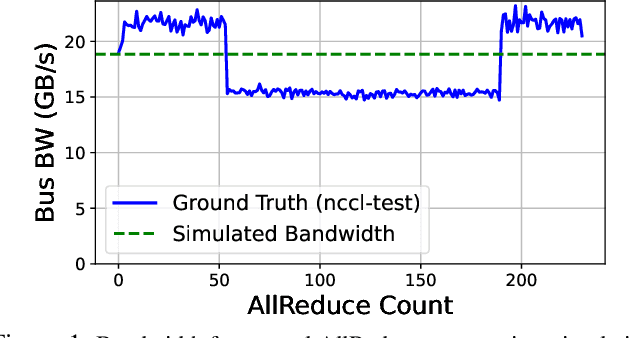
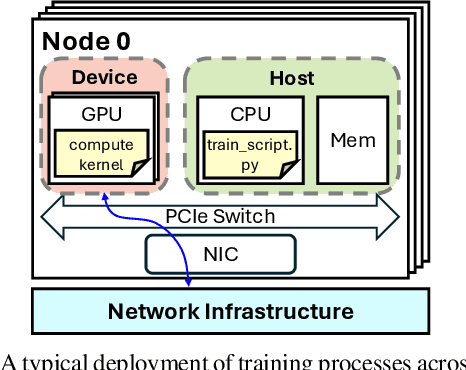
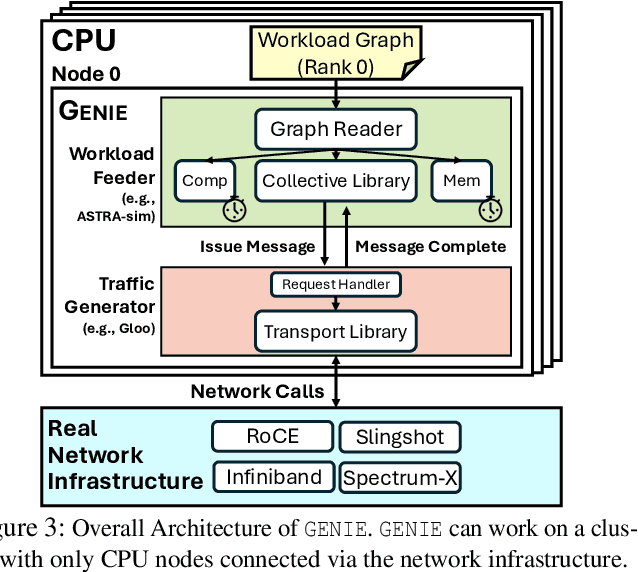
This paper lays the foundation for Genie, a testing framework that captures the impact of real hardware network behavior on ML workload performance, without requiring expensive GPUs. Genie uses CPU-initiated traffic over a hardware testbed to emulate GPU to GPU communication, and adapts the ASTRA-sim simulator to model interaction between the network and the ML workload.