 Add to Chrome
 Add to Firefox
 Add to Edge
ASTRA-sim 3.0: Next-Level Distributed Machine Learning Simulations via High-Fidelity GPU and Infrastructure Modeling
Jun 09, 2026
Distributed machine learning (ML) is a key paradigm for today's large-scale artificial intelligence applications. As model inference arises as an important use case, faithful modeling of latency-sensitive collective communication has never been more important. Capturing the device architecture and modeling control and data paths at high fidelity is therefore a necessity today. Having a common, detailed representation for distributed ML infrastructure is also crucial. We revisit the promising open-source, community-driven simulator: ASTRA-sim. In this work, we identify limitations of the current ASTRA-sim simulator and augment it with new features. To this end, we enable fine-grained, high-fidelity simulation with a standardized infrastructure representation, opening new design space exploration opportunities. We propose the simulation at cache-line-sized load-store granularity, with a detailed graphics processing unit (GPU) execution model, to balance simulation scalability and fidelity. We also introduce InfraGraph, a standardized representation to capture distributed ML network infrastructure in detail. Using the updated ASTRA-sim 3.0 simulator, we showcase interesting design space explorations for designing optimized collective algorithms, network requirements, and GPU architectures.

Towards Easy and Realistic Network Infrastructure Testing for Large-scale Machine Learning
Apr 29, 2025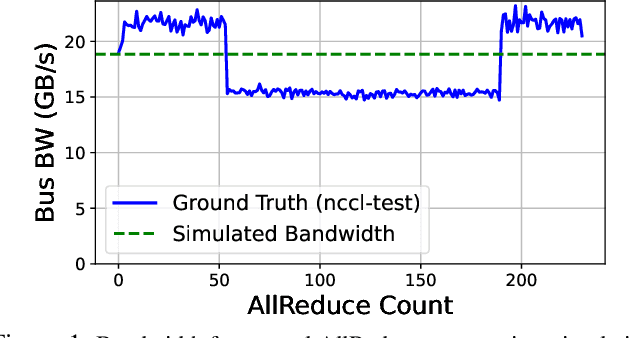
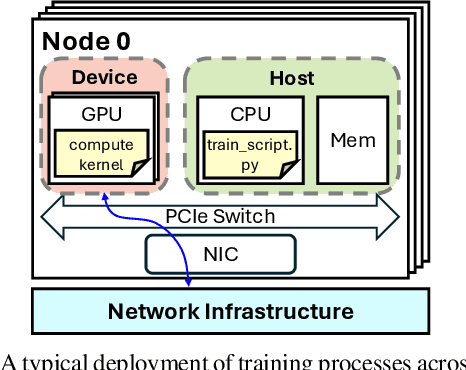
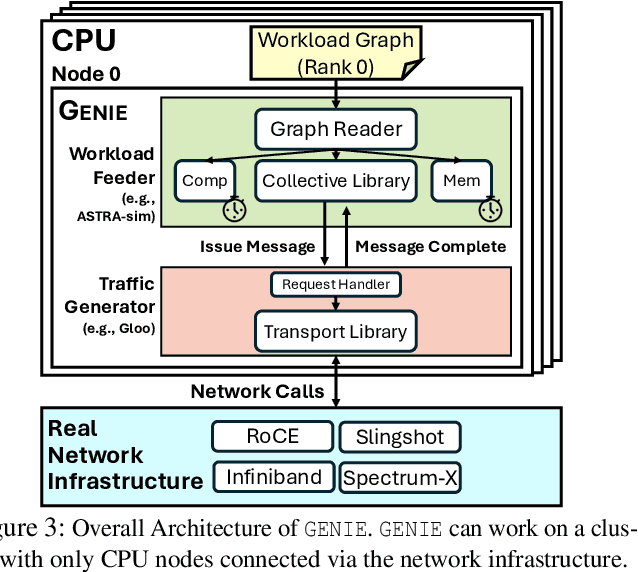
This paper lays the foundation for Genie, a testing framework that captures the impact of real hardware network behavior on ML workload performance, without requiring expensive GPUs. Genie uses CPU-initiated traffic over a hardware testbed to emulate GPU to GPU communication, and adapts the ASTRA-sim simulator to model interaction between the network and the ML workload.
KFinEval-Pilot: A Comprehensive Benchmark Suite for Korean Financial Language Understanding
Apr 17, 2025We introduce KFinEval-Pilot, a benchmark suite specifically designed to evaluate large language models (LLMs) in the Korean financial domain. Addressing the limitations of existing English-centric benchmarks, KFinEval-Pilot comprises over 1,000 curated questions across three critical areas: financial knowledge, legal reasoning, and financial toxicity. The benchmark is constructed through a semi-automated pipeline that combines GPT-4-generated prompts with expert validation to ensure domain relevance and factual accuracy. We evaluate a range of representative LLMs and observe notable performance differences across models, with trade-offs between task accuracy and output safety across different model families. These results highlight persistent challenges in applying LLMs to high-stakes financial applications, particularly in reasoning and safety. Grounded in real-world financial use cases and aligned with the Korean regulatory and linguistic context, KFinEval-Pilot serves as an early diagnostic tool for developing safer and more reliable financial AI systems.