 Add to Chrome
 Add to Firefox
 Add to Edge
L2D2-GS: Learning to Densify for Feedforward Dynamic Gaussian Scene Reconstruction
Jun 28, 2026
High-fidelity reconstruction of dynamic urban environments is a cornerstone of autonomous driving simulation and large-scale world modeling. While 3D Gaussian Splatting (3DGS) has established a new standard for real-time rendering, its reliance on expensive per-scene optimization limits scalability. Conversely, recent feedforward methods that infer Gaussian parameters offer faster speed but face fundamental bottlenecks: they are memory-prohibitive at high resolutions and struggle to fuse dense multi-view observations consistently. This paper presents L2D2-GS, a unified framework that reformulates generalizable reconstruction not as a one-shot regression, but as a robust iterative process of optimization and densification. To resolve the ambiguity of supervision in primitive generation, we propose a self-supervised densification policy that derives explicit reward signals from global reconstruction gains to guide local densification. Furthermore, we mitigate irreversible early-stage artifacts through a geometric regularization mechanism, utilizing reparameterization to constrain the optimization manifold and prevent convergence to poor local optima. Extensive experiments on the PandaSet and Waymo datasets demonstrate that our method achieves state-of-the-art reconstruction fidelity and strong zero-shot generalization, while using fewer primitives than competing baselines.

Multi-Document Scientific Summarization from a Knowledge Graph-Centric View
Sep 09, 2022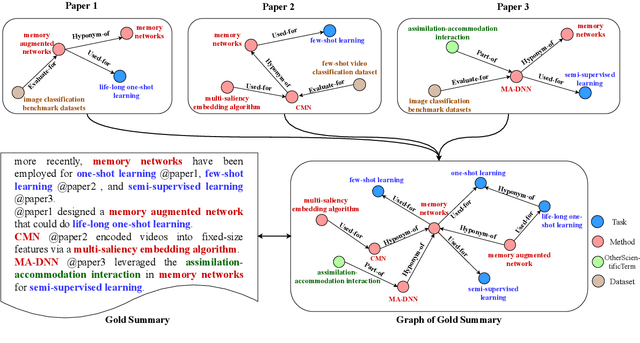
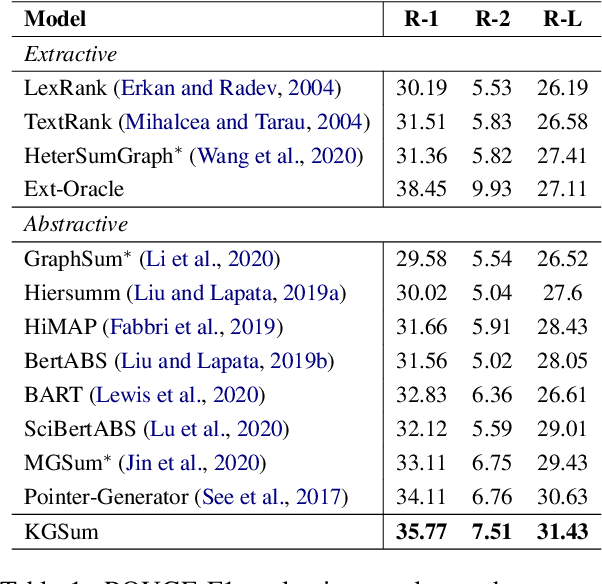
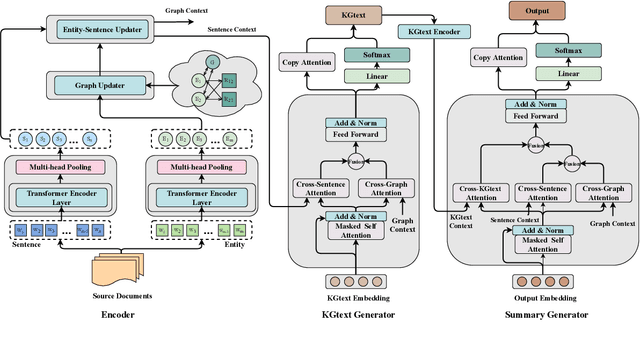
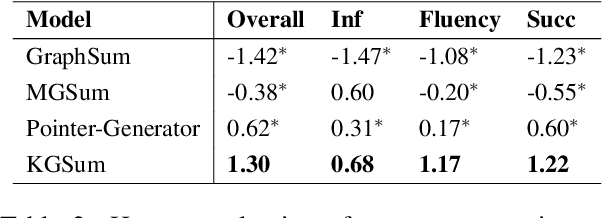
Multi-Document Scientific Summarization (MDSS) aims to produce coherent and concise summaries for clusters of topic-relevant scientific papers. This task requires precise understanding of paper content and accurate modeling of cross-paper relationships. Knowledge graphs convey compact and interpretable structured information for documents, which makes them ideal for content modeling and relationship modeling. In this paper, we present KGSum, an MDSS model centred on knowledge graphs during both the encoding and decoding process. Specifically, in the encoding process, two graph-based modules are proposed to incorporate knowledge graph information into paper encoding, while in the decoding process, we propose a two-stage decoder by first generating knowledge graph information of summary in the form of descriptive sentences, followed by generating the final summary. Empirical results show that the proposed architecture brings substantial improvements over baselines on the Multi-Xscience dataset.