 Add to Chrome
 Add to Firefox
 Add to Edge
HybridSplat: Fast Reflection-baked Gaussian Tracing using Hybrid Splatting
Dec 15, 2025
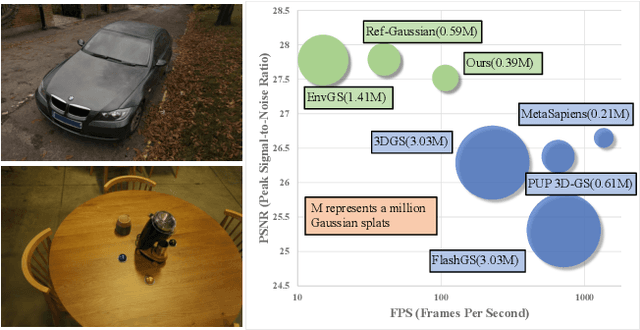
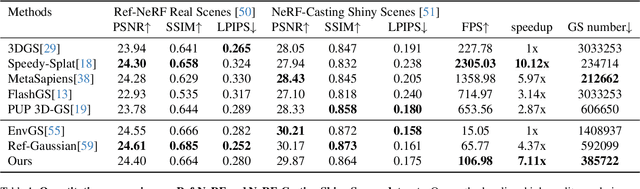
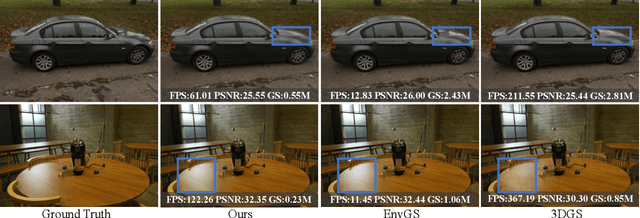
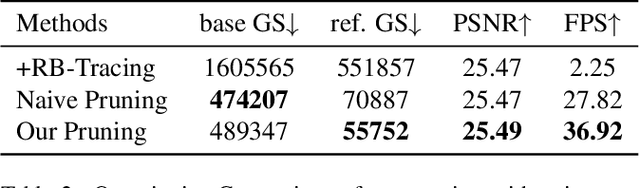
Rendering complex reflection of real-world scenes using 3D Gaussian splatting has been a quite promising solution for photorealistic novel view synthesis, but still faces bottlenecks especially in rendering speed and memory storage. This paper proposes a new Hybrid Splatting(HybridSplat) mechanism for Gaussian primitives. Our key idea is a new reflection-baked Gaussian tracing, which bakes the view-dependent reflection within each Gaussian primitive while rendering the reflection using tile-based Gaussian splatting. Then we integrate the reflective Gaussian primitives with base Gaussian primitives using a unified hybrid splatting framework for high-fidelity scene reconstruction. Moreover, we further introduce a pipeline-level acceleration for the hybrid splatting, and reflection-sensitive Gaussian pruning to reduce the model size, thus achieving much faster rendering speed and lower memory storage while preserving the reflection rendering quality. By extensive evaluation, our HybridSplat accelerates about 7x rendering speed across complex reflective scenes from Ref-NeRF, NeRF-Casting with 4x fewer Gaussian primitives than similar ray-tracing based Gaussian splatting baselines, serving as a new state-of-the-art method especially for complex reflective scenes.

Deep Uncalibrated Photometric Stereo via Inter-Intra Image Feature Fusion
Aug 06, 2022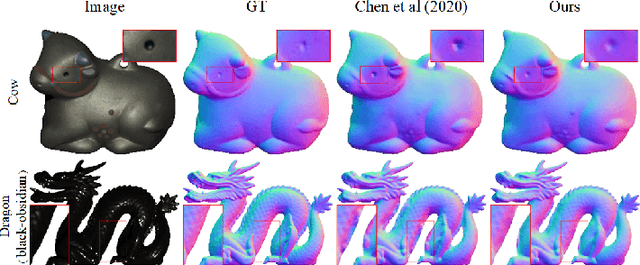
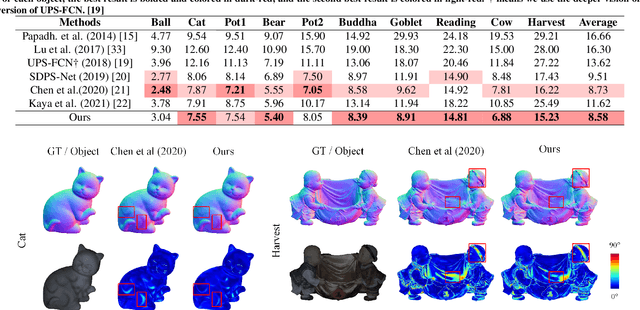
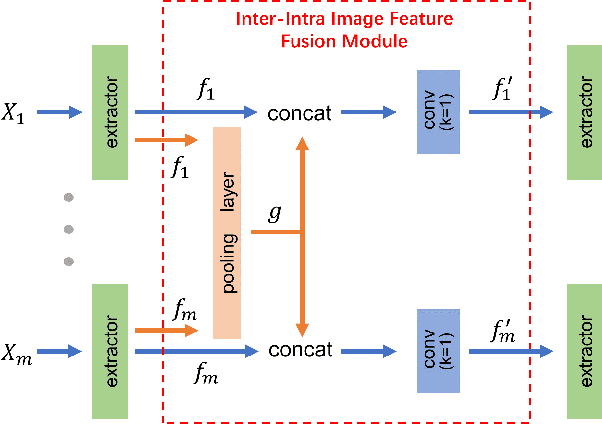
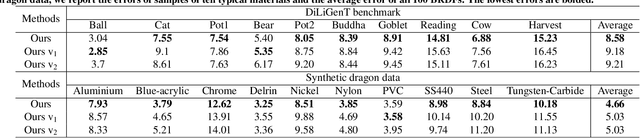
Uncalibrated photometric stereo is proposed to estimate the detailed surface normal from images under varying and unknown lightings. Recently, deep learning brings powerful data priors to this underdetermined problem. This paper presents a new method for deep uncalibrated photometric stereo, which efficiently utilizes the inter-image representation to guide the normal estimation. Previous methods use optimization-based neural inverse rendering or a single size-independent pooling layer to deal with multiple inputs, which are inefficient for utilizing information among input images. Given multi-images under different lighting, we consider the intra-image and inter-image variations highly correlated. Motivated by the correlated variations, we designed an inter-intra image feature fusion module to introduce the inter-image representation into the per-image feature extraction. The extra representation is used to guide the per-image feature extraction and eliminate the ambiguity in normal estimation. We demonstrate the effect of our design on a wide range of samples, especially on dark materials. Our method produces significantly better results than the state-of-the-art methods on both synthetic and real data.