 Add to Chrome
 Add to Firefox
 Add to Edge
MedCalc-R1: Knowledge-Guided Reward Framework for Medical Mathematical Reasoning
Aug 09, 2026
In Reinforcement Learning with Verifiable Rewards (RLVR) frameworks for mathematical reasoning tasks, floating-point results are typically evaluated using a tolerance-based reward. However, this strategy suffers from challenges such as difficulty in threshold calibration, unstable training dynamics, and limited accuracy, especially in clinical scenarios. To address these limitations, we propose a knowledge-guided hybrid reward framework (\textsc{MedCalc-R1}). Specifically, we introduce a knowledge verification reward mechanism that enforces explicit generation of computational formulas, which are further validated by an external verifier to enhance interpretability and reasoning reliability. Furthermore, we design a hybrid soft-hard reward scheme combining a hard constraint based on clinical safety thresholds with a soft, precision-sensitive reward that progressively guides learning within the acceptable range. Experimental results demonstrate that our method significantly outperforms existing baselines in both reasoning accuracy and generalization capability, validating the effectiveness and applicability in safety-critical domains.

KA2L: A Knowledge-Aware Active Learning Framework for LLMs
Mar 18, 2026Fine-tuning large language models (LLMs) with high-quality knowledge has been shown to enhance their performance effectively. However, there is a paucity of research on the depth of domain-specific knowledge comprehension by LLMs and the application of targeted active learning to improve their expertise. To address this gap, we introduce the Knowledge-Aware Active Learning (KA2L) framework. This framework assesses LLMs' mastery of specific knowledge points to aid in constructing unanswerable or unknowable questions through latent space analysis. This active learning strategy enhances training efficiency by focusing on knowledge the model has yet to master, thereby minimizing redundancy in learning already acquired information. This study innovatively employs a knowledge distribution probing technique to examine the hidden states of specific Transformer layers and identify the distribution of known and unknown knowledge within the LLM. Additionally, a hidden-state decoding method is proposed to generate numerous unknown questions in natural language from the latent knowledge space. In our experiments, we selected nine open-source LLMs to validate the effectiveness of the proposed framework. Results indicate that KA2L not only significantly reduces 50% annotation and computation costs across two open-domain and one vertical-domain dataset but also achieves better performance, offering valuable insights into active learning strategies for LLMs. The code is available at https://anonymous.4open.science/r/KA2L-F15C.
ProSpec RL: Plan Ahead, then Execute
Jul 31, 2024Imagining potential outcomes of actions before execution helps agents make more informed decisions, a prospective thinking ability fundamental to human cognition. However, mainstream model-free Reinforcement Learning (RL) methods lack the ability to proactively envision future scenarios, plan, and guide strategies. These methods typically rely on trial and error to adjust policy functions, aiming to maximize cumulative rewards or long-term value, even if such high-reward decisions place the environment in extremely dangerous states. To address this, we propose the Prospective (ProSpec) RL method, which makes higher-value, lower-risk optimal decisions by imagining future n-stream trajectories. Specifically, ProSpec employs a dynamic model to predict future states (termed "imagined states") based on the current state and a series of sampled actions. Furthermore, we integrate the concept of Model Predictive Control and introduce a cycle consistency constraint that allows the agent to evaluate and select the optimal actions from these trajectories. Moreover, ProSpec employs cycle consistency to mitigate two fundamental issues in RL: augmenting state reversibility to avoid irreversible events (low risk) and augmenting actions to generate numerous virtual trajectories, thereby improving data efficiency. We validated the effectiveness of our method on the DMControl benchmarks, where our approach achieved significant performance improvements. Code will be open-sourced upon acceptance.
Apollo's Oracle: Retrieval-Augmented Reasoning in Multi-Agent Debates
Dec 08, 2023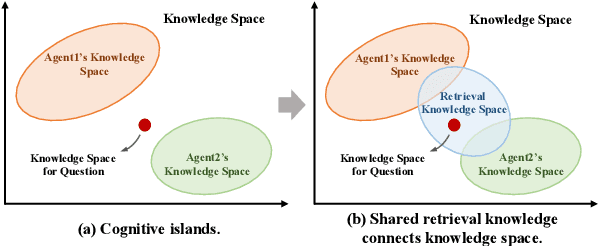
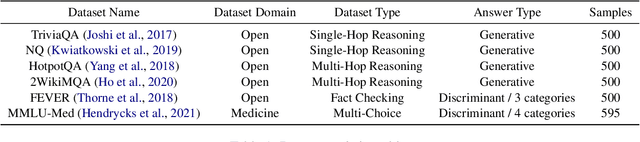
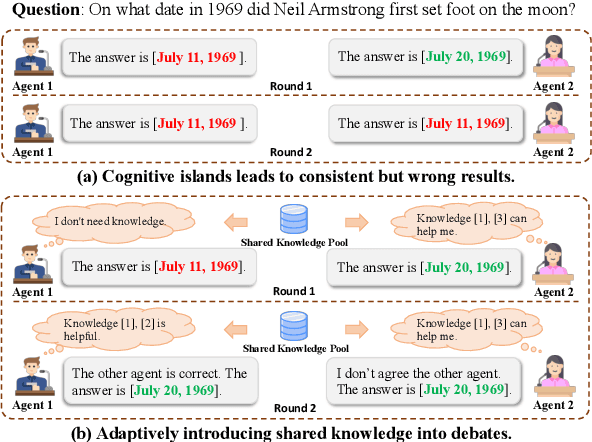
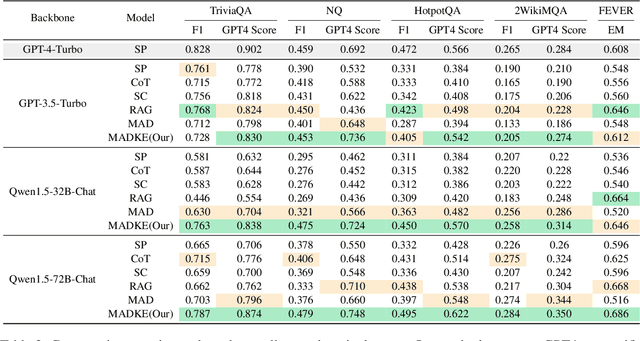
Multi-agent debate systems are designed to derive accurate and consistent conclusions through adversarial interactions among agents. However, these systems often encounter challenges due to cognitive constraints, manifesting as (1) agents' obstinate adherence to incorrect viewpoints and (2) their propensity to abandon correct viewpoints. These issues are primarily responsible for the ineffectiveness of such debates. Addressing the challenge of cognitive constraints, we introduce a novel framework, the Multi-Agent Debate with Retrieval Augmented (MADRA). MADRA incorporates retrieval of prior knowledge into the debate process, effectively breaking cognitive constraints and enhancing the agents' reasoning capabilities. Furthermore, we have developed a self-selection module within this framework, enabling agents to autonomously select pertinent evidence, thereby minimizing the impact of irrelevant or noisy data. We have comprehensively tested and analyzed MADRA across six diverse datasets. The experimental results demonstrate that our approach significantly enhances performance across various tasks, proving the effectiveness of our proposed method.