 Add to Chrome
 Add to Firefox
 Add to Edge
Satisfiability Solving with LLMs: A Matched-Pair Evaluation of Reasoning Capability
May 27, 2026
Large language models (LLMs) are increasingly used for tasks that implicitly reduce to Boolean satisfiability (SAT), yet their reasoning ability on SAT remains unclear. We present a systematic study of LLMs on 2-SAT and 3-SAT, together with two canonical reductions, Vertex Cover and discrete 3D packing, to probe representation-invariant reasoning. We first evaluate models using conventional metrics, including accuracy, precision, recall, and F1, as well as the SAT phase-transition setting. We find that these metrics can be misleading: many models obtain high scores by over-predicting satisfiable formulas, fail to reproduce the classical easy-hard-easy signature around the 3-SAT threshold, and degrade sharply as the number of variables grows. To address this problem, we introduce a paired-formula protocol based on minimally different satisfiable and unsatisfiable instances, together with Accurate Differentiation Rate (ADR), which requires both members of each pair to be classified correctly. ADR separates reasoning-oriented models from heuristic ones and correlates with witness validity. Beyond CNF, we test cross-representation consistency by converting CNF to Vertex Cover and 3-SAT to discrete 3D packing. Model decisions on CNF and on the corresponding graph or packing instances agree for most models on more than 80 percent of instances, suggesting stable decision rules across representations. Overall, our results show that SAT is a conservative probe for LLM reasoning, and that paired evaluation with ADR provides a more faithful and representation-robust assessment than conventional metrics.

BLIA: Detect model memorization in binary classification model through passive Label Inference attack
Mar 17, 2025Model memorization has implications for both the generalization capacity of machine learning models and the privacy of their training data. This paper investigates label memorization in binary classification models through two novel passive label inference attacks (BLIA). These attacks operate passively, relying solely on the outputs of pre-trained models, such as confidence scores and log-loss values, without interacting with or modifying the training process. By intentionally flipping 50% of the labels in controlled subsets, termed "canaries," we evaluate the extent of label memorization under two conditions: models trained without label differential privacy (Label-DP) and those trained with randomized response-based Label-DP. Despite the application of varying degrees of Label-DP, the proposed attacks consistently achieve success rates exceeding 50%, surpassing the baseline of random guessing and conclusively demonstrating that models memorize training labels, even when these labels are deliberately uncorrelated with the features.
Uncertainty Quantification in Table Structure Recognition
Jul 01, 2024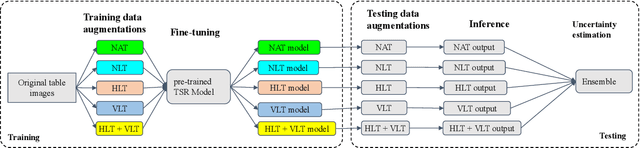
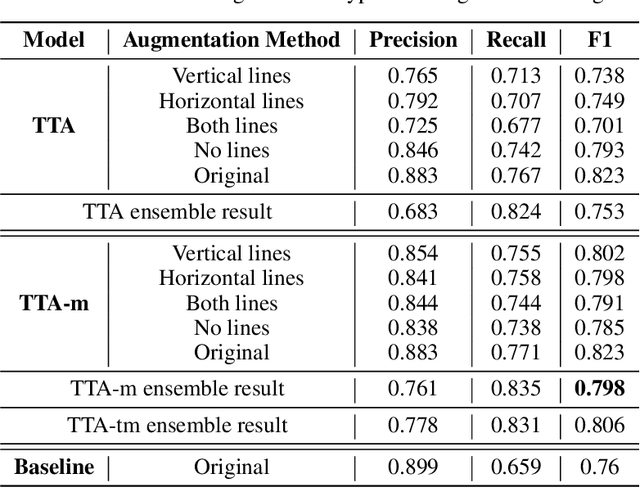
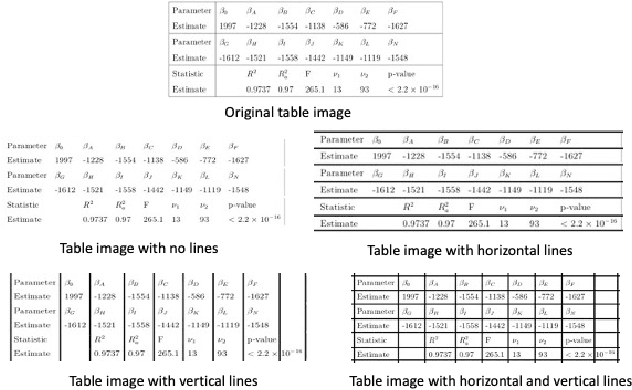
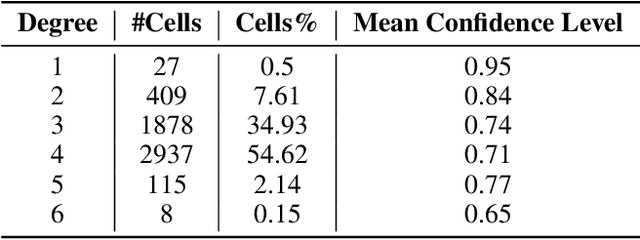
Quantifying uncertainties for machine learning models is a critical step to reduce human verification effort by detecting predictions with low confidence. This paper proposes a method for uncertainty quantification (UQ) of table structure recognition (TSR). The proposed UQ method is built upon a mixture-of-expert approach termed Test-Time Augmentation (TTA). Our key idea is to enrich and diversify the table representations, to spotlight the cells with high recognition uncertainties. To evaluate the effectiveness, we proposed two heuristics to differentiate highly uncertain cells from normal cells, namely, masking and cell complexity quantification. Masking involves varying the pixel intensity to deem the detection uncertainty. Cell complexity quantification gauges the uncertainty of each cell by its topological relation with neighboring cells. The evaluation results based on standard benchmark datasets demonstrate that the proposed method is effective in quantifying uncertainty in TSR models. To our best knowledge, this study is the first of its kind to enable UQ in TSR tasks. Our code and data are available at: https://github.com/lamps-lab/UQTTA.git.