 Add to Chrome
 Add to Firefox
 Add to Edge
Overhead Wildlife Locator (OWL): Benchmarking Weakly Supervised Learning for Aerial Wildlife Surveys
Jun 11, 2026
Automated aerial wildlife surveys increasingly rely on deep learning, yet standard object detectors require bounding-box annotations, reported to be up to seven times slower and three times more expensive to produce than point-level labels. To address this bottleneck, we introduce the Overhead Wildlife Locator (OWL), a weakly supervised density-estimation framework with three variants: OWL-C, a fully convolutional model for high-throughput screening; OWL-T, a Swin-augmented hybrid for heterogeneous, cluttered scenes; and OWL-D, built on a frozen DINOv3 ViT-H+/16 encoder with a DPT-style fusion decoder. We benchmark all three against POLO, YOLOv11n, and YOLOv11l across five public aerial datasets, from sparse fixed-wing savanna surveys to dense UAV paddock imagery, and against the published HerdNet baseline on its native Delplanque split. OWL-D sets a new state of the art on Delplanque (0.934 AP vs. HerdNet's 0.840) and records the highest AP on four of the five datasets. Performance is regime-dependent: on the extreme-density SheepCounter UAV dataset the hybrid OWL-T leads (0.978 AP) and the convolutional variants attain the lowest counting error, whereas the foundation-based OWL-D degrades, indicating which variant suits which survey type. We further validate operational readiness on the Alaska Department of Fish and Game's 2022 Central Arctic Caribou census: under cross-herd and cross-temporal transfer, OWL-C fine-tuned on the 2017 Porcupine Caribou Herd split attains F1 = 0.965 on a held-out patch test set, with a signed count error of +3.1% aggregated across the released test patches. We release the OWL code, model weights, and the annotated Porcupine Caribou Herd 2017 (PCH) and Central Arctic Herd 2022 (CAH) patches, the first open patch-level datasets for large-scale caribou aerial surveys, at https://github.com/microsoft/MegaDetector-Overhead.

Centering Ecological Goals in Automated Identification of Individual Animals
Apr 22, 2026Recognizing individual animals over time is central to many ecological and conservation questions, including estimating abundance, survival, movement, and social structure. Recent advances in automated identification from images and even acoustic data suggest that this process could be greatly accelerated, yet their promise has not translated well into ecological practice. We argue that the main barrier is not the performance of the automated methods themselves, but a mismatch between how those methods are typically developed and evaluated, and how ecological data is actually collected, processed, reviewed, and used. Future progress, therefore, will depend less on algorithmic gains alone than on recognizing that the usefulness of automated identification is grounded in ecological context: it depends on what question is being asked, what data are available, and what kinds of mistakes matter. Only by centering these questions can we move toward automated identification of individuals that is not only accurate but also ecologically useful, transparent, and trustworthy.
Multispecies Animal Re-ID Using a Large Community-Curated Dataset
Dec 07, 2024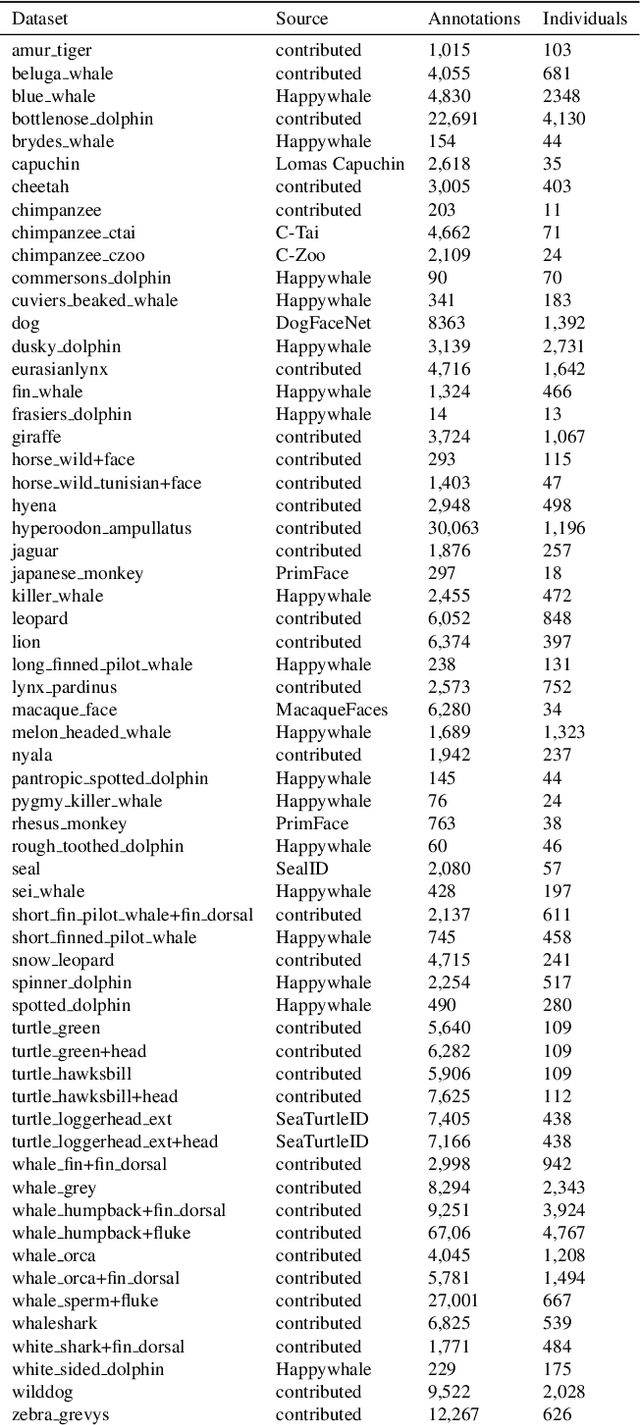
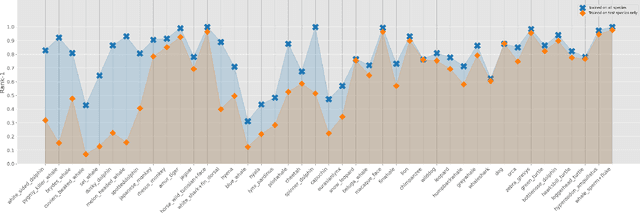
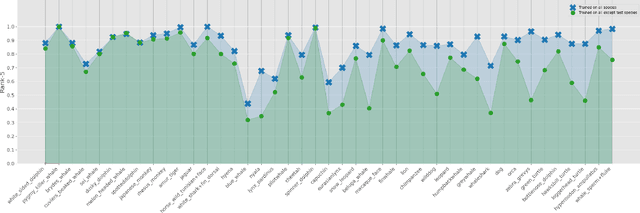
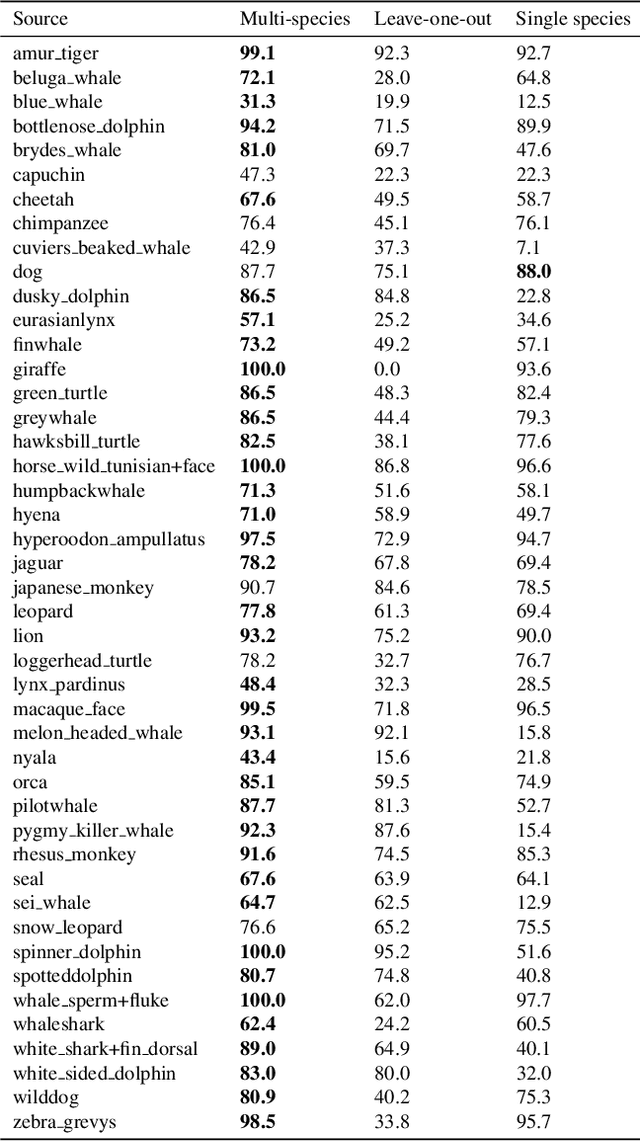
Recent work has established the ecological importance of developing algorithms for identifying animals individually from images. Typically, a separate algorithm is trained for each species, a natural step but one that creates significant barriers to wide-spread use: (1) each effort is expensive, requiring data collection, data curation, and model training, deployment, and maintenance, (2) there is little training data for many species, and (3) commonalities in appearance across species are not exploited. We propose an alternative approach focused on training multi-species individual identification (re-id) models. We construct a dataset that includes 49 species, 37K individual animals, and 225K images, using this data to train a single embedding network for all species. Our model employs an EfficientNetV2 backbone and a sub-center ArcFace loss function with dynamic margins. We evaluate the performance of this multispecies model in several ways. Most notably, we demonstrate that it consistently outperforms models trained separately on each species, achieving an average gain of 12.5% in top-1 accuracy. Furthermore, the model demonstrates strong zero-shot performance and fine-tuning capabilities for new species with limited training data, enabling effective curation of new species through both incremental addition of data to the training set and fine-tuning without the original data. Additionally, our model surpasses the recent MegaDescriptor on unseen species, averaging an 19.2% top-1 improvement per species and showing gains across all 33 species tested. The fully-featured code repository is publicly available on GitHub, and the feature extractor model can be accessed on HuggingFace for seamless integration with wildlife re-identification pipelines. The model is already in production use for 60+ species in a large-scale wildlife monitoring system.
Understanding the Impact of Training Set Size on Animal Re-identification
May 24, 2024
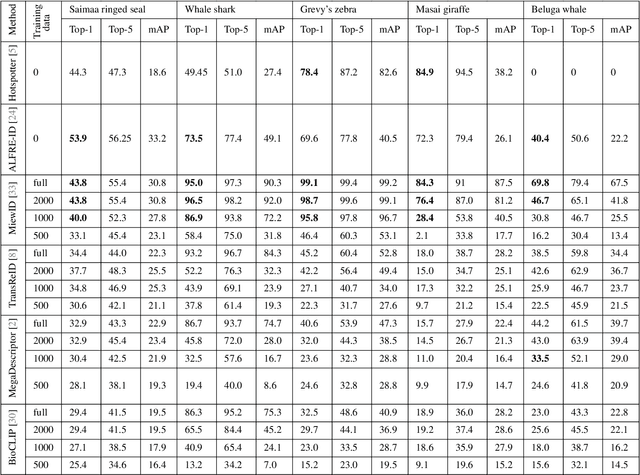
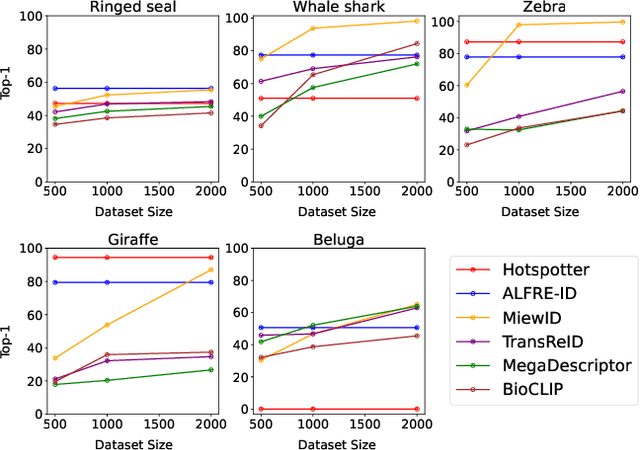
Recent advancements in the automatic re-identification of animal individuals from images have opened up new possibilities for studying wildlife through camera traps and citizen science projects. Existing methods leverage distinct and permanent visual body markings, such as fur patterns or scars, and typically employ one of two strategies: local features or end-to-end learning. In this study, we delve into the impact of training set size by conducting comprehensive experiments across six different methods and five animal species. While it is well known that end-to-end learning-based methods surpass local feature-based methods given a sufficient amount of good-quality training data, the challenge of gathering such datasets for wildlife animals means that local feature-based methods remain a more practical approach for many species. We demonstrate the benefits of both local feature and end-to-end learning-based approaches and show that species-specific characteristics, particularly intra-individual variance, have a notable effect on training data requirements.