 Add to Chrome
 Add to Firefox
 Add to Edge
A Foundation Model for Virtual Sensors
Jan 28, 2026
Virtual sensors use machine learning to predict target signals from available measurements, replacing expensive physical sensors in critical applications. Existing virtual sensor approaches require application-specific models with hand-selected inputs for each sensor, cannot leverage task synergies, and lack consistent benchmarks. At the same time, emerging time series foundation models are computationally expensive and limited to predicting their input signals, making them incompatible with virtual sensors. We introduce the first foundation model for virtual sensors addressing both limitations. Our unified model can simultaneously predict diverse virtual sensors exploiting synergies while maintaining computational efficiency. It learns relevant input signals for each virtual sensor, eliminating expert knowledge requirements while adding explainability. In our large-scale evaluation on a standard benchmark and an application-specific dataset with over 18 billion samples, our architecture achieves 415x reduction in computation time and 951x reduction in memory requirements, while maintaining or even improving predictive quality compared to baselines. Our model scales gracefully to hundreds of virtual sensors with nearly constant parameter count, enabling practical deployment in large-scale sensor networks.

Deep Occupancy-Predictive Representations for Autonomous Driving
Mar 07, 2023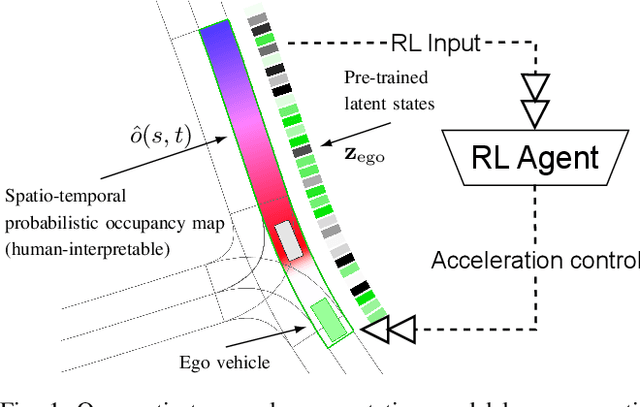
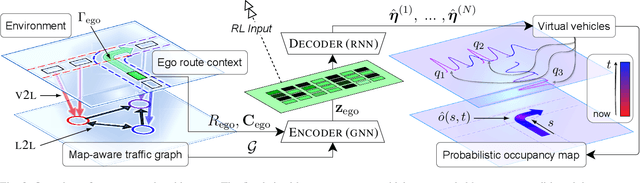
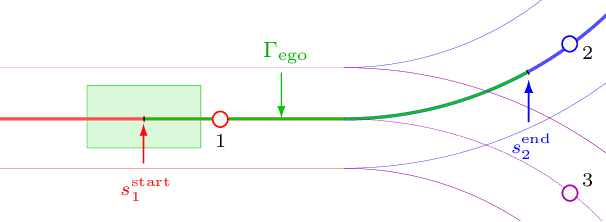
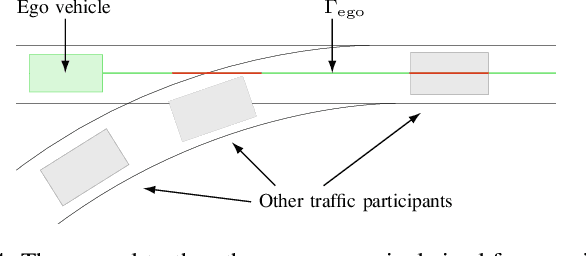
Manually specifying features that capture the diversity in traffic environments is impractical. Consequently, learning-based agents cannot realize their full potential as neural motion planners for autonomous vehicles. Instead, this work proposes to learn which features are task-relevant. Given its immediate relevance to motion planning, our proposed architecture encodes the probabilistic occupancy map as a proxy for obtaining pre-trained state representations. By leveraging a map-aware graph formulation of the environment, our agent-centric encoder generalizes to arbitrary road networks and traffic situations. We show that our approach significantly improves the downstream performance of a reinforcement learning agent operating in urban traffic environments.