 Add to Chrome
 Add to Firefox
 Add to Edge
EvLIR: Learning Illumination Residuals from Ordered Events for Low-Light Image Enhancement
Jun 28, 2026
Low-light image enhancement is severely ill-posed when the input frame contains missing structure, saturated noise, and weak local contrast. Event cameras provide asynchronous brightness-change observations with high temporal resolution, but prior works often treat voxel channels as an unordered or static feature stack before fusion, rather than explicitly modeling their within-window temporal evolution, weakening the temporal evidence that makes events useful. We propose EvLIR, a temporal-residual enhancement framework that learns illumination residuals from ordered events for low-light image enhancement. Given a low-light frame and its aligned event voxel, EvLIR preserves the ordered temporal bins of the event stream and introduces a Temporal Event Residual Module (TERM) to encode short-window event dynamics with a lightweight ConvGRU. The resulting temporal state is converted into a bounded illumination correction, which provides spatially adaptive photometric guidance for Retinex-style illumination estimation and subsequent reliability-aware image-event restoration. On SDE and SDSD indoor/outdoor benchmarks, EvLIR achieves the best result on eleven of twelve dataset-metric pairs, with average scores of 25.63~dB PSNR, 28.30~dB PSNR*, and 0.827 SSIM across the four benchmarks.

FracEvent: Event-Camera Simulation via Fractional-Relaxation Pixel Dynamics
Jun 25, 2026Event cameras asynchronously report brightness changes with microsecond-level temporal resolution, but real event data remain difficult to collect at scale because specialized sensors, careful synchronization, and task-specific annotations are required. Event-camera simulation is therefore important to event-based vision tasks. Most practical simulators build on contrast-threshold event generation, some with additional filtering, stochastic noise, or hand-tuned sensor parameters. While effective, such formulations often simplify the temporal structure produced by the lifecycle of each pixel, which can distort event timing and weaken downstream transfer. We introduce FracEvent, an event simulator that models this pixel-level lifecycle with fractional-relaxation voltage dynamics. Given a log-intensity trajectory, FracEvent drives a compact stack of relaxation modes, combines their responses into a voltage state, emits ON/OFF events by localizing threshold crossings on the continuous voltage trajectory, and updates the reference while retaining the underlying memory modes. This retained state links residual voltage response to later event timing. We evaluate FracEvent through event-stream comparison and downstream transfer on image reconstruction and optical flow estimation. Across multiple datasets, FracEvent improves the temporal structure of generated events and achieves stronger downstream-transfer results than competing simulator baselines, showing its practical value for event-camera simulation.
A Survey of 3D Reconstruction with Event Cameras: From Event-based Geometry to Neural 3D Rendering
May 13, 2025Event cameras have emerged as promising sensors for 3D reconstruction due to their ability to capture per-pixel brightness changes asynchronously. Unlike conventional frame-based cameras, they produce sparse and temporally rich data streams, which enable more accurate 3D reconstruction and open up the possibility of performing reconstruction in extreme environments such as high-speed motion, low light, or high dynamic range scenes. In this survey, we provide the first comprehensive review focused exclusively on 3D reconstruction using event cameras. The survey categorises existing works into three major types based on input modality - stereo, monocular, and multimodal systems, and further classifies them by reconstruction approach, including geometry-based, deep learning-based, and recent neural rendering techniques such as Neural Radiance Fields and 3D Gaussian Splatting. Methods with a similar research focus were organised chronologically into the most subdivided groups. We also summarise public datasets relevant to event-based 3D reconstruction. Finally, we highlight current research limitations in data availability, evaluation, representation, and dynamic scene handling, and outline promising future research directions. This survey aims to serve as a comprehensive reference and a roadmap for future developments in event-driven 3D reconstruction.
Towards End-to-End Neuromorphic Voxel-based 3D Object Reconstruction Without Physical Priors
Jan 01, 2025


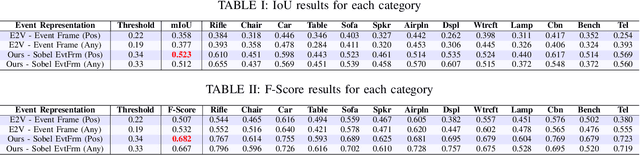
Neuromorphic cameras, also known as event cameras, are asynchronous brightness-change sensors that can capture extremely fast motion without suffering from motion blur, making them particularly promising for 3D reconstruction in extreme environments. However, existing research on 3D reconstruction using monocular neuromorphic cameras is limited, and most of the methods rely on estimating physical priors and employ complex multi-step pipelines. In this work, we propose an end-to-end method for dense voxel 3D reconstruction using neuromorphic cameras that eliminates the need to estimate physical priors. Our method incorporates a novel event representation to enhance edge features, enabling the proposed feature-enhancement model to learn more effectively. Additionally, we introduced Optimal Binarization Threshold Selection Principle as a guideline for future related work, using the optimal reconstruction results achieved with threshold optimization as the benchmark. Our method achieves a 54.6% improvement in reconstruction accuracy compared to the baseline method.