 Add to Chrome
 Add to Firefox
 Add to Edge
Unifying Graph Neural Networks Through a Common Layer Equation
Aug 17, 2026
Graph neural networks are commonly described through family-specific equations whose notation obscures shared computations and structural differences. We introduce a common layer equation that represents covered architectures through seven components: an update domain, channel set, propagation bank, per-channel message maps, channel-fusion operator, ego/residual map, and update map. The central factorization separates where information moves, encoded by the propagation bank, from what moves, encoded by the message maps. Function-valued fillings extend the same equation across local message passing, attention, spectral filtering, global communication, relation-specific channels, higher-order domains, and geometric messages. We make this unification explicit and checkable through worked reductions of canonical layers and component assignments spanning seven nonexclusive architectural families. A fixed slot discipline assigns operations by computational role and defines the framework's coverage boundary. The decomposition also yields component-level theoretical insights: under endpoint-local messages and node-local updates, operator support bounds one-layer dependencies, and one-layer global mixing requires a full effective operator row under the stated hypotheses. The resulting framework organizes more than 200 architectures in a common design space, enables component-wise comparison and generation of structurally consistent architectures, and connects propagation choices to oversmoothing, oversquashing, heterophily, and expressivity. It further exposes the empirical inverse problem of mapping measurable graph and task properties to validated component choices.

AEGIS: A Multi-Task Joint-Embedding Predictive Architecture for Mammography
Jun 30, 2026We present Aegis, a joint-embedding predictive architecture for breast cancer detection and density assessment in mammography. We train three Vision Transformer variants (Small/Base/Large) using self-supervised joint-embedding predictive architecture (JEPA) pre-training on 71,103 studies from 14 clinical sites, followed by supervised fine-tuning with progressive resolution scaling up to 2048x1536. On a curated 785-study test set, our largest model achieves area under the receiver operating characteristic curve (AUC) 0.949 for breast cancer triage with 93% sensitivity and 75% specificity at the optimal operating point. An ensemble combining our model with a U.S. Food and Drug Administration-cleared baseline further improves discrimination to 0.952 AUC. For breast density classification, the model achieves 0.953 AUC for binary (dense vs. non-dense) classification and 62.6% exact accuracy across four Breast Imaging Reporting and Data System (BI-RADS) categories, with 98.8% adjacent accuracy comparable to reported human inter-reader agreement. External validation on the public VinDr-Mammo dataset provides evidence of cross-population transfer under a different reference standard, with the largest model achieving 0.871 AUC for triage in a zero-shot setting.
Parameter-Efficient Continuous-Variable Photonic Quantum Neural Networks for Edge Quantum AI: Demonstration in Oral Cancer Detection
Jun 26, 2026Early detection of oral cancer markedly improves clinical outcomes, yet specialized diagnostic tools remain scarce in low-resource settings. Smartphone-based screening is a scalable alternative but needs lightweight models that run within edge-hardware constraints. Hybrid classical-quantum architectures are emerging candidates for parameter-efficient learning, yet most rely on qubit hardware that needs cryogenic operation, unsuitable for edge deployment. Continuous-variable (CV) photonic quantum computing, which operates at room temperature, offers a complementary route. We investigate a hybrid classical-CV quantum classifier for oral cancer detection from smartphone images. The pipeline combines a MobileNetV1 feature extractor, principal component analysis to 16 dimensions, and a parameterized CV-QNN of displacement, interferometric, and Kerr gates on a photonic backend. We propose a simplified $Φ\circ D \circ U_1$ CV-QNN architecture that cuts trainable parameters 40-45% relative to the standard CV-QNN layer of Killoran et al. (2019a), and identify dimensionality-reduction and encoding-restriction strategies that mitigate barren plateaus, raising loss-gradient variance by roughly 58 orders of magnitude. Whether the simplified layer beats the full layer is width-dependent: the full layer holds a small but significant edge at two qumodes, whereas the simplified layer is significantly better at four qumodes using 44% fewer parameters. The strongest model, a four-qumode simplified CV-QNN with only 18 parameters, attains the highest validation AUC of all models, exceeds a 55-parameter classical baseline using 67% fewer parameters, and reaches 100% calibrated test accuracy across all seeds. These results support CV photonic quantum machine learning for parameter-efficient, room-temperature medical image classification and motivate progress toward edge quantum AI.
BAC-JEPA: Label-Efficient Breast Arterial Calcification Segmentation via Synthetic Mammography-Guided Supervision
Jun 20, 2026Breast arterial calcification (BAC) on screening mammograms is an emerging cardiovascular risk biomarker, but quantitative use requires reproducible segmentation and expert pixel-level labels are costly. We present BAC-JEPA, a label-efficient segmentation framework trained on procedurally generated arterial calcification inserted into real mammographic backgrounds with exact masks. Candidate backgrounds were selected from model-screened mammograms with low predicted BAC response; the generator samples arterial structure, disease burden, radiographic appearance, and hard-negative distractors including nonarterial calcifications and metallic objects. Synthetic masks are paired with mammography self-supervised Vision Transformer encoders and a high-resolution convolutional decoder to produce full-resolution segmentation maps. The study used 75,472 mammography studies from 34,956 patients for background selection and representation learning, trained on synthetic images from 10,000 backgrounds, selected checkpoints with 1,000 development backgrounds, and evaluated transfer on all 1,000 human-labeled BacSeg synthetic 2D mammograms. On held-out synthetic validation data, the larger backbone achieved IoU 0.5325 and Dice 0.6357. On BacSeg, image-level classification from segmentation probability maps reached AUROC 0.8719, with 0.8547 for the smaller backbone. Four-view inference required 110.68--213.63 ms on an RTX 5090 GPU, and severe-preset synthetic image generation averaged 2.7071 s per image on a multicore workstation. These results indicate that BAC-specific synthetic supervision can produce useful image-level transfer without human pixel-level training masks, while expert-reviewed real-mammogram segmentation remains necessary for clinical validation and calibration.
Robust Classification of Oral Cancer with Limited Training Data
Oct 02, 2025Oral cancer ranks among the most prevalent cancers globally, with a particularly high mortality rate in regions lacking adequate healthcare access. Early diagnosis is crucial for reducing mortality; however, challenges persist due to limited oral health programs, inadequate infrastructure, and a shortage of healthcare practitioners. Conventional deep learning models, while promising, often rely on point estimates, leading to overconfidence and reduced reliability. Critically, these models require large datasets to mitigate overfitting and ensure generalizability, an unrealistic demand in settings with limited training data. To address these issues, we propose a hybrid model that combines a convolutional neural network (CNN) with Bayesian deep learning for oral cancer classification using small training sets. This approach employs variational inference to enhance reliability through uncertainty quantification. The model was trained on photographic color images captured by smartphones and evaluated on three distinct test datasets. The proposed method achieved 94% accuracy on a test dataset with a distribution similar to that of the training data, comparable to traditional CNN performance. Notably, for real-world photographic image data, despite limitations and variations differing from the training dataset, the proposed model demonstrated superior generalizability, achieving 88% accuracy on diverse datasets compared to 72.94% for traditional CNNs, even with a smaller dataset. Confidence analysis revealed that the model exhibits low uncertainty (high confidence) for correctly classified samples and high uncertainty (low confidence) for misclassified samples. These results underscore the effectiveness of Bayesian inference in data-scarce environments in enhancing early oral cancer diagnosis by improving model reliability and generalizability.
CLINICAL: Targeted Active Learning for Imbalanced Medical Image Classification
Oct 04, 2022Training deep learning models on medical datasets that perform well for all classes is a challenging task. It is often the case that a suboptimal performance is obtained on some classes due to the natural class imbalance issue that comes with medical data. An effective way to tackle this problem is by using targeted active learning, where we iteratively add data points to the training data that belong to the rare classes. However, existing active learning methods are ineffective in targeting rare classes in medical datasets. In this work, we propose Clinical (targeted aCtive Learning for ImbalaNced medICal imAge cLassification) a framework that uses submodular mutual information functions as acquisition functions to mine critical data points from rare classes. We apply our framework to a wide-array of medical imaging datasets on a variety of real-world class imbalance scenarios - namely, binary imbalance and long-tail imbalance. We show that Clinical outperforms the state-of-the-art active learning methods by acquiring a diverse set of data points that belong to the rare classes.
Improving Adherence to Heart Failure Management Guidelines via Abductive Reasoning
Jul 16, 2017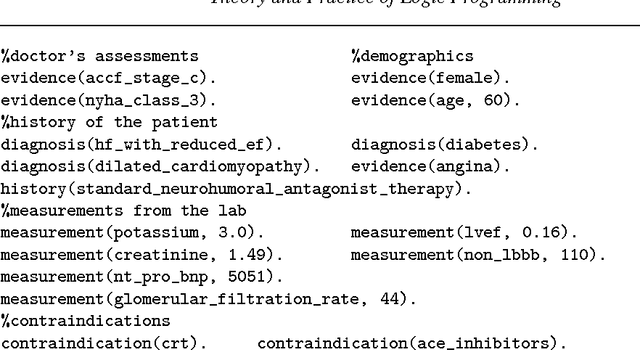
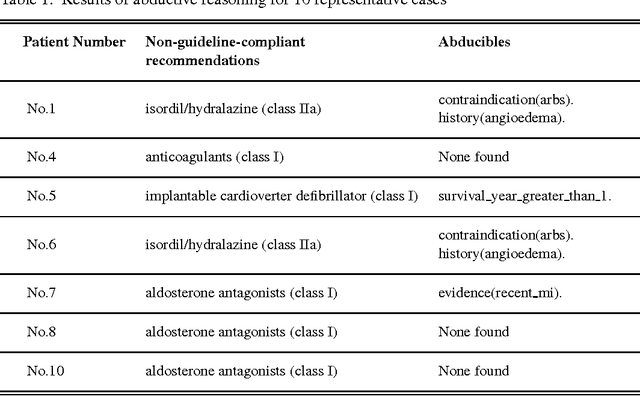
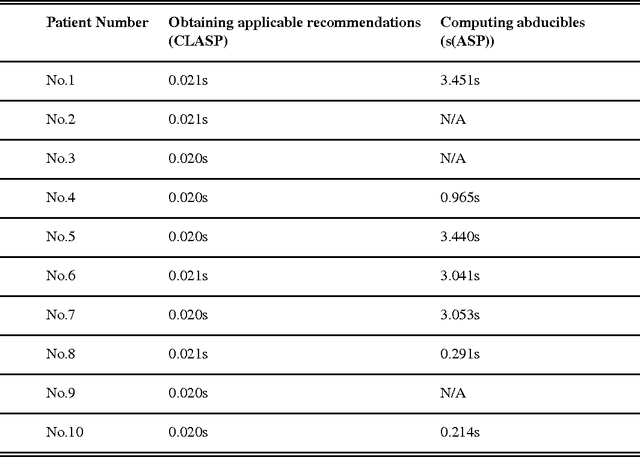
Management of chronic diseases such as heart failure (HF) is a major public health problem. A standard approach to managing chronic diseases by medical community is to have a committee of experts develop guidelines that all physicians should follow. Due to their complexity, these guidelines are difficult to implement and are adopted slowly by the medical community at large. We have developed a physician advisory system that codes the entire set of clinical practice guidelines for managing HF using answer set programming(ASP). In this paper we show how abductive reasoning can be deployed to find missing symptoms and conditions that the patient must exhibit in order for a treatment prescribed by a physician to work effectively. Thus, if a physician does not make an appropriate recommendation or makes a non-adherent recommendation, our system will advise the physician about symptoms and conditions that must be in effect for that recommendation to apply. It is under consideration for acceptance in TPLP.
A Physician Advisory System for Chronic Heart Failure Management Based on Knowledge Patterns
Oct 25, 2016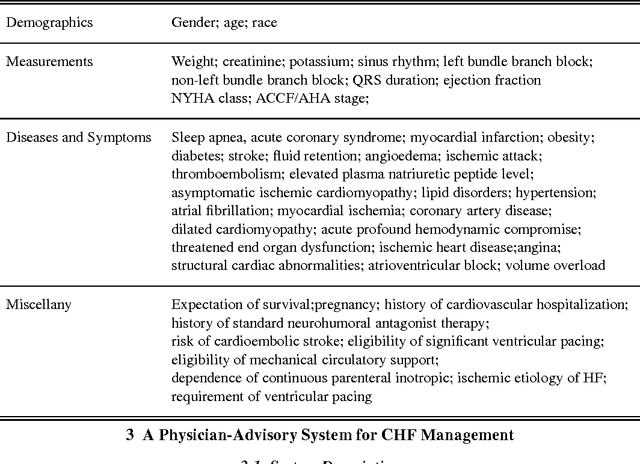

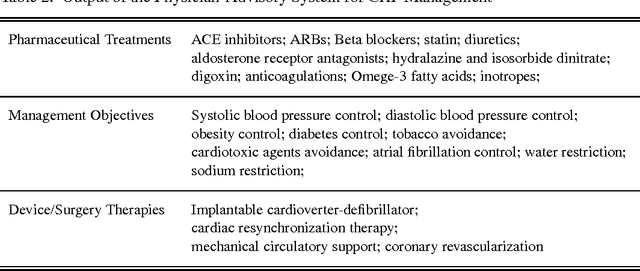
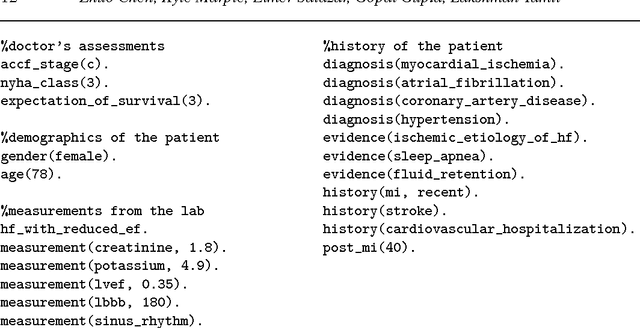
Management of chronic diseases such as heart failure, diabetes, and chronic obstructive pulmonary disease (COPD) is a major problem in health care. A standard approach that the medical community has devised to manage widely prevalent chronic diseases such as chronic heart failure (CHF) is to have a committee of experts develop guidelines that all physicians should follow. These guidelines typically consist of a series of complex rules that make recommendations based on a patient's information. Due to their complexity, often the guidelines are either ignored or not complied with at all, which can result in poor medical practices. It is not even clear whether it is humanly possible to follow these guidelines due to their length and complexity. In the case of CHF management, the guidelines run nearly 80 pages. In this paper we describe a physician-advisory system for CHF management that codes the entire set of clinical practice guidelines for CHF using answer set programming. Our approach is based on developing reasoning templates (that we call knowledge patterns) and using these patterns to systemically code the clinical guidelines for CHF as ASP rules. Use of the knowledge patterns greatly facilitates the development of our system. Given a patient's medical information, our system generates a recommendation for treatment just as a human physician would, using the guidelines. Our system will work even in the presence of incomplete information. Our work makes two contributions: (i) it shows that highly complex guidelines can be successfully coded as ASP rules, and (ii) it develops a series of knowledge patterns that facilitate the coding of knowledge expressed in a natural language and that can be used for other application domains. This paper is under consideration for acceptance in TPLP.