 Add to Chrome
 Add to Firefox
 Add to Edge
Robust $Q$-learning for mean-field control under Wasserstein uncertainty in common noise
Jun 18, 2026
In this article, we present a robust $Q$-learning algorithm for discrete-time mean-field control problems under Wasserstein uncertainty in the common noise law. The algorithm combines a quantization-and-projection scheme with a Wasserstein dual reformulation on the common-noise space. We establish its convergence together with finite-time iteration bounds for both synchronous and asynchronous learning schemes. Numerical experiments on systemic risk and epidemic models compare the asynchronous implementation with an idealized Bellman iteration, illustrate the robustness-performance tradeoff under common-noise misspecification, and report the observed convergence behavior of the asynchronous $Q$-learning algorithm.

IdleSpec: Exploiting Idle Time via Speculative Planning for LLM Agents
May 21, 2026Large language model (LLM)-based agents solve complex tasks by leveraging multi-step reasoning with iterative tool calls and environment interactions, which incur idle time while waiting for observations. Despite the prevalence of idle time in most agentic scenarios, existing works treat it as an unavoidable overhead or propose restricted solutions that overlook varying computational budgets across different tool calls and future observation uncertainty, thereby leading to suboptimal utilization of idle time. In this paper, we introduce IdleSpec, a scalable and generic inference approach that leverages idle-time computation to improve agent performance while minimizing latency overhead. Specifically, IdleSpec iteratively generates plan candidates during idle periods and, once observations become available, aggregates them to guide the next reasoning step. For effective plan generation under observation uncertainty, IdleSpec samples between complementary drafting strategies (i.e., progressive and recovery) from a learned distribution that is updated via posterior feedback. Our experiments demonstrate that IdleSpec significantly improves agent performance in various agentic scenarios by effectively utilizing idle time. In particular, on the GAIA and FRAMES, IdleSpec achieves 55.6% average accuracy with Gemini-2.5-Flash, surpassing the vanilla baseline without idle-time usage by 5.1%. Furthermore, for MLE-Bench, which involves substantial delay from code executions, IdleSpec achieves performance gains of up to 9.1% on the Any Medal rate, highlighting its generalizability to long-horizon tasks.
Feature-aligned N-BEATS with Sinkhorn divergence
May 24, 2023


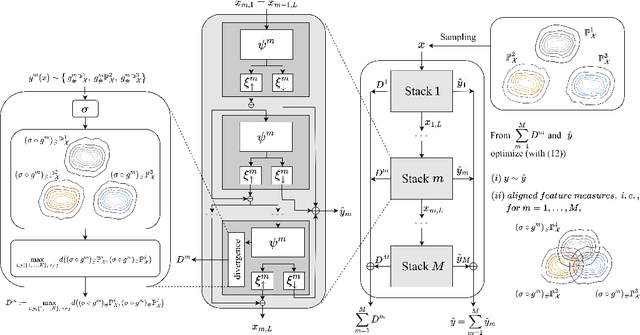
In this study, we propose Feature-aligned N-BEATS as a domain generalization model for univariate time series forecasting problems. The proposed model is an extension of the doubly residual stacking architecture of N-BEATS (Oreshkin et al. [34]) into a representation learning framework. The model is a new structure that involves marginal feature probability measures (i.e., pushforward measures of multiple source domains) induced by the intricate composition of residual operators of N-BEATS in each stack and aligns them stack-wise via an entropic regularized Wasserstein distance referred to as the Sinkhorn divergence (Genevay et al. [14]). The loss function consists of a typical forecasting loss for multiple source domains and an alignment loss calculated with the Sinkhorn divergence, which allows the model to learn invariant features stack-wise across multiple source data sequences while retaining N-BEATS's interpretable design. We conduct a comprehensive experimental evaluation of the proposed approach and the results demonstrate the model's forecasting and generalization capabilities in comparison with methods based on the original N-BEATS.