 Add to Chrome
 Add to Firefox
 Add to Edge
SafeBranch: Branch-Pair Safety Alignment for Embodied Agents
Aug 20, 2026
Vision-language-model-based embodied agents can complete instructed tasks but often violate safety constraints in the process, a problem recently framed as interactive safety. Training such agents to act safely is difficult, since safety and task success are distinct objectives, and safety arises only at a small number of safety-critical steps within a trajectory. Standard supervision is insufficient: imitating safe trajectories teaches behavior without explaining why it is safe, and contrasting arbitrary safe and unsafe trajectories mixes the safety signal with unrelated differences. We propose SafeBranch, a framework that aligns an embodied actor on safety through branch pairs constructed from the actor's own unsafe rollouts via environment rollback. SafeBranch rolls each unsafe rollout back to the safety-critical step that caused the violation, queries the actor for a safe alternative, and pairs the original action with the alternative so that the two branches differ only at that step. The trained actor acts safely at deployment with no critic in the loop. On IS-Bench, SafetyALFRED, and out-of-distribution variants with unseen tasks and objects, it handles safety reliably without sacrificing task success, achieving roughly ten times more safe successes than the untrained baseline on the unseen-object variant.

K-BrowseComp: A Web Browsing Agent Benchmark Grounded in Korean Contexts
Jun 01, 2026Frontier model evaluations are shifting from foundational capabilities (e.g., instruction following and reasoning) toward compositional, agentic ones, but Korean agentic benchmarks remain scarce. We introduce K-BrowseComp, a web-browsing agent benchmark grounded in Korean contexts, consisting of 400 problems. The 300-problem K-BrowseComp-Verified subset is manually constructed and validated by native Korean speakers. On this subset, frontier LLMs, including GPT-5.5, DeepSeek-V4-Pro, and GLM-5.1, reach only 30.00--45.67\%, a substantial drop from BrowseComp, while Korean LLMs released through Korea's Proprietary AI Foundation Model program obtain only 0.00--10.33\%. We further construct a 100-problem synthetic split using hard few-shot exemplars and failure-mode-targeted generation to exploit the asymmetry between solving and creating web browsing problems. On the adversarially filtered synthetic diagnostic split, the strongest model reaches only 26.00\%, and we report this split separately as a targeted stress test. We publicly release our data and code.
ETHIC: Evaluating Large Language Models on Long-Context Tasks with High Information Coverage
Oct 22, 2024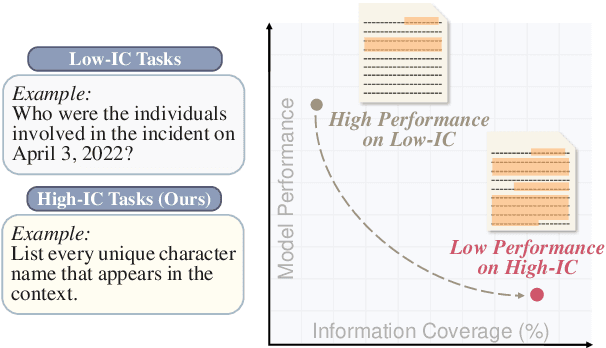
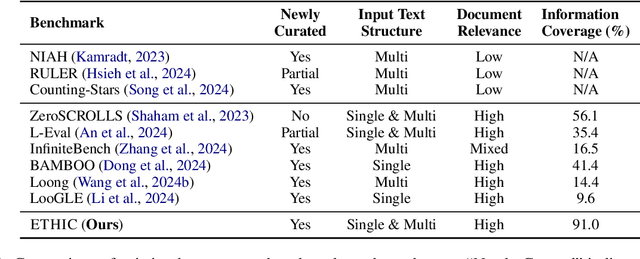
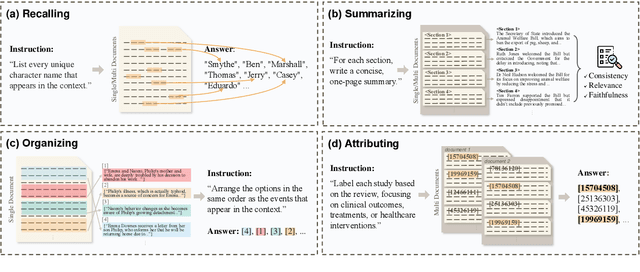
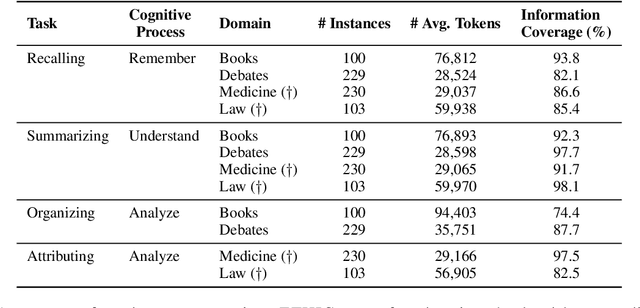
Recent advancements in large language models (LLM) capable of processing extremely long texts highlight the need for a dedicated evaluation benchmark to assess their long-context capabilities. However, existing methods, like the needle-in-a-haystack test, do not effectively assess whether these models fully utilize contextual information, raising concerns about the reliability of current evaluation techniques. To thoroughly examine the effectiveness of existing benchmarks, we introduce a new metric called information coverage (IC), which quantifies the proportion of the input context necessary for answering queries. Our findings indicate that current benchmarks exhibit low IC; although the input context may be extensive, the actual usable context is often limited. To address this, we present ETHIC, a novel benchmark designed to assess LLMs' ability to leverage the entire context. Our benchmark comprises 2,648 test instances spanning four long-context tasks with high IC scores in the domains of books, debates, medicine, and law. Our evaluations reveal significant performance drops in contemporary LLMs, highlighting a critical challenge in managing long contexts. Our benchmark is available at https://github.com/dmis-lab/ETHIC.