 Add to Chrome
 Add to Firefox
 Add to Edge
On the Generalization of Steering Vectors for Chain-of-Thought Faithfulness
Jul 31, 2026
Model capabilities have improved in large part due to scaling chain of thought. This has been a promising development for AI safety--where models verbalize their reasoning, it is possible to monitor it. However, in some cases, models do not verbalize important steps in their reasoning process. For example, models prompted with a cue suggesting the incorrect answer may fail to acknowledge that cue, even when it appears instrumental to their conclusion. When chain of thought (CoT) fails to disclose instrumental reasoning steps, we describe it as unfaithful. Prior work has shown that activation steering can be a useful method to improve faithfulness in CoT. We extend this line of work by studying how well steering for faithfulness generalizes across cue types, datasets, and methods of constructing the steering vector for three models (Gemma-3 4B, Qwen-3.5 9B, Gemma-3 12B) in a cued question-answering setting. While steering reliably increases cue acknowledgment for only the largest model (Gemma-3 12B), we find that when steering is effective, its effect generalizes broadly across cue types and datasets--in cross-cue and cross-dataset analyses, effect size is determined primarily by the evaluation setting, rather than the vector's train setting. How the vector is built also matters little--four construction methods, including one whose optimization target mentions no specific cue, yield similar effect sizes. Finally, we consider the possibility that steering promotes the salience of the cue and causes greater cue use, rather than targeting verbalization behaviors. However, we find no evidence for this--steering leaves the rate of cue use roughly unchanged while reducing hidden cue use, i.e., cue use that is not acknowledged.

Decoding Answers Before Chain-of-Thought: Evidence from Pre-CoT Probes and Activation Steering
Mar 02, 2026As chain-of-thought (CoT) has become central to scaling reasoning capabilities in large language models (LLMs), it has also emerged as a promising tool for interpretability, suggesting the opportunity to understand model decisions through verbalized reasoning. However, the utility of CoT toward interpretability depends upon its faithfulness -- whether the model's stated reasoning reflects the underlying decision process. We provide mechanistic evidence that instruction-tuned models often determine their answer before generating CoT. Training linear probes on residual stream activations at the last token before CoT, we can predict the model's final answer with 0.9 AUC on most tasks. We find that these directions are not only predictive, but also causal: steering activations along the probe direction flips model answers in over 50% of cases, significantly exceeding orthogonal baselines. When steering induces incorrect answers, we observe two distinct failure modes: non-entailment (stating correct premises but drawing unsupported conclusions) and confabulation (fabricating false premises). While post-hoc reasoning may be instrumentally useful when the model has a correct pre-CoT belief, these failure modes suggest it can result in undesirable behaviors when reasoning from a false belief.
Thought Graph: Generating Thought Process for Biological Reasoning
Mar 11, 2024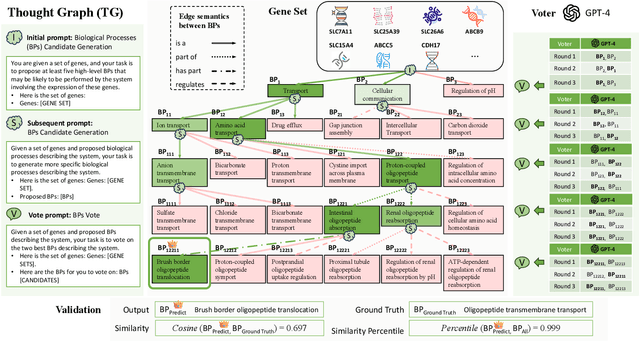
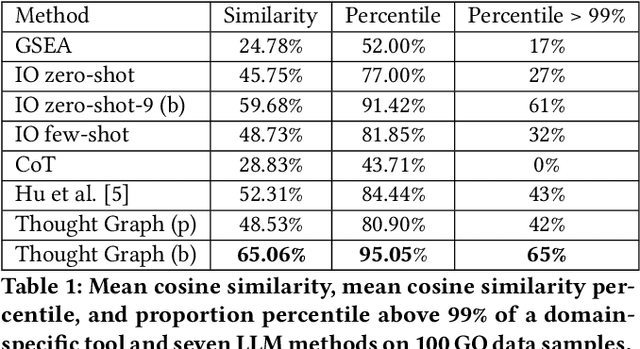
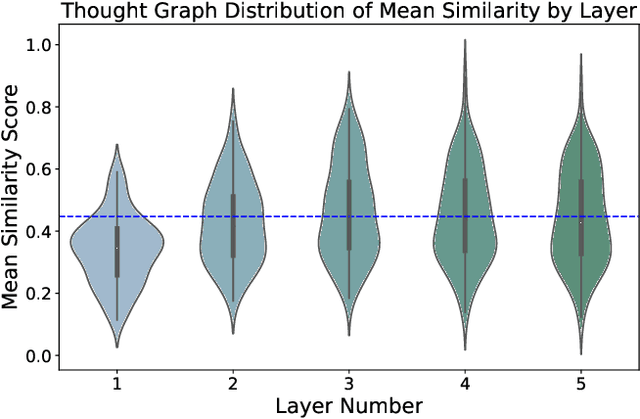
We present the Thought Graph as a novel framework to support complex reasoning and use gene set analysis as an example to uncover semantic relationships between biological processes. Our framework stands out for its ability to provide a deeper understanding of gene sets, significantly surpassing GSEA by 40.28% and LLM baselines by 5.38% based on cosine similarity to human annotations. Our analysis further provides insights into future directions of biological processes naming, and implications for bioinformatics and precision medicine.