 Add to Chrome
 Add to Firefox
 Add to Edge
Fast Amortized Fitting of Scientific Signals Across Time and Ensembles via Transferable Neural Fields
Apr 21, 2026
Neural fields, also known as implicit neural representations (INRs), offer a powerful framework for modeling continuous geometry, but their effectiveness in high-dimensional scientific settings is limited by slow convergence and scaling challenges. In this study, we extend INR models to handle spatiotemporal and multivariate signals and show how INR features can be transferred across scientific signals to enable efficient and scalable representation across time and ensemble runs in an amortized fashion. Across controlled transformation regimes (e.g., geometric transformations and localized perturbations of synthetic fields) and high-fidelity scientific domains-including turbulent flows, fluid-material impact dynamics, and astrophysical systems-we show that transferable features improve not only signal fidelity but also the accuracy of derived geometric and physical quantities, including density gradients and vorticity. In particular, transferable features reduce iterations to reach target reconstruction quality by up to an order of magnitude, increase early-stage reconstruction quality by multiple dB (with gains exceeding 10 dB in some cases), and consistently improve gradient-based physical accuracy.

The Surprising Effectiveness of Noise Pretraining for Implicit Neural Representations
Mar 30, 2026The approximation and convergence properties of implicit neural representations (INRs) are known to be highly sensitive to parameter initialization strategies. While several data-driven initialization methods demonstrate significant improvements over standard random sampling, the reasons for their success -- specifically, whether they encode classical statistical signal priors or more complex features -- remain poorly understood. In this study, we explore this phenomenon through a series of experimental analyses leveraging noise pretraining. We pretrain INRs on diverse noise classes (e.g., Gaussian, Dead Leaves, Spectral) and measure their ability to both fit unseen signals and encode priors for an inverse imaging task (denoising). Our analyses on image and video data reveal a surprising finding: simply pretraining on unstructured noise (Uniform, Gaussian) dramatically improves signal fitting capacity compared to all other baselines. However, unstructured noise also yields poor deep image priors for denoising. In contrast, we also find that noise with the classic $1/|f^α|$ spectral structure of natural images achieves an excellent balance of signal fitting and inverse imaging capabilities, performing on par with the best data-driven initialization methods. This finding enables more efficient INR training in applications lacking sufficient prior domain-specific data. For more details, visit project page at https://kushalvyas.github.io/noisepretraining.html
Learning Transferable Features for Implicit Neural Representations
Sep 15, 2024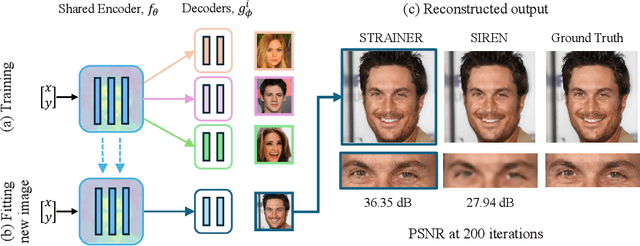
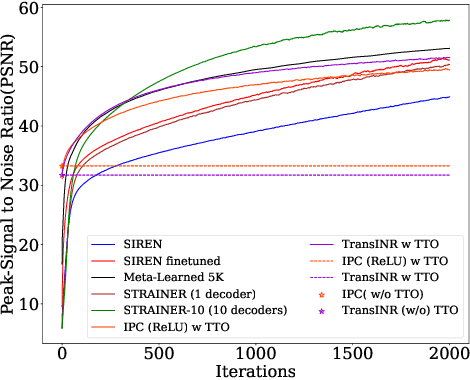

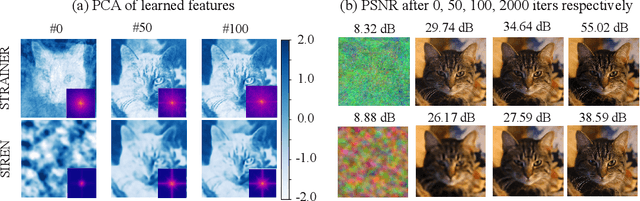
Implicit neural representations (INRs) have demonstrated success in a variety of applications, including inverse problems and neural rendering. An INR is typically trained to capture one signal of interest, resulting in learned neural features that are highly attuned to that signal. Assumed to be less generalizable, we explore the aspect of transferability of such learned neural features for fitting similar signals. We introduce a new INR training framework, STRAINER that learns transferrable features for fitting INRs to new signals from a given distribution, faster and with better reconstruction quality. Owing to the sequential layer-wise affine operations in an INR, we propose to learn transferable representations by sharing initial encoder layers across multiple INRs with independent decoder layers. At test time, the learned encoder representations are transferred as initialization for an otherwise randomly initialized INR. We find STRAINER to yield extremely powerful initialization for fitting images from the same domain and allow for $\approx +10dB$ gain in signal quality early on compared to an untrained INR itself. STRAINER also provides a simple way to encode data-driven priors in INRs. We evaluate STRAINER on multiple in-domain and out-of-domain signal fitting tasks and inverse problems and further provide detailed analysis and discussion on the transferability of STRAINER's features. Our demo can be accessed at https://colab.research.google.com/drive/1fBZAwqE8C_lrRPAe-hQZJTWrMJuAKtG2?usp=sharing .