 Add to Chrome
 Add to Firefox
 Add to Edge
Neuro-Symbolic Verification on Instruction Following of LLMs
Jan 25, 2026
A fundamental problem of applying Large Language Models (LLMs) to important applications is that LLMs do not always follow instructions, and violations are often hard to observe or check. In LLM-based agentic workflows, such violations can propagate and amplify along reasoning chains, causing task failures and system incidents. This paper presents NSVIF, a neuro-symbolic framework for verifying whether an LLM's output follows the instructions used to prompt the LLM. NSVIF is a universal, general-purpose verifier; it makes no assumption about the instruction or the LLM. NSVIF formulates instruction-following verification as a constraint-satisfaction problem by modeling user instructions as constraints. NSVIF models both logical and semantic constraints; constraint solving is done by a unified solver that orchestrates logical reasoning and semantic analysis. To evaluate NSVIF, we develop VIFBENCH, a new benchmark for instruction-following verifiers with fine-grained data labels. Experiments show that NSVIF significantly outperforms LLM-based approaches and provides interpretable feedback. We also show that feedback from NSVIF helps improve LLMs' instruction-following capability without post-training.

ReVeal: Self-Evolving Code Agents via Iterative Generation-Verification
Jun 13, 2025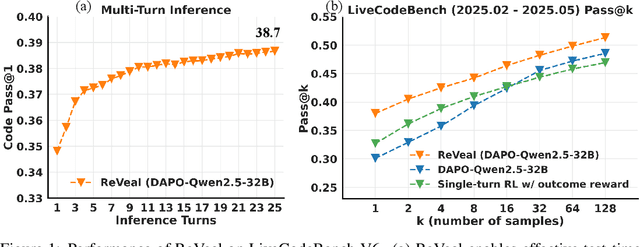
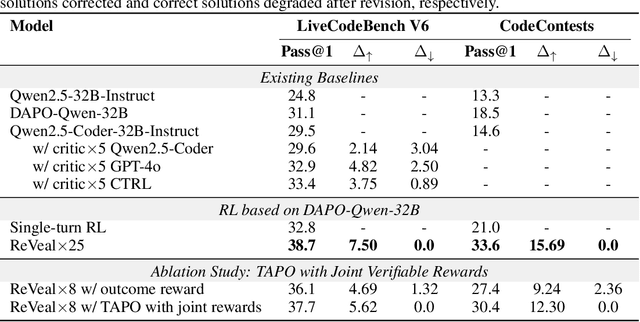
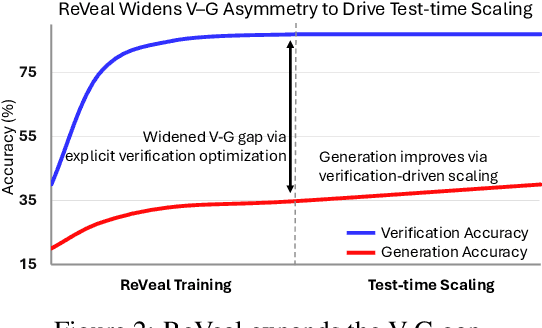
Recent advances in reinforcement learning (RL) with verifiable outcome rewards have significantly improved the reasoning capabilities of large language models (LLMs), especially when combined with multi-turn tool interactions. However, existing methods lack both meaningful verification signals from realistic environments and explicit optimization for verification, leading to unreliable self-verification. To address these limitations, we propose ReVeal, a multi-turn reinforcement learning framework that interleaves code generation with explicit self-verification and tool-based evaluation. ReVeal enables LLMs to autonomously generate test cases, invoke external tools for precise feedback, and improves performance via a customized RL algorithm with dense, per-turn rewards. As a result, ReVeal fosters the co-evolution of a model's generation and verification capabilities through RL training, expanding the reasoning boundaries of the base model, demonstrated by significant gains in Pass@k on LiveCodeBench. It also enables test-time scaling into deeper inference regimes, with code consistently evolving as the number of turns increases during inference, ultimately surpassing DeepSeek-R1-Zero-Qwen-32B. These findings highlight the promise of ReVeal as a scalable and effective paradigm for building more robust and autonomous AI agents.