 Add to Chrome
 Add to Firefox
 Add to Edge
From Synthetic to Native: Benchmarking Multilingual Intent Classification in Logistics Customer Service
Mar 24, 2026
Multilingual intent classification is central to customer-service systems on global logistics platforms, where models must process noisy user queries across languages and hierarchical label spaces. Yet most existing multilingual benchmarks rely on machine-translated text, which is typically cleaner and more standardized than native customer requests and can therefore overestimate real-world robustness. We present a public benchmark for hierarchical multilingual intent classification constructed from real logistics customer-service logs. The dataset contains approximately 30K de-identified, stand-alone user queries curated from 600K historical records through filtering, LLM-assisted quality control, and human verification, and is organized into a two-level taxonomy with 13 parent and 17 leaf intents. English, Spanish, and Arabic are included as seen languages, while Indonesian, Chinese, and additional test-only languages support zero-shot evaluation. To directly measure the gap between synthetic and real evaluation, we provide paired native and machine-translated test sets and benchmark multilingual encoders, embedding models, and small language models under flat and hierarchical protocols. Results show that translated test sets substantially overestimate performance on noisy native queries, especially for long-tail intents and cross-lingual transfer, underscoring the need for more realistic multilingual intent benchmarks.

Effective Generation of Feasible Solutions for Integer Programming via Guided Diffusion
Jun 18, 2024

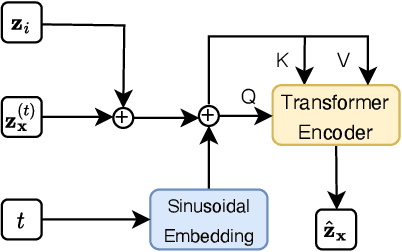

Feasible solutions are crucial for Integer Programming (IP) since they can substantially speed up the solving process. In many applications, similar IP instances often exhibit similar structures and shared solution distributions, which can be potentially modeled by deep learning methods. Unfortunately, existing deep-learning-based algorithms, such as Neural Diving and Predict-and-search framework, are limited to generating only partial feasible solutions, and they must rely on solvers like SCIP and Gurobi to complete the solutions for a given IP problem. In this paper, we propose a novel framework that generates complete feasible solutions end-to-end. Our framework leverages contrastive learning to characterize the relationship between IP instances and solutions, and learns latent embeddings for both IP instances and their solutions. Further, the framework employs diffusion models to learn the distribution of solution embeddings conditioned on IP representations, with a dedicated guided sampling strategy that accounts for both constraints and objectives. We empirically evaluate our framework on four typical datasets of IP problems, and show that it effectively generates complete feasible solutions with a high probability (> 89.7 \%) without the reliance of Solvers and the quality of solutions is comparable to the best heuristic solutions from Gurobi. Furthermore, by integrating our method's sampled partial solutions with the CompleteSol heuristic from SCIP, the resulting feasible solutions outperform those from state-of-the-art methods across all datasets, exhibiting a 3.7 to 33.7\% improvement in the gap to optimal values, and maintaining a feasible ratio of over 99.7\% for all datasets.
A Deep Reinforcement Learning Approach for Constrained Online Logistics Route Assignment
Sep 08, 2021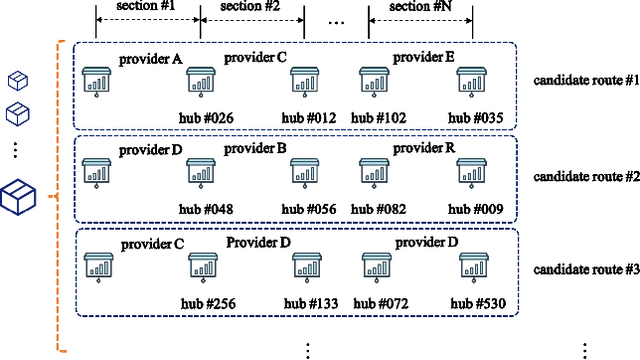
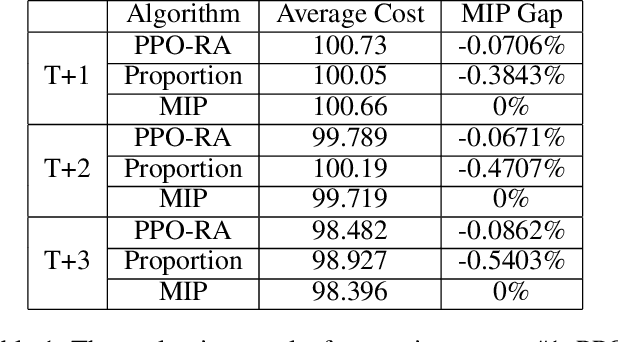
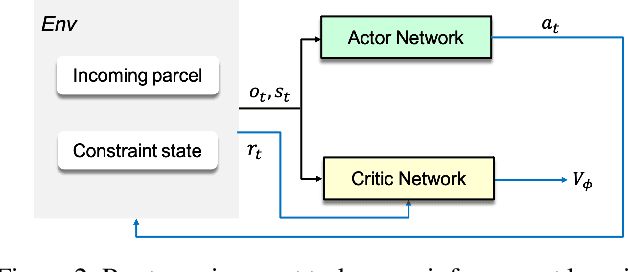
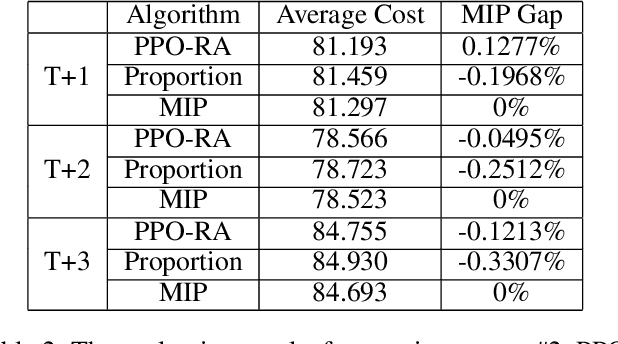
As online shopping prevails and e-commerce platforms emerge, there is a tremendous number of parcels being transported every day. Thus, it is crucial for the logistics industry on how to assign a candidate logistics route for each shipping parcel properly as it leaves a significant impact on the total logistics cost optimization and business constraints satisfaction such as transit hub capacity and delivery proportion of delivery providers. This online route-assignment problem can be viewed as a constrained online decision-making problem. Notably, the large amount (beyond ${10^5}$) of daily parcels, the variability and non-Markovian characteristics of parcel information impose difficulties on attaining (near-) optimal solution without violating constraints excessively. In this paper, we develop a model-free DRL approach named PPO-RA, in which Proximal Policy Optimization (PPO) is improved with dedicated techniques to address the challenges for route assignment (RA). The actor and critic networks use attention mechanism and parameter sharing to accommodate each incoming parcel with varying numbers and identities of candidate routes, without modeling non-Markovian parcel arriving dynamics since we make assumption of i.i.d. parcel arrival. We use recorded delivery parcel data to evaluate the performance of PPO-RA by comparing it with widely-used baselines via simulation. The results show the capability of the proposed approach to achieve considerable cost savings while satisfying most constraints.