 Add to Chrome
 Add to Firefox
 Add to Edge
Towards Reducing Foreign Language Anxiety Using Level-Appropriate Embodied Conversational Agents
Jul 24, 2026
Foreign language anxiety (FLA) can be a major barrier to second language acquisition (SLA), especially in conversational contexts. With the proliferation of large language models (LLMs) throughout all areas of life, recent work suggests that interacting with LLM agents can be instrumental within the field of SLA and foreign language education, especially for reducing FLA. Related work also suggests that linguistic demands and task complexity can be predictors of FLA, implying that the use of demanding, complex language could lead to learners experiencing higher FLA. In this paper, we propose a novel multi-agent embodied conversational system that generates level-appropriate dialogue for English language learners. These levels are based on those defined by the Common European Framework of Reference for Languages (CEFR) to describe non-native listener and speaker proficiency. Using a "generate-evaluate-regenerate" loop with multiple LLM agents and a level classifier, it achieves a desired simplicity that is adaptive to the user's proficiency level. We also share the results of a preliminary small-sample pilot study that tested this system with Japanese university students, to see whether it would yield lower FLA levels than an unsimplified embodied conversational agent. Analysis of conversational output showed that 87.4% of dialogue sentences generated by the proposed multi-agent system fell within one predicted CEFR level of the learner's self-assessed proficiency, compared to 54.1% for the unsimplified agent. This suggests that the novel system is better able to produce output at an appropriate level for the learner. Though this study did not yield statistically significant evidence that the system reduces FLA levels in Japanese learners of English, likely due to a small sample size, it provides usability findings and culturally-informed design insights that will inform future study.
* 8 pages, 6 figures, published in the proceedings of EDULEARN26

Noise Flooding for Detecting Audio Adversarial Examples Against Automatic Speech Recognition
Dec 25, 2018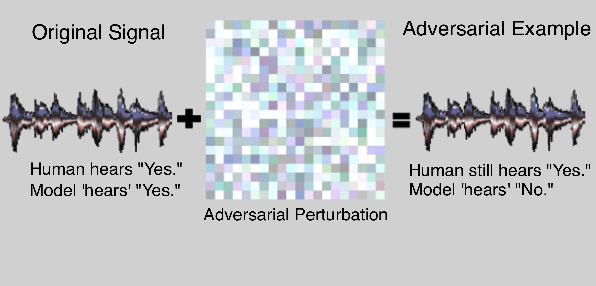
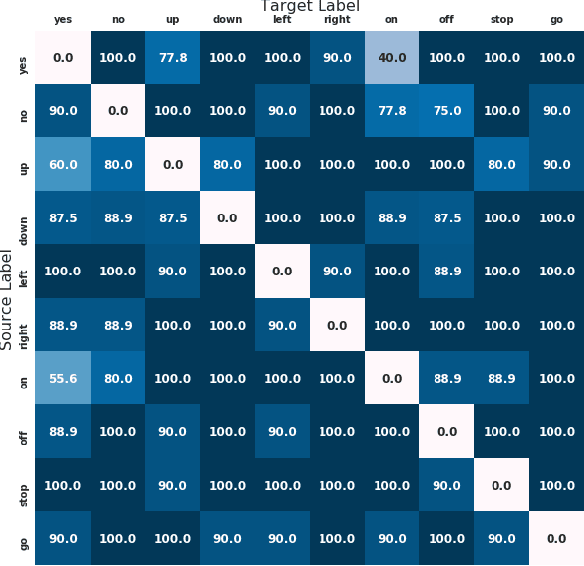
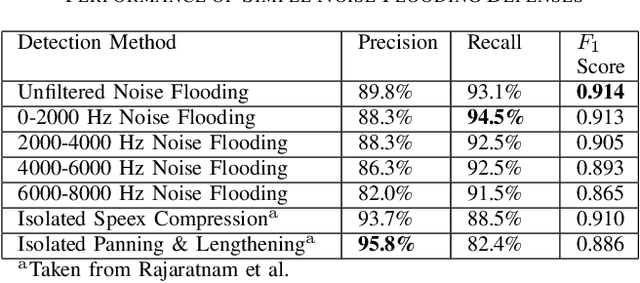
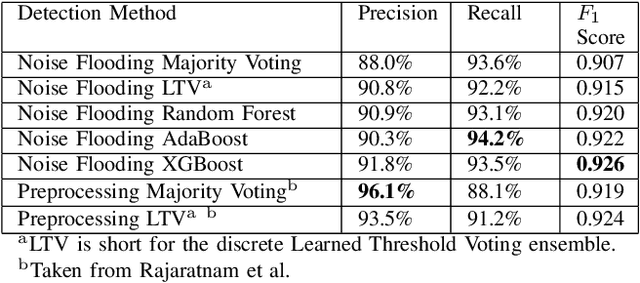
Neural models enjoy widespread use across a variety of tasks and have grown to become crucial components of many industrial systems. Despite their effectiveness and extensive popularity, they are not without their exploitable flaws. Initially applied to computer vision systems, the generation of adversarial examples is a process in which seemingly imperceptible perturbations are made to an image, with the purpose of inducing a deep learning based classifier to misclassify the image. Due to recent trends in speech processing, this has become a noticeable issue in speech recognition models. In late 2017, an attack was shown to be quite effective against the Speech Commands classification model. Limited-vocabulary speech classifiers, such as the Speech Commands model, are used quite frequently in a variety of applications, particularly in managing automated attendants in telephony contexts. As such, adversarial examples produced by this attack could have real-world consequences. While previous work in defending against these adversarial examples has investigated using audio preprocessing to reduce or distort adversarial noise, this work explores the idea of flooding particular frequency bands of an audio signal with random noise in order to detect adversarial examples. This technique of flooding, which does not require retraining or modifying the model, is inspired by work done in computer vision and builds on the idea that speech classifiers are relatively robust to natural noise. A combined defense incorporating 5 different frequency bands for flooding the signal with noise outperformed other existing defenses in the audio space, detecting adversarial examples with 91.8% precision and 93.5% recall.
Isolated and Ensemble Audio Preprocessing Methods for Detecting Adversarial Examples against Automatic Speech Recognition
Sep 11, 2018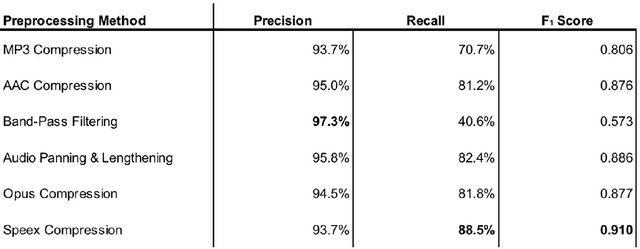
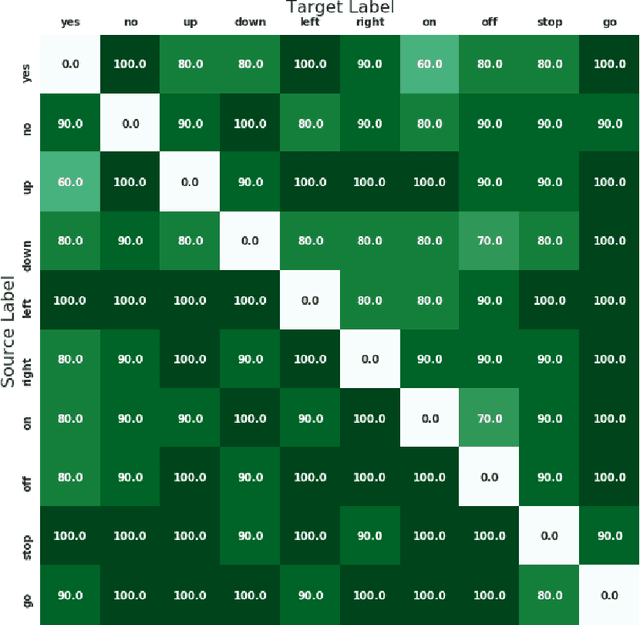
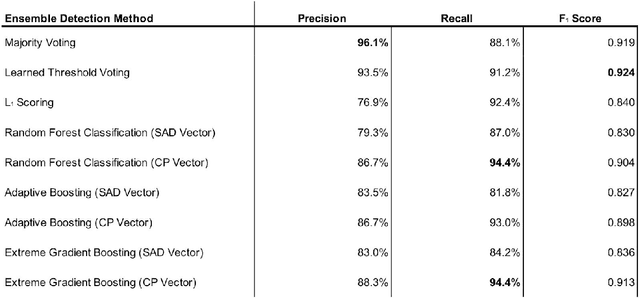

An adversarial attack is an exploitative process in which minute alterations are made to natural inputs, causing the inputs to be misclassified by neural models. In the field of speech recognition, this has become an issue of increasing significance. Although adversarial attacks were originally introduced in computer vision, they have since infiltrated the realm of speech recognition. In 2017, a genetic attack was shown to be quite potent against the Speech Commands Model. Limited-vocabulary speech classifiers, such as the Speech Commands Model, are used in a variety of applications, particularly in telephony; as such, adversarial examples produced by this attack pose as a major security threat. This paper explores various methods of detecting these adversarial examples with combinations of audio preprocessing. One particular combined defense incorporating compressions, speech coding, filtering, and audio panning was shown to be quite effective against the attack on the Speech Commands Model, detecting audio adversarial examples with 93.5% precision and 91.2% recall.