 Add to Chrome
 Add to Firefox
 Add to Edge
Towards Reducing Foreign Language Anxiety Using Level-Appropriate Embodied Conversational Agents
Jul 24, 2026
Foreign language anxiety (FLA) can be a major barrier to second language acquisition (SLA), especially in conversational contexts. With the proliferation of large language models (LLMs) throughout all areas of life, recent work suggests that interacting with LLM agents can be instrumental within the field of SLA and foreign language education, especially for reducing FLA. Related work also suggests that linguistic demands and task complexity can be predictors of FLA, implying that the use of demanding, complex language could lead to learners experiencing higher FLA. In this paper, we propose a novel multi-agent embodied conversational system that generates level-appropriate dialogue for English language learners. These levels are based on those defined by the Common European Framework of Reference for Languages (CEFR) to describe non-native listener and speaker proficiency. Using a "generate-evaluate-regenerate" loop with multiple LLM agents and a level classifier, it achieves a desired simplicity that is adaptive to the user's proficiency level. We also share the results of a preliminary small-sample pilot study that tested this system with Japanese university students, to see whether it would yield lower FLA levels than an unsimplified embodied conversational agent. Analysis of conversational output showed that 87.4% of dialogue sentences generated by the proposed multi-agent system fell within one predicted CEFR level of the learner's self-assessed proficiency, compared to 54.1% for the unsimplified agent. This suggests that the novel system is better able to produce output at an appropriate level for the learner. Though this study did not yield statistically significant evidence that the system reduces FLA levels in Japanese learners of English, likely due to a small sample size, it provides usability findings and culturally-informed design insights that will inform future study.
* 8 pages, 6 figures, published in the proceedings of EDULEARN26

Monitoring and Improving Personalized Sleep Quality from Long-Term Lifelogs
Nov 23, 2022Sleep plays a vital role in our physical, cognitive, and psychological well-being. Despite its importance, long-term monitoring of personalized sleep quality (SQ) in real-world contexts is still challenging. Many sleep researches are still developing clinically and far from accessible to the general public. Fortunately, wearables and IoT devices provide the potential to explore the sleep insights from multimodal data, and have been used in some SQ researches. However, most of these studies analyze the sleep related data and present the results in a delayed manner (i.e., today's SQ obtained from last night's data), it is sill difficult for individuals to know how their sleep will be before they go to bed and how they can proactively improve it. To this end, this paper proposes a computational framework to monitor the individual SQ based on both the objective and subjective data from multiple sources, and moves a step further towards providing the personalized feedback to improve the SQ in a data-driven manner. The feedback is implemented by referring the insights from the PMData dataset based on the discovered patterns between life events and different levels of SQ. The deep learning based personal SQ model (PerSQ), using the long-term heterogeneous data and considering the carry-over effect, achieves higher prediction performance compared with baseline models. A case study also shows reasonable results for an individual to monitor and improve the SQ in the future.
An Open Case-based Reasoning Framework for Personalized On-board Driving Assistance in Risk Scenarios
Nov 23, 2022Driver reaction is of vital importance in risk scenarios. Drivers can take correct evasive maneuver at proper cushion time to avoid the potential traffic crashes, but this reaction process is highly experience-dependent and requires various levels of driving skills. To improve driving safety and avoid the traffic accidents, it is necessary to provide all road drivers with on-board driving assistance. This study explores the plausibility of case-based reasoning (CBR) as the inference paradigm underlying the choice of personalized crash evasive maneuvers and the cushion time, by leveraging the wealthy of human driving experience from the steady stream of traffic cases, which have been rarely explored in previous studies. To this end, in this paper, we propose an open evolving framework for generating personalized on-board driving assistance. In particular, we present the FFMTE model with high performance to model the traffic events and build the case database; A tailored CBR-based method is then proposed to retrieve, reuse and revise the existing cases to generate the assistance. We take the 100-Car Naturalistic Driving Study dataset as an example to build and test our framework; the experiments show reasonable results, providing the drivers with valuable evasive information to avoid the potential crashes in different scenarios.
Prerequisite-driven Q-matrix Refinement for Learner Knowledge Assessment: A Case Study in Online Learning Context
Aug 31, 2022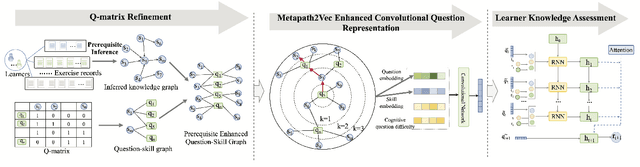
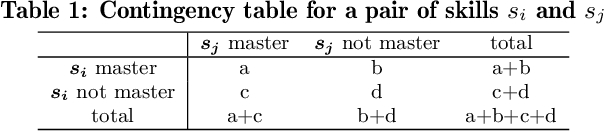
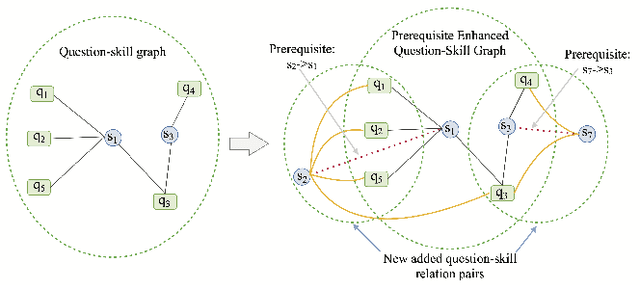
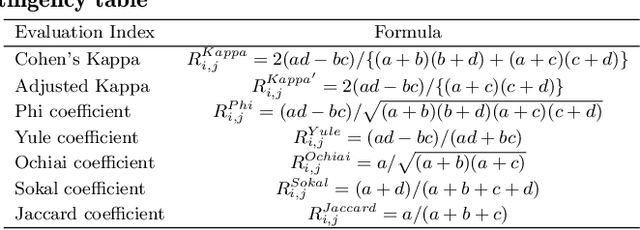
The ever growing abundance of learning traces in the online learning platforms promises unique insights into the learner knowledge assessment (LKA), a fundamental personalized-tutoring technique for enabling various further adaptive tutoring services in these platforms. Precise assessment of learner knowledge requires the fine-grained Q-matrix, which is generally designed by experts to map the items to skills in the domain. Due to the subjective tendency, some misspecifications may degrade the performance of LKA. Some efforts have been made to refine the small-scale Q-matrix, however, it is difficult to extend the scalability and apply these methods to the large-scale online learning context with numerous items and massive skills. Moreover, the existing LKA models employ flexible deep learning models that excel at this task, but the adequacy of LKA is still challenged by the representation capability of the models on the quite sparse item-skill graph and the learners' exercise data. To overcome these issues, in this paper we propose a prerequisite-driven Q-matrix refinement framework for learner knowledge assessment (PQRLKA) in online context. We infer the prerequisites from learners' response data and use it to refine the expert-defined Q-matrix, which enables the interpretability and the scalability to apply it to the large-scale online learning context. Based on the refined Q-matrix, we propose a Metapath2Vec enhanced convolutional representation method to obtain the comprehensive representations of the items with rich information, and feed them to the PQRLKA model to finally assess the learners' knowledge. Experiments conducted on three real-world datasets demonstrate the capability of our model to infer the prerequisites for Q-matrix refinement, and also its superiority for the LKA task.