 Add to Chrome
 Add to Firefox
 Add to Edge
Pointy - A Lightweight Transformer for Point Cloud Foundation Models
Mar 11, 2026
Foundation models for point cloud data have recently grown in capability, often leveraging extensive representation learning from language or vision. In this work, we take a more controlled approach by introducing a lightweight transformer-based point cloud architecture. In contrast to the heavy reliance on cross-modal supervision, our model is trained only on 39k point clouds - yet it outperforms several larger foundation models trained on over 200k training samples. Interestingly, our method approaches state-of-the-art results from models that have seen over a million point clouds, images, and text samples, demonstrating the value of a carefully curated training setup and architecture. To ensure rigorous evaluation, we conduct a comprehensive replication study that standardizes the training regime and benchmarks across multiple point cloud architectures. This unified experimental framework isolates the impact of architectural choices, allowing for transparent comparisons and highlighting the benefits of our design and other tokenizer-free architectures. Our results show that simple backbones can deliver competitive results to more complex or data-rich strategies. The implementation, including code, pre-trained models, and training protocols, is available at https://github.com/KonradSzafer/Pointy.

MOMENT: A Family of Open Time-series Foundation Models
Feb 06, 2024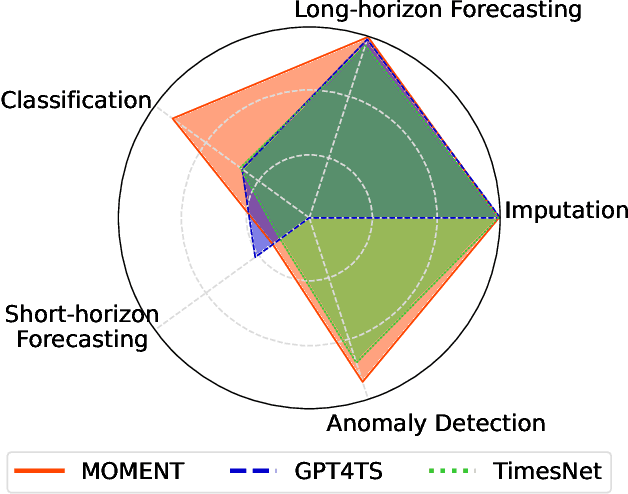
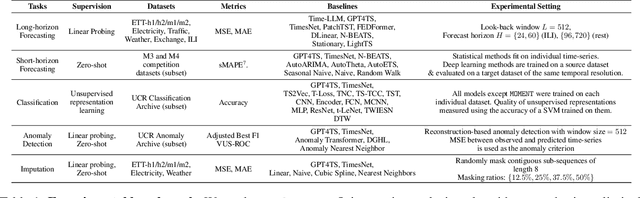
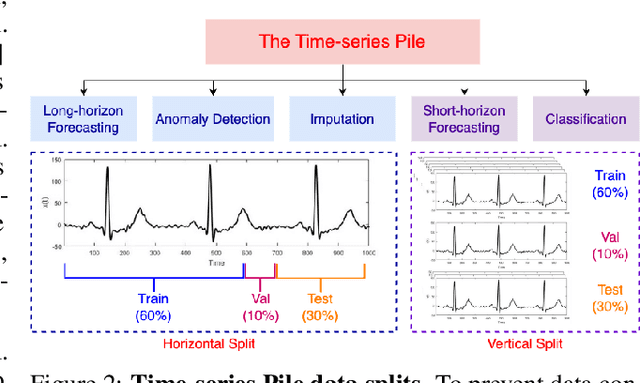
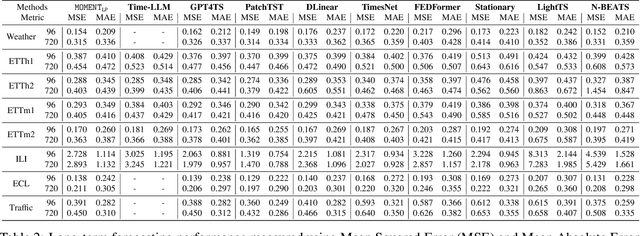
We introduce MOMENT, a family of open-source foundation models for general-purpose time-series analysis. Pre-training large models on time-series data is challenging due to (1) the absence of a large and cohesive public time-series repository, and (2) diverse time-series characteristics which make multi-dataset training onerous. Additionally, (3) experimental benchmarks to evaluate these models, especially in scenarios with limited resources, time, and supervision, are still in their nascent stages. To address these challenges, we compile a large and diverse collection of public time-series, called the Time-series Pile, and systematically tackle time-series-specific challenges to unlock large-scale multi-dataset pre-training. Finally, we build on recent work to design a benchmark to evaluate time-series foundation models on diverse tasks and datasets in limited supervision settings. Experiments on this benchmark demonstrate the effectiveness of our pre-trained models with minimal data and task-specific fine-tuning. Finally, we present several interesting empirical observations about large pre-trained time-series models. Our code is available anonymously at anonymous.4open.science/r/BETT-773F/.