 Add to Chrome
 Add to Firefox
 Add to Edge
From Intent to Execution: Composing Agentic Workflows with Agent Recommendation
May 05, 2026
Multi-Agent Systems (MAS) built using AI agents fulfill a variety of user intents that may be used to design and build a family of related applications. However, the creation of such MAS currently involves manual composition of the plan, manual selection of appropriate agents, and manual creation of execution graphs. This paper introduces a framework for the automated creation of multi-agent systems which replaces multiple manual steps with an automated framework. The proposed framework consists of software modules and a workflow to orchestrate the requisite task- specific application. The modules include: an LLM-derived planner, a set of tasks described in natural language, a dynamic call graph, an orchestrator for map agents to tasks, and an agent recommender that finds the most suitable agent(s) from local and global agent registries. The agent recommender uses a two-stage information retrieval (IR) system comprising a fast retriever and an LLM-based re-ranker. We implemented a series of experiments exploring the choice of embedders, re- rankers, agent description enrichment, and supervising critique agent. We benchmarked this system end-to-end, evaluating the combination of planning, agent selection, and task completion, with our proposed approach. Our experimental results show that our approach outperforms the state-of-the- art in terms of the recall rate and is more robust and scalable compared to previous approaches. The critique agent holistically reevaluates both agent and tool recommendations against the overall plan. We show that the inclusion of the critique agent further enhances the recall score, proving that the comprehensive review and revision of task-based agent selection is an essential step in building end-to-end multi-agent systems.

Composition Loss for Counting, Density Map Estimation and Localization in Dense Crowds
Aug 02, 2018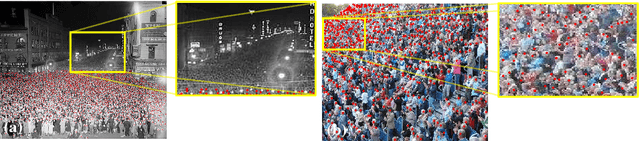
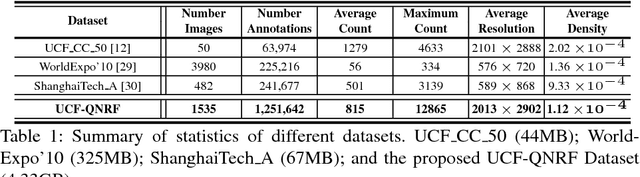
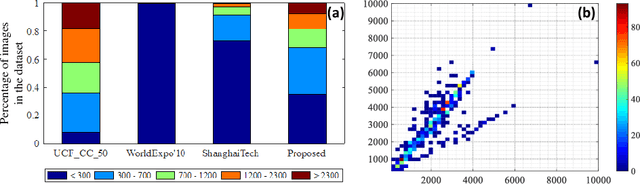
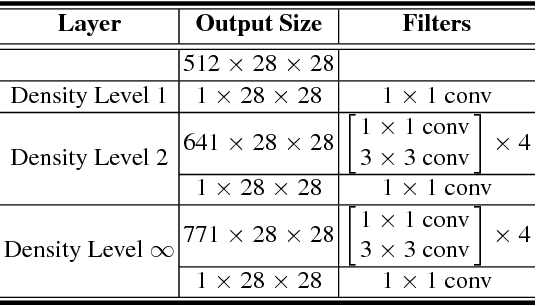
With multiple crowd gatherings of millions of people every year in events ranging from pilgrimages to protests, concerts to marathons, and festivals to funerals; visual crowd analysis is emerging as a new frontier in computer vision. In particular, counting in highly dense crowds is a challenging problem with far-reaching applicability in crowd safety and management, as well as gauging political significance of protests and demonstrations. In this paper, we propose a novel approach that simultaneously solves the problems of counting, density map estimation and localization of people in a given dense crowd image. Our formulation is based on an important observation that the three problems are inherently related to each other making the loss function for optimizing a deep CNN decomposable. Since localization requires high-quality images and annotations, we introduce UCF-QNRF dataset that overcomes the shortcomings of previous datasets, and contains 1.25 million humans manually marked with dot annotations. Finally, we present evaluation measures and comparison with recent deep CNN networks, including those developed specifically for crowd counting. Our approach significantly outperforms state-of-the-art on the new dataset, which is the most challenging dataset with the largest number of crowd annotations in the most diverse set of scenes.