 Add to Chrome
 Add to Firefox
 Add to Edge
From Intent to Execution: Composing Agentic Workflows with Agent Recommendation
May 05, 2026
Multi-Agent Systems (MAS) built using AI agents fulfill a variety of user intents that may be used to design and build a family of related applications. However, the creation of such MAS currently involves manual composition of the plan, manual selection of appropriate agents, and manual creation of execution graphs. This paper introduces a framework for the automated creation of multi-agent systems which replaces multiple manual steps with an automated framework. The proposed framework consists of software modules and a workflow to orchestrate the requisite task- specific application. The modules include: an LLM-derived planner, a set of tasks described in natural language, a dynamic call graph, an orchestrator for map agents to tasks, and an agent recommender that finds the most suitable agent(s) from local and global agent registries. The agent recommender uses a two-stage information retrieval (IR) system comprising a fast retriever and an LLM-based re-ranker. We implemented a series of experiments exploring the choice of embedders, re- rankers, agent description enrichment, and supervising critique agent. We benchmarked this system end-to-end, evaluating the combination of planning, agent selection, and task completion, with our proposed approach. Our experimental results show that our approach outperforms the state-of-the- art in terms of the recall rate and is more robust and scalable compared to previous approaches. The critique agent holistically reevaluates both agent and tool recommendations against the overall plan. We show that the inclusion of the critique agent further enhances the recall score, proving that the comprehensive review and revision of task-based agent selection is an essential step in building end-to-end multi-agent systems.

SPADE: Self-supervised Pretraining for Acoustic DisEntanglement
Feb 03, 2023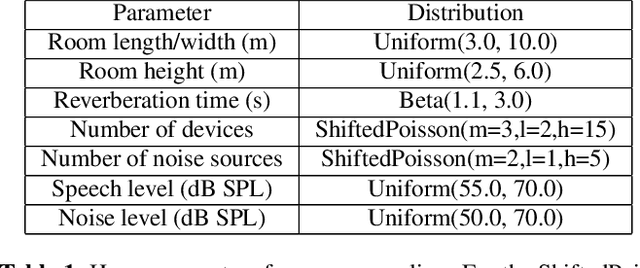
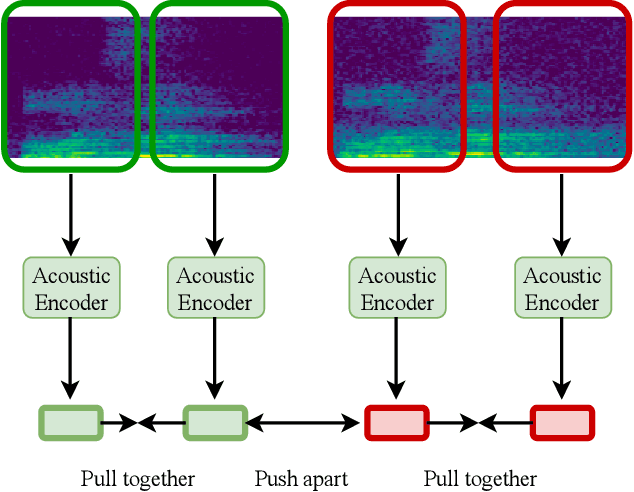
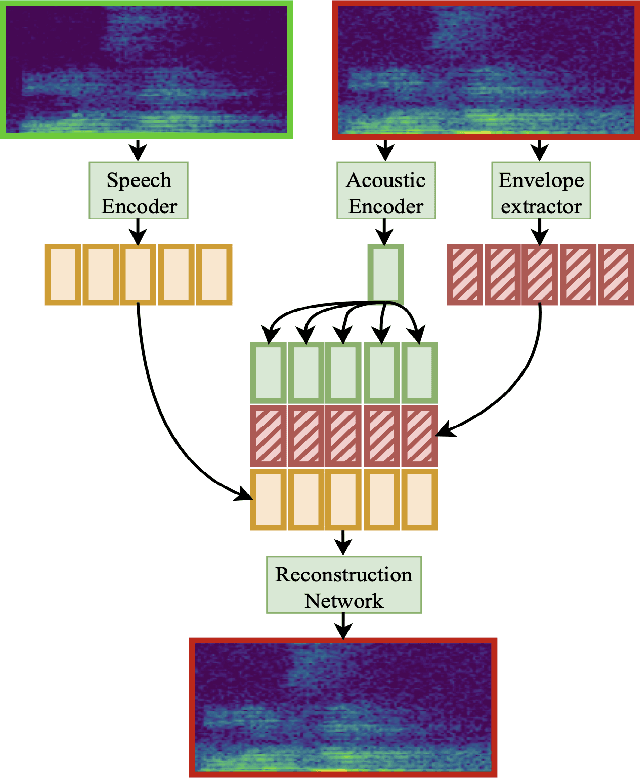
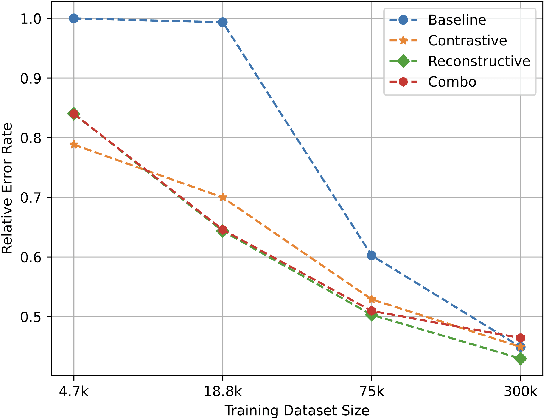
Self-supervised representation learning approaches have grown in popularity due to the ability to train models on large amounts of unlabeled data and have demonstrated success in diverse fields such as natural language processing, computer vision, and speech. Previous self-supervised work in the speech domain has disentangled multiple attributes of speech such as linguistic content, speaker identity, and rhythm. In this work, we introduce a self-supervised approach to disentangle room acoustics from speech and use the acoustic representation on the downstream task of device arbitration. Our results demonstrate that our proposed approach significantly improves performance over a baseline when labeled training data is scarce, indicating that our pretraining scheme learns to encode room acoustic information while remaining invariant to other attributes of the speech signal.