 Add to Chrome
 Add to Firefox
 Add to Edge
Does Persona Make LLMs K-pop Fans? A Pilot Study of LLM-Based Online Concert Audience Agents
Jun 05, 2026
A concert is a collective experience, but recorded performance videos are typically watched alone, stripping away the shared audience presence that makes concerts feel eventful. We investigate whether persona-based LLM audience agents can recreate aspects of this collective experience by generating real-time fan chat alongside a K-pop performance video. We present a multi-agent system in which ten LLM agents react through live-chat messages, comparing a persona-conditioned audience (each agent assigned a distinct fan identity, bias, and chat style) with a no-persona baseline. In a within-subjects pilot with K-pop fans (N=11), persona conditioning substantially improved model-level chat quality and perceived naturalness, but did not translate into differences in social connectedness, engagement, or affective response. Interviews suggest that online K-pop concert chat may operate as collective monologue rather than interpersonal dialogue, and that meaningful participation depends on shared identification with the specific artist and fandom. Persona conditioning can make LLM audiences appear more natural, but culturally meaningful collective experience may require deeper alignment between persona, crowd behavior, fandom identity, and user expectations.

Tipiano: Cascaded Piano Hand Motion Synthesis via Fingertip Priors
Apr 06, 2026Synthesizing realistic piano hand motions requires both precision and naturalness. Physics-based methods achieve precision but produce stiff motions; data-driven models learn natural dynamics but struggle with positional accuracy. Piano motion exhibits a natural hierarchy: fingertip positions are nearly deterministic given piano geometry and fingering, while wrist and intermediate joints offer stylistic freedom. We present [OURS], a four-stage framework exploiting this hierarchy: (1) statistics-based fingertip positioning, (2) FiLM-conditioned trajectory refinement, (3) wrist estimation, and (4) STGCN-based pose synthesis. We contribute expert-annotated fingerings for the FürElise dataset (153 pieces, ~10 hours). Experiments demonstrate F1 = 0.910, substantially outperforming diffusion baselines (F1 = 0.121), with user study (N=41) confirming quality approaching motion capture. Expert evaluation by professional pianists (N=5) identified anticipatory motion as the key remaining gap, providing concrete directions for future improvement.
Finetuning a Text-to-Audio Model for Room Impulse Response Generation
Mar 10, 2026Room Impulse Responses (RIRs) enable realistic acoustic simulation, with applications ranging from multimedia production to speech data augmentation. However, acquiring high-quality real-world RIRs is labor-intensive, and data scarcity remains a challenge for data-driven RIR generation approaches. In this paper, we propose a novel approach to RIR generation by fine-tuning a pre-trained text-to-audio model, demonstrating for the first time that large-scale generative audio priors can be effectively leveraged for the task. To address the lack of text-RIR paired data, we establish a labeling pipeline utilizing vision-language models to extract acoustic descriptions from existing image-RIR datasets. We introduce an in-context learning strategy to accommodate free-form user prompts during inference. Evaluations involving MUSHRA listening tests and downstream ASR performance demonstrate that our model generates plausible RIRs and serves as an effective tool for speech data augmentation.
Two Web Toolkits for Multimodal Piano Performance Dataset Acquisition and Fingering Annotation
Sep 18, 2025Piano performance is a multimodal activity that intrinsically combines physical actions with the acoustic rendition. Despite growing research interest in analyzing the multimodal nature of piano performance, the laborious process of acquiring large-scale multimodal data remains a significant bottleneck, hindering further progress in this field. To overcome this barrier, we present an integrated web toolkit comprising two graphical user interfaces (GUIs): (i) PiaRec, which supports the synchronized acquisition of audio, video, MIDI, and performance metadata. (ii) ASDF, which enables the efficient annotation of performer fingering from the visual data. Collectively, this system can streamline the acquisition of multimodal piano performance datasets.
PianoVAM: A Multimodal Piano Performance Dataset
Sep 10, 2025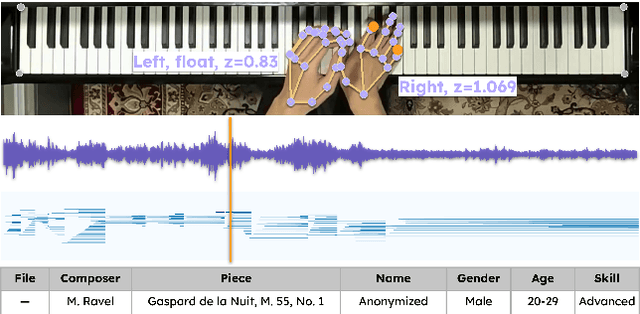


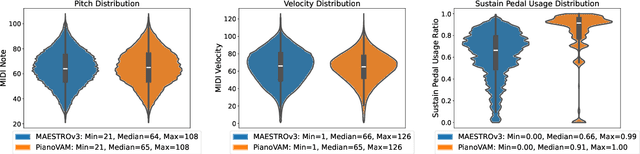
The multimodal nature of music performance has driven increasing interest in data beyond the audio domain within the music information retrieval (MIR) community. This paper introduces PianoVAM, a comprehensive piano performance dataset that includes videos, audio, MIDI, hand landmarks, fingering labels, and rich metadata. The dataset was recorded using a Disklavier piano, capturing audio and MIDI from amateur pianists during their daily practice sessions, alongside synchronized top-view videos in realistic and varied performance conditions. Hand landmarks and fingering labels were extracted using a pretrained hand pose estimation model and a semi-automated fingering annotation algorithm. We discuss the challenges encountered during data collection and the alignment process across different modalities. Additionally, we describe our fingering annotation method based on hand landmarks extracted from videos. Finally, we present benchmarking results for both audio-only and audio-visual piano transcription using the PianoVAM dataset and discuss additional potential applications.