 Add to Chrome
 Add to Firefox
 Add to Edge
Tipiano: Cascaded Piano Hand Motion Synthesis via Fingertip Priors
Apr 06, 2026
Synthesizing realistic piano hand motions requires both precision and naturalness. Physics-based methods achieve precision but produce stiff motions; data-driven models learn natural dynamics but struggle with positional accuracy. Piano motion exhibits a natural hierarchy: fingertip positions are nearly deterministic given piano geometry and fingering, while wrist and intermediate joints offer stylistic freedom. We present [OURS], a four-stage framework exploiting this hierarchy: (1) statistics-based fingertip positioning, (2) FiLM-conditioned trajectory refinement, (3) wrist estimation, and (4) STGCN-based pose synthesis. We contribute expert-annotated fingerings for the FürElise dataset (153 pieces, ~10 hours). Experiments demonstrate F1 = 0.910, substantially outperforming diffusion baselines (F1 = 0.121), with user study (N=41) confirming quality approaching motion capture. Expert evaluation by professional pianists (N=5) identified anticipatory motion as the key remaining gap, providing concrete directions for future improvement.

ARTLAS: Mapping Art-Technology Institutions via Conceptual Axes, Text Embeddings, and Unsupervised Clustering
Mar 28, 2026The global landscape of art-technology institutions, including festivals, biennials, research labs, conferences, and hybrid organizations, has grown increasingly diverse, yet systematic frameworks for analyzing their multidimensional characteristics remain scarce. This paper proposes ARTLAS, a computational methodology combining an eight-axis conceptual framework (Curatorial Philosophy, Territorial Relation, Knowledge Production Mode, Institutional Genealogy, Temporal Orientation, Ecosystem Function, Audience Relation, and Disciplinary Positioning) with a text-embedding and clustering pipeline to map 78 cultural-technology institutions into a unified analytical space. Each institution is characterized through qualitative descriptions along the eight axes, encoded via E5-large-v2 sentence embeddings and quantized through a word-level codebook into TF-IDF feature vectors. Dimensionality reduction using UMAP, followed by agglomerative clustering (Average linkage, k=10), yields a composite score of 0.825, a silhouette coefficient of 0.803, and a Calinski-Harabasz index of 11,196. Non-negative matrix factorization extracts ten latent topics, and a neighbor-cluster entropy measure identifies boundary institutions bridging multiple thematic communities. An interactive web-based visualization tool built with React enables stakeholders to explore institutional similarities, thematic profiles, and cross-disciplinary connections. The results reveal coherent groupings such as an art-science hub cluster anchored by ZKM and ArtScience Museum, an innovation and industry cluster including Ars Electronica, transmediale, and Sonar, an ACM academic community cluster comprising TEI, DIS, and NIME, and an electronic music and media cluster including CTM Festival, MUTEK, and Sonic Acts. This work contributes a replicable, data-driven approach to institutional ecology in the cultural-technology sector.
Two Web Toolkits for Multimodal Piano Performance Dataset Acquisition and Fingering Annotation
Sep 18, 2025Piano performance is a multimodal activity that intrinsically combines physical actions with the acoustic rendition. Despite growing research interest in analyzing the multimodal nature of piano performance, the laborious process of acquiring large-scale multimodal data remains a significant bottleneck, hindering further progress in this field. To overcome this barrier, we present an integrated web toolkit comprising two graphical user interfaces (GUIs): (i) PiaRec, which supports the synchronized acquisition of audio, video, MIDI, and performance metadata. (ii) ASDF, which enables the efficient annotation of performer fingering from the visual data. Collectively, this system can streamline the acquisition of multimodal piano performance datasets.
PianoVAM: A Multimodal Piano Performance Dataset
Sep 10, 2025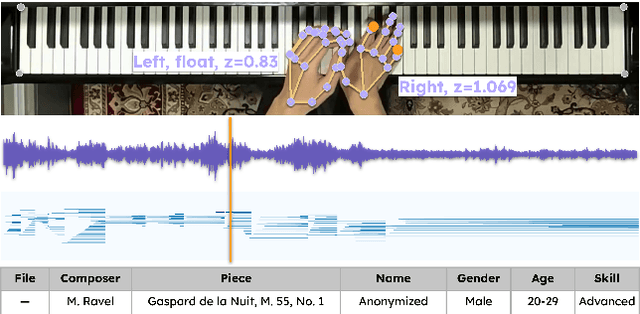


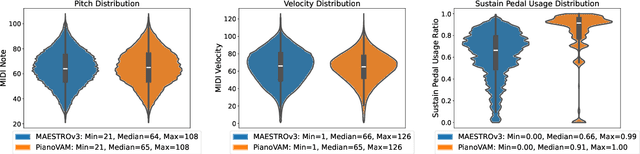
The multimodal nature of music performance has driven increasing interest in data beyond the audio domain within the music information retrieval (MIR) community. This paper introduces PianoVAM, a comprehensive piano performance dataset that includes videos, audio, MIDI, hand landmarks, fingering labels, and rich metadata. The dataset was recorded using a Disklavier piano, capturing audio and MIDI from amateur pianists during their daily practice sessions, alongside synchronized top-view videos in realistic and varied performance conditions. Hand landmarks and fingering labels were extracted using a pretrained hand pose estimation model and a semi-automated fingering annotation algorithm. We discuss the challenges encountered during data collection and the alignment process across different modalities. Additionally, we describe our fingering annotation method based on hand landmarks extracted from videos. Finally, we present benchmarking results for both audio-only and audio-visual piano transcription using the PianoVAM dataset and discuss additional potential applications.