 Add to Chrome
 Add to Firefox
 Add to Edge
Zero-Shot Generalization from Motion Demonstrations to New Tasks
Mar 16, 2026
Learning motion policies from expert demonstrations is an essential paradigm in modern robotics. While end-to-end models aim for broad generalization, they require large datasets and computationally heavy inference. Conversely, learning dynamical systems (DS) provides fast, reactive, and provably stable control from very few demonstrations. However, existing DS learning methods typically model isolated tasks and struggle to reuse demonstrations for novel behaviors. In this work, we formalize the problem of combining isolated demonstrations within a shared workspace to enable generalization to unseen tasks. The Gaussian Graph is introduced, which reinterprets spatial components of learned motion primitives as discrete vertices with connections to one another. This formulation allows us to bridge continuous control with discrete graph search. We propose two frameworks leveraging this graph: Stitching, for constructing time-invariant DSs, and Chaining, giving a sequence-based DS for complex motions while retaining convergence guarantees. Simulations and real-robot experiments show that these methods successfully generalize to new tasks where baseline methods fail.

Decoupling Task and Behavior: A Two-Stage Reward Curriculum in Reinforcement Learning for Robotics
Mar 05, 2026Deep Reinforcement Learning is a promising tool for robotic control, yet practical application is often hindered by the difficulty of designing effective reward functions. Real-world tasks typically require optimizing multiple objectives simultaneously, necessitating precise tuning of their weights to learn a policy with the desired characteristics. To address this, we propose a two-stage reward curriculum where we decouple task-specific objectives from behavioral terms. In our method, we first train the agent on a simplified task-only reward function to ensure effective exploration before introducing the full reward that includes auxiliary behavior-related terms such as energy efficiency. Further, we analyze various transition strategies and demonstrate that reusing samples between phases is critical for training stability. We validate our approach on the DeepMind Control Suite, ManiSkill3, and a mobile robot environment, modified to include auxiliary behavioral objectives. Our method proves to be simple yet effective, substantially outperforming baselines trained directly on the full reward while exhibiting higher robustness to specific reward weightings.
Sample-Efficient Curriculum Reinforcement Learning for Complex Reward Functions
Oct 22, 2024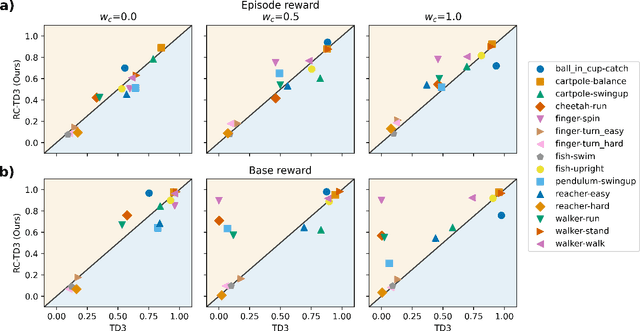
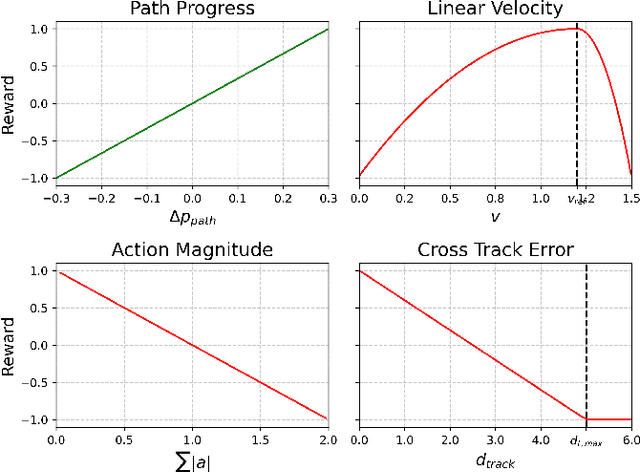
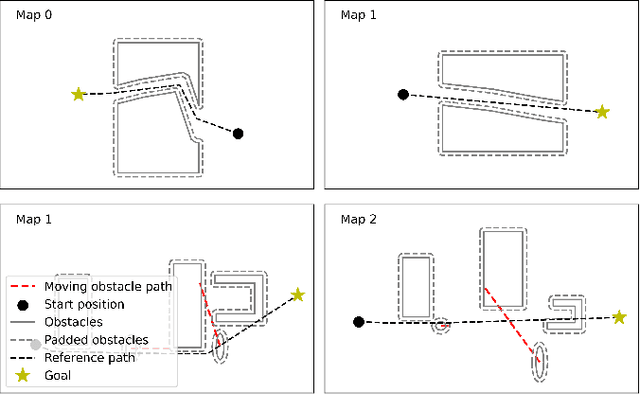
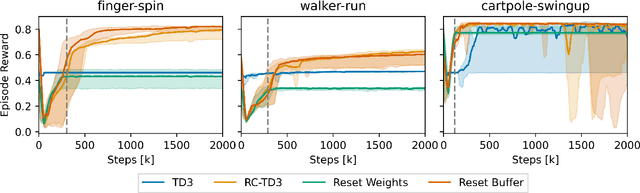
Reinforcement learning (RL) shows promise in control problems, but its practical application is often hindered by the complexity arising from intricate reward functions with constraints. While the reward hypothesis suggests these competing demands can be encapsulated in a single scalar reward function, designing such functions remains challenging. Building on existing work, we start by formulating preferences over trajectories to derive a realistic reward function that balances goal achievement with constraint satisfaction in the application of mobile robotics with dynamic obstacles. To mitigate reward exploitation in such complex settings, we propose a novel two-stage reward curriculum combined with a flexible replay buffer that adaptively samples experiences. Our approach first learns on a subset of rewards before transitioning to the full reward, allowing the agent to learn trade-offs between objectives and constraints. After transitioning to a new stage, our method continues to make use of past experiences by updating their rewards for sample-efficient learning. We investigate the efficacy of our approach in robot navigation tasks and demonstrate superior performance compared to baselines in terms of true reward achievement and task completion, underlining its effectiveness.