 Add to Chrome
 Add to Firefox
 Add to Edge
FrameDiT: Diffusion Transformer with Frame-Level Matrix Attention for Efficient Video Generation
Mar 10, 2026
High-fidelity video generation remains challenging for diffusion models due to the difficulty of modeling complex spatio-temporal dynamics efficiently. Recent video diffusion methods typically represent a video as a sequence of spatio-temporal tokens which can be modeled using Diffusion Transformers (DiTs). However, this approach faces a trade-off between the strong but expensive Full 3D Attention and the efficient but temporally limited Local Factorized Attention. To resolve this trade-off, we propose Matrix Attention, a frame-level temporal attention mechanism that processes an entire frame as a matrix and generates query, key, and value matrices via matrix-native operations. By attending across frames rather than tokens, Matrix Attention effectively preserves global spatio-temporal structure and adapts to significant motion. We build FrameDiT-G, a DiT architecture based on MatrixAttention, and further introduce FrameDiT-H, which integrates Matrix Attention with Local Factorized Attention to capture both large and small motion. Extensive experiments show that FrameDiT-H achieves state-of-the-art results across multiple video generation benchmarks, offering improved temporal coherence and video quality while maintaining efficiency comparable to Local Factorized Attention.

Learning Structural Causal Models from Ordering: Identifiable Flow Models
Dec 13, 2024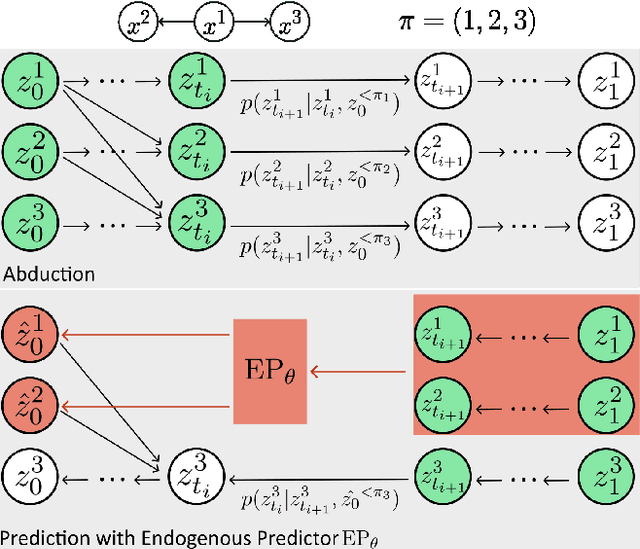
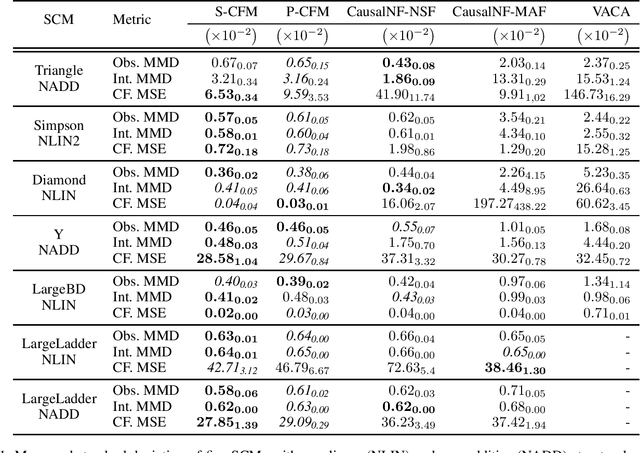
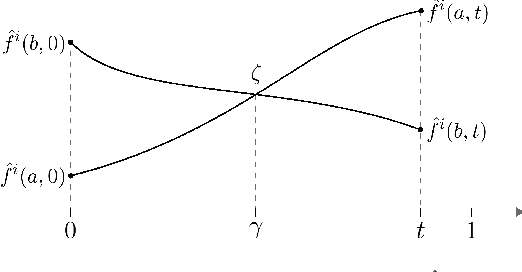
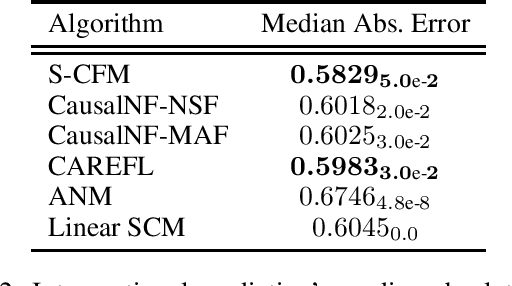
In this study, we address causal inference when only observational data and a valid causal ordering from the causal graph are available. We introduce a set of flow models that can recover component-wise, invertible transformation of exogenous variables. Our flow-based methods offer flexible model design while maintaining causal consistency regardless of the number of discretization steps. We propose design improvements that enable simultaneous learning of all causal mechanisms and reduce abduction and prediction complexity to linear O(n) relative to the number of layers, independent of the number of causal variables. Empirically, we demonstrate that our method outperforms previous state-of-the-art approaches and delivers consistent performance across a wide range of structural causal models in answering observational, interventional, and counterfactual questions. Additionally, our method achieves a significant reduction in computational time compared to existing diffusion-based techniques, making it practical for large structural causal models.