 Add to Chrome
 Add to Firefox
 Add to Edge
Measuring Intelligence Beyond Human Scale
Jul 08, 2026
How can we measure intelligence beyond human capability? Human-authored benchmarks saturate, and above human capability, examiners may not know which tasks are both hard and verifiable. We argue that this difficulty is inherent to absolute-scale evaluation and propose a new paradigm based on relative measurement in which models generate public challenges that separate other systems. Aggregating these outcomes yields an adversarial psychometric rating system that can scale with the systems being measured. We describe practical protocols that reduce incentives for private-information attacks, support judge-free adjudication, and naturally scale with agent capabilities. We instantiate the framework across verifiable and open-ended, non-verifiable domains, illustrating how model-generated evaluation can continue to measure systems beyond the human frontier.

GENSTRAT: Toward a Science of Strategic Reasoning in Large Language Models
May 22, 2026Large language models (LLMs) are increasingly deployed as economic agents in marketplaces, auctions, and bidding settings. Anticipating their behavior in any specific deployment is hard. Existing strategic-reasoning benchmarks evaluate models on fixed canonical games. These benchmarks may saturate as the frontier improves, and they do not allow evaluators to generalize with confidence from benchmark performance to the varied and messy strategic environments that actual deployments involve. We introduce GENSTRAT, which uses procedurally generated strategic environments to address these challenges. Concretely, we generate a distribution of two-player zero-sum imperfect-information card games. The generator can draw fresh games on demand, allowing for evergreen evaluation and resistance to contamination. We pair the game distribution with a capability-profile methodology that decomposes model competence across six axes (state space, temporal depth, information sensitivity, opponent modeling, risk, and brittleness). We also introduce a jaggedness measure of within-distribution smoothness that detects when a model's advantage jumps unpredictably between strategically similar games. We sample 50 benchmark games from a 2,000-game generated pool and evaluate nine frontier and open-weight LLMs in a head-to-head tournament with over 36,000 matches. Newer frontier-tier models score higher on average. Beyond that average, models with near-identical overall strength show qualitatively different capability profiles, and two of the top three leaderboard models (gpt-5 and claude) are noticeably more locally volatile than the third (gemini-3.1-pro), despite being close in overall strength. Together, the capability profile and the jaggedness measure give a deployment-relevant diagnostic that the overall ranking alone cannot provide.
Continuous Diffusion Transformers for Designing Synthetic Regulatory Elements
Mar 11, 2026We present a parameter-efficient Diffusion Transformer (DiT) for generating 200bp cell-type-specific regulatory DNA sequences. By replacing the U-Net backbone of DNA-Diffusion with a transformer denoiser equipped with a 2D CNN input encoder, our model matches the U-Net's best validation loss in 13 epochs (60$\times$ fewer) and converges 39% lower, while reducing memorization from 5.3% to 1.7% of generated sequences aligning to training data via BLAT. Ablations show the CNN encoder is essential: without it, validation loss increases 70% regardless of positional embedding choice. We further apply DDPO finetuning using Enformer as a reward model, achieving a 38$\times$ improvement in predicted regulatory activity. Cross-validation against DRAKES on an independent prediction task confirms that improvements reflect genuine regulatory signal rather than reward model overfitting.
Understanding the Limits of Vision Language Models Through the Lens of the Binding Problem
Oct 31, 2024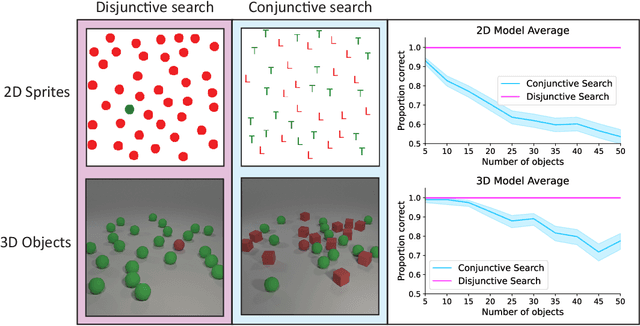
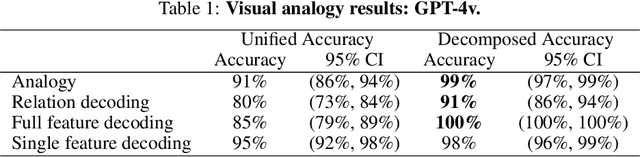
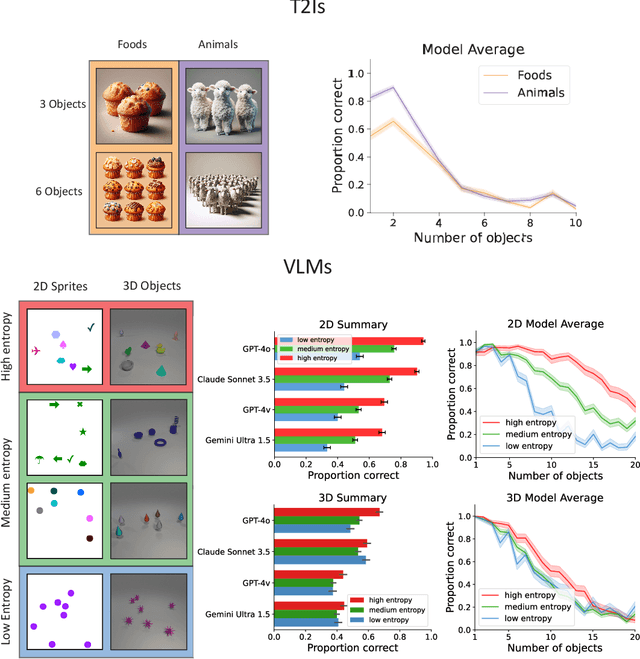
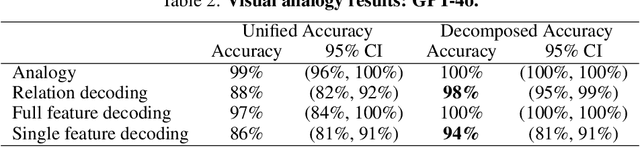
Recent work has documented striking heterogeneity in the performance of state-of-the-art vision language models (VLMs), including both multimodal language models and text-to-image models. These models are able to describe and generate a diverse array of complex, naturalistic images, yet they exhibit surprising failures on basic multi-object reasoning tasks -- such as counting, localization, and simple forms of visual analogy -- that humans perform with near perfect accuracy. To better understand this puzzling pattern of successes and failures, we turn to theoretical accounts of the binding problem in cognitive science and neuroscience, a fundamental problem that arises when a shared set of representational resources must be used to represent distinct entities (e.g., to represent multiple objects in an image), necessitating the use of serial processing to avoid interference. We find that many of the puzzling failures of state-of-the-art VLMs can be explained as arising due to the binding problem, and that these failure modes are strikingly similar to the limitations exhibited by rapid, feedforward processing in the human brain.