 Add to Chrome
 Add to Firefox
 Add to Edge
Scalable Contrastive Causal Discovery under Unknown Soft Interventions
Mar 03, 2026
Observational causal discovery is only identifiable up to the Markov equivalence class. While interventions can reduce this ambiguity, in practice interventions are often soft with multiple unknown targets. In many realistic scenarios, only a single intervention regime is observed. We propose a scalable causal discovery model for paired observational and interventional settings with shared underlying causal structure and unknown soft interventions. The model aggregates subset-level PDAGs and applies contrastive cross-regime orientation rules to construct a globally consistent maximal PDAG under Meek closure, enabling generalization to both in-distribution and out-of-distribution settings. Theoretically, we prove that our model is sound with respect to a restricted $Ψ$ equivalence class induced solely by the information available in the subset-restricted setting. We further show that the model asymptotically recovers the corresponding identifiable PDAG and can orient additional edges compared to non-contrastive subset-restricted methods. Experiments on synthetic data demonstrate improved causal structure recovery, generalization to unseen graphs with held-out causal mechanisms, and scalability to larger graphs, with ablations supporting the theoretical results.

CARFF: Conditional Auto-encoded Radiance Field for 3D Scene Forecasting
Jan 31, 2024

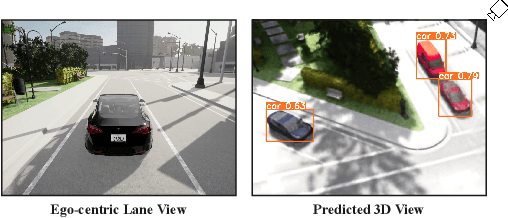
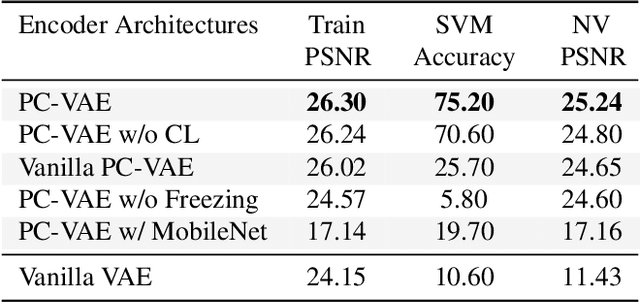
We propose CARFF: Conditional Auto-encoded Radiance Field for 3D Scene Forecasting, a method for predicting future 3D scenes given past observations, such as 2D ego-centric images. Our method maps an image to a distribution over plausible 3D latent scene configurations using a probabilistic encoder, and predicts the evolution of the hypothesized scenes through time. Our latent scene representation conditions a global Neural Radiance Field (NeRF) to represent a 3D scene model, which enables explainable predictions and straightforward downstream applications. This approach extends beyond previous neural rendering work by considering complex scenarios of uncertainty in environmental states and dynamics. We employ a two-stage training of Pose-Conditional-VAE and NeRF to learn 3D representations. Additionally, we auto-regressively predict latent scene representations as a partially observable Markov decision process, utilizing a mixture density network. We demonstrate the utility of our method in realistic scenarios using the CARLA driving simulator, where CARFF can be used to enable efficient trajectory and contingency planning in complex multi-agent autonomous driving scenarios involving visual occlusions.