 Add to Chrome
 Add to Firefox
 Add to Edge
AnalyticsGPT: An LLM Workflow for Scientometric Question Answering
Feb 10, 2026
This paper introduces AnalyticsGPT, an intuitive and efficient large language model (LLM)-powered workflow for scientometric question answering. This underrepresented downstream task addresses the subcategory of meta-scientific questions concerning the "science of science." When compared to traditional scientific question answering based on papers, the task poses unique challenges in the planning phase. Namely, the need for named-entity recognition of academic entities within questions and multi-faceted data retrieval involving scientometric indices, e.g. impact factors. Beyond their exceptional capacity for treating traditional natural language processing tasks, LLMs have shown great potential in more complex applications, such as task decomposition and planning and reasoning. In this paper, we explore the application of LLMs to scientometric question answering, and describe an end-to-end system implementing a sequential workflow with retrieval-augmented generation and agentic concepts. We also address the secondary task of effectively synthesizing the data into presentable and well-structured high-level analyses. As a database for retrieval-augmented generation, we leverage a proprietary research performance assessment platform. For evaluation, we consult experienced subject matter experts and leverage LLMs-as-judges. In doing so, we provide valuable insights on the efficacy of LLMs towards a niche downstream task. Our (skeleton) code and prompts are available at: https://github.com/lyvykhang/llm-agents-scientometric-qa/tree/acl.

Improving Article Classification with Edge-Heterogeneous Graph Neural Networks
Sep 20, 2023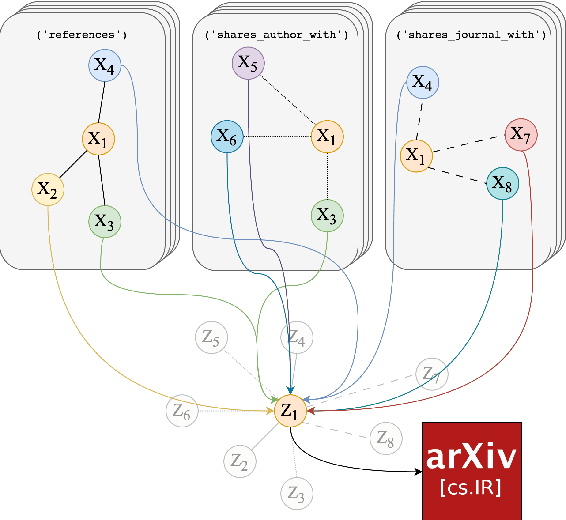
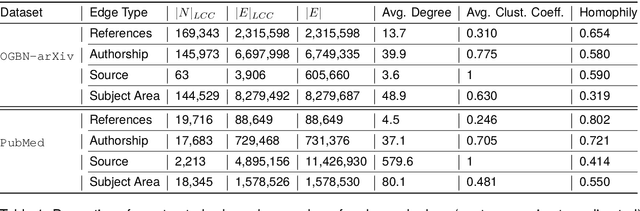
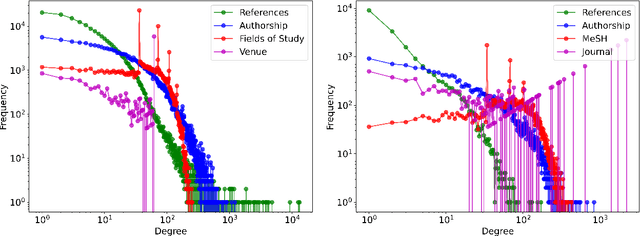
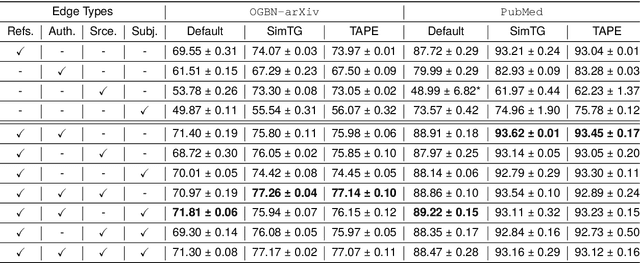
Classifying research output into context-specific label taxonomies is a challenging and relevant downstream task, given the volume of existing and newly published articles. We propose a method to enhance the performance of article classification by enriching simple Graph Neural Networks (GNN) pipelines with edge-heterogeneous graph representations. SciBERT is used for node feature generation to capture higher-order semantics within the articles' textual metadata. Fully supervised transductive node classification experiments are conducted on the Open Graph Benchmark (OGB) ogbn-arxiv dataset and the PubMed diabetes dataset, augmented with additional metadata from Microsoft Academic Graph (MAG) and PubMed Central, respectively. The results demonstrate that edge-heterogeneous graphs consistently improve the performance of all GNN models compared to the edge-homogeneous graphs. The transformed data enable simple and shallow GNN pipelines to achieve results on par with more complex architectures. On ogbn-arxiv, we achieve a top-15 result in the OGB competition with a 2-layer GCN (accuracy 74.61%), being the highest-scoring solution with sub-1 million parameters. On PubMed, we closely trail SOTA GNN architectures using a 2-layer GraphSAGE by including additional co-authorship edges in the graph (accuracy 89.88%). The implementation is available at: $\href{https://github.com/lyvykhang/edgehetero-nodeproppred}{\text{https://github.com/lyvykhang/edgehetero-nodeproppred}}$.