 Add to Chrome
 Add to Firefox
 Add to Edge
Detecting Data Contamination in Large Language Models
Apr 21, 2026
Large Language Models (LLMs) utilize large amounts of data for their training, some of which may come from copyrighted sources. Membership Inference Attacks (MIA) aim to detect those documents and whether they have been included in the training corpora of the LLMs. The black-box MIAs require a significant amount of data manipulation; therefore, their comparison is often challenging. We study state-of-the-art (SOTA) MIAs under the black-box assumptions and compare them to each other using a unified set of datasets to determine if any of them can reliably detect membership under SOTA LLMs. In addition, a new method, called the Familiarity Ranking, was developed to showcase a possible approach to black-box MIAs, thereby giving LLMs more freedom in their expression to understand their reasoning better. The results indicate that none of the methods are capable of reliably detecting membership in LLMs, as shown by an AUC-ROC of approximately 0.5 for all methods across several LLMs. The higher TPR and FPR for more advanced LLMs indicate higher reasoning and generalizing capabilities, showcasing the difficulty of detecting membership in LLMs using black-box MIAs.

Improving Article Classification with Edge-Heterogeneous Graph Neural Networks
Sep 20, 2023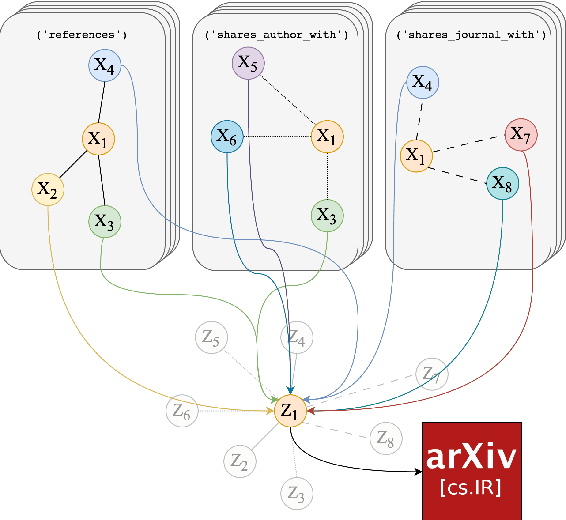
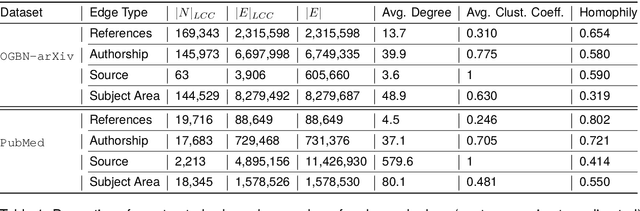
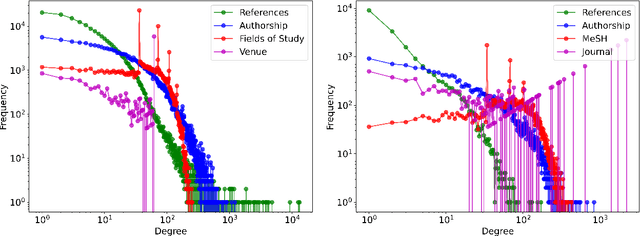
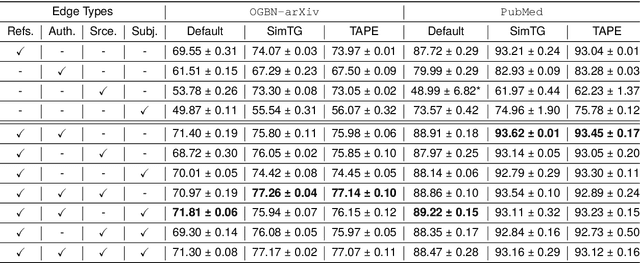
Classifying research output into context-specific label taxonomies is a challenging and relevant downstream task, given the volume of existing and newly published articles. We propose a method to enhance the performance of article classification by enriching simple Graph Neural Networks (GNN) pipelines with edge-heterogeneous graph representations. SciBERT is used for node feature generation to capture higher-order semantics within the articles' textual metadata. Fully supervised transductive node classification experiments are conducted on the Open Graph Benchmark (OGB) ogbn-arxiv dataset and the PubMed diabetes dataset, augmented with additional metadata from Microsoft Academic Graph (MAG) and PubMed Central, respectively. The results demonstrate that edge-heterogeneous graphs consistently improve the performance of all GNN models compared to the edge-homogeneous graphs. The transformed data enable simple and shallow GNN pipelines to achieve results on par with more complex architectures. On ogbn-arxiv, we achieve a top-15 result in the OGB competition with a 2-layer GCN (accuracy 74.61%), being the highest-scoring solution with sub-1 million parameters. On PubMed, we closely trail SOTA GNN architectures using a 2-layer GraphSAGE by including additional co-authorship edges in the graph (accuracy 89.88%). The implementation is available at: $\href{https://github.com/lyvykhang/edgehetero-nodeproppred}{\text{https://github.com/lyvykhang/edgehetero-nodeproppred}}$.