 Add to Chrome
 Add to Firefox
 Add to Edge
Stacked Intelligent Metasurfaces for Near-Field Multi-User Covert Communications
Mar 29, 2026
Reconfigurable intelligent surfaces have emerged as a cutting-edge technology for next-generation wireless communications that are capable of reconfiguring the wireless environment using a large number of cost-effective reflecting elements. However, a significant body of prior studies has focused on single-layer surfaces that lack the capability of significantly mitigating inter-user interference. Moreover, previous studies mostly consider far-field operation and neglect working in the near-field region. In this paper, we propose a stacked intelligent metasurfaces (SIM)-assisted near-field multi-user multiple-input-single-output covert communication system. More specifically, we have a multi-antenna base station that is assisted with a SIM to serve multiple single-antenna users in the presence of multiple single-antenna wardens. We aim at optimizing the beamfocusing vectors at the BS and SIM phase shift matrices to maximize the sum covert rate under maximum transmit power budget constraint, quality-of-service (QoS) constraint for all users, and covertness constraint. Since the formulated problem is highly non-convex due to the coupling between the variables, we adopt alternating optimization to tackle it, where we divide the problem into beamfocusing sub-problem and SIM phase shift sub-problem, which are solved alternately until convergence. We leverage successive convex approximation (SCA) to solve the two sub-problems. Additionally, we formulate the SIM phase shift sub-problem using the widely adopted projected gradient ascent (PGA) method for comparison purposes. The conducted simulations reveal that the SCA-based algorithm outperforms the existing PGA-based algorithm as well as other benchmarks in terms of the achieved sum covert rate, demonstrating its consistent performance and robustness under various system parameter configurations.

STAR-RIS-Aided Secure Communications:Analytical Insights and Performance Comparison
Dec 12, 2025Simultaneously transmitting and reflecting reconfigurable intelligent surfaces (STAR-RISs) have emerged as a promising technology for enabling full-space signal manipulation and enhancing wireless network coverage and capacity. In this article, we present a comprehensive analytical comparison of STAR-RIS-assisted systems with single-input single-output (SISO), conventional RISs, and decode-and-forward (DF) relaying schemes, including both half-duplex (HD) and full-duplex (FD) modes. Closed-form expressions are derived for the achievable secrecy rates of STAR-RIS-aided communications under both the absence and presence of eavesdroppers. Unlike most existing works, the direct source destination link is incorporated in all considered schemes, and optimal transmit power allocation is investigated for HD and FD-DF relaying. Furthermore, we provide the conditions under which STAR-RIS outperforms HD- and FD-DF relaying and quantify the minimum number of STAR-RIS elements required to achieve superior rates. The impacts of key system parameters including transmit power, number of elements, reflection-to-transmission power ratio, element-splitting factor, and deployment positions on both achievable and secrecy performance are investigated. The results reveal that STAR-RIS systems can achieve superior rates and secrecy rates compared to all benchmark schemes.
Positioning Using LEO Satellite Communication Signals Under Orbital Errors
Nov 08, 2025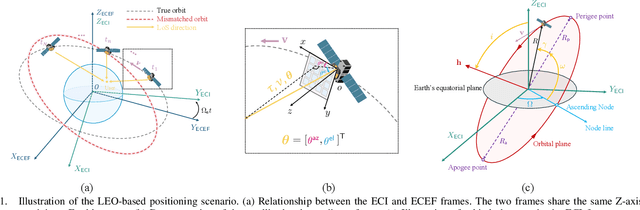
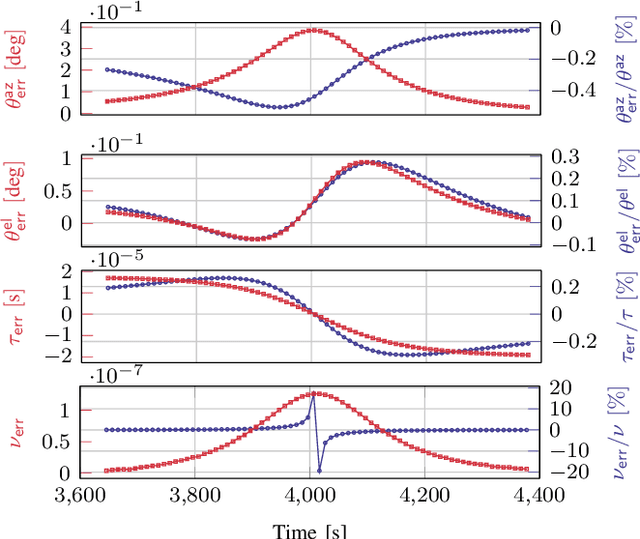
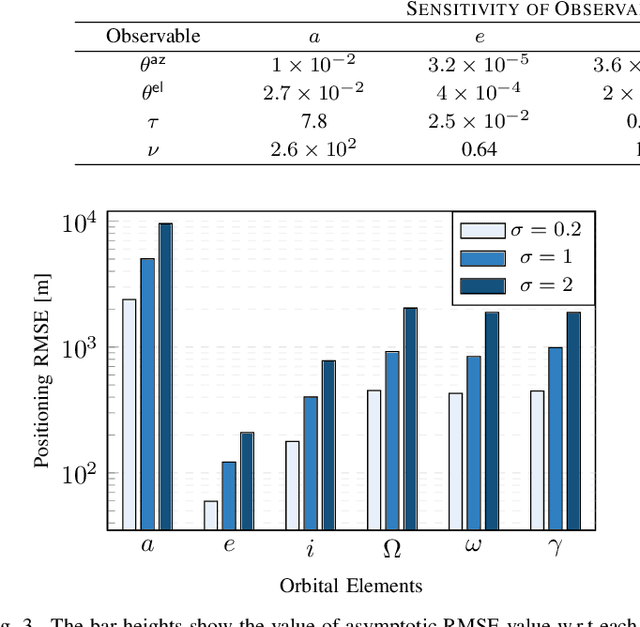
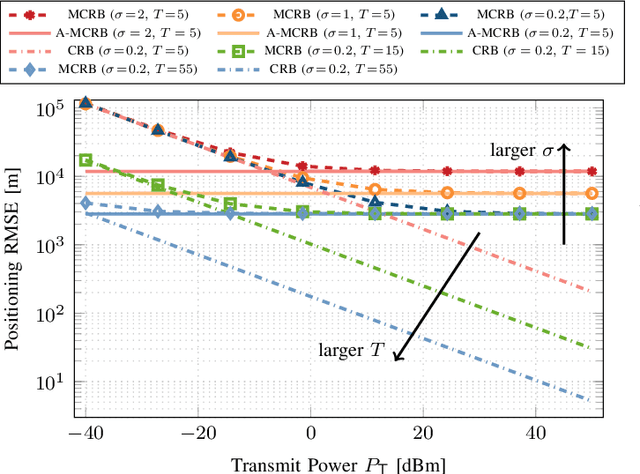
Low Earth orbit (LEO) satellites offer a promising alternative to global navigation satellite systems for precise positioning; however, their relatively low altitudes make them more susceptible to orbital perturbations, which in turn degrade positioning accuracy. In this work, we study LEO-based positioning under orbital errors within a signal-of-opportunity framework. First, we introduce a LEO orbit model that accounts for Earth's non-sphericity and derive a wideband communication model that captures fast- and slow-time Doppler effects and multipath propagation. Subsequently, we perform a misspecified Cramér-Rao bound (MCRB) analysis to evaluate the impact of orbital errors on positioning performance. Then, we propose a two-stage positioning method starting with a (i) MCRB-based weighted orbit calibration, followed by (ii) least-squares user positioning using the corrected orbit. The MCRB analysis indicates that orbital errors can induce kilometer-level position biases. Extensive simulations show that the proposed estimator can considerably enhance the positioning accuracy relative to the orbit-mismatched baseline, yielding errors on the order of a few meters.
Parametric Channel Estimation and Design for Active-RIS-Assisted Communications
Oct 26, 2025Reconfigurable Intelligent Surface (RIS) technology has emerged as a key enabler for future wireless communications. However, its potential is constrained by the difficulty of acquiring accurate user-to-RIS channel state information (CSI), due to the cascaded channel structure and the high pilot overhead of non-parametric methods. Unlike a passive RIS, where the reflected signal suffers from multiplicative path loss, an active RIS amplifies the signal, improving its practicality in real deployments. In this letter, we propose a parametric channel estimation method tailored for active RISs. The proposed approach integrates an active RIS model with an adaptive Maximum Likelihood Estimator (MLE) to recover the main channel parameters using a minimal number of pilots. To further enhance performance, an adaptive active RIS configuration strategy is employed, which refines the beam direction based on an initial user location estimate. Moreover, an orthogonal angle-pair codebook is used instead of the conventional Discrete Fourier Transform (DFT) codebook, significantly reducing the codebook size and ensuring reliable operation for both far-field and near-field users. Extensive simulations demonstrate that the proposed method achieves near-optimal performance with very few pilots compared to non-parametric approaches. Its performance is also benchmarked against that of a traditional passive RIS under the same total power budget to ensure fairness. Results show that active RIS yields higher spectral efficiency (SE) by eliminating the multiplicative fading inherent in passive RISs and allocating more resources to data transmission