 Add to Chrome
 Add to Firefox
 Add to Edge
GPU-Parallel Linearization Error Bounds for Real-Time Robust Optimal Control of Nonlinear and Neural Network Dynamics
Jul 01, 2026
This paper studies real-time robust optimal control for uncertain nonlinear systems, where linear time-varying (LTV) approximations make planning tractable but require sound linearization error bounds (LEBs) to guarantee robust constraint satisfaction. We develop tight, differentiable, GPU-parallel LEBs for LTV approximations of nonlinear and neural network (NN) dynamics. For analytic dynamics, we introduce path-based Hessian bounds that are tighter than standard interval methods. For NN dynamics, we derive certified LEBs using NN verifier-generated affine relaxations and local Jacobian corrections. We adapt a GPU-parallel system-level synthesis LTV-based robust control solver to be compatible with these LEBs by extending it to handle right-invertible disturbance matrices and non-zero-centered disturbance sets for tight zonotopic uncertainty propagation. Our method, GPUSLS-LEO, enables online optimization of robust feedback policies that account for linearization error, producing tight, formally verified reachable tubes. On complex nonlinear and NN dynamics up to 168 state dimensions, our method can compute robust control policies on the GPU at rates up to 67 Hz, reducing solve times and conservativeness relative to baselines while preserving formal guarantees and real-time performance.

Parallel Differentiable Reachability for Learning and Planning with Certified Neural Dynamics and Controllers
May 25, 2026Neural network (NN) dynamics models and control policies achieve strong performance in robotics, but providing sound guarantees under uncertainty remains difficult, especially for closed-loop NN systems. Existing reachability tools provide formal over-approximations, yet are often non-differentiable, overly conservative, or too slow for modern learning and online planning pipelines. To address this, we present a parallelizable, differentiable reachability framework in JAX for continuous- and discrete-time systems with analytical and NN-based dynamics and controllers. Our framework combines Taylor-model flowpipe construction with CROWN-style linear bound propagation through a unified representation that preserves affine dependencies while supporting GPU-batched computation and automatic differentiation. Building on this reachability primitive, we develop (i) a certified training method that encourages reachability-friendly dynamics models and controllers, and (ii) a reachability-aware sampling-based MPC scheme with gradient-based refinement. Experiments on non-prehensile manipulation and quadrotor tasks, including hardware and higher-dimensional evaluations (up to 72D), demonstrate practical online planning while maintaining certified reachable-set over-approximations under bounded uncertainty.
BaB-ND: Long-Horizon Motion Planning with Branch-and-Bound and Neural Dynamics
Dec 12, 2024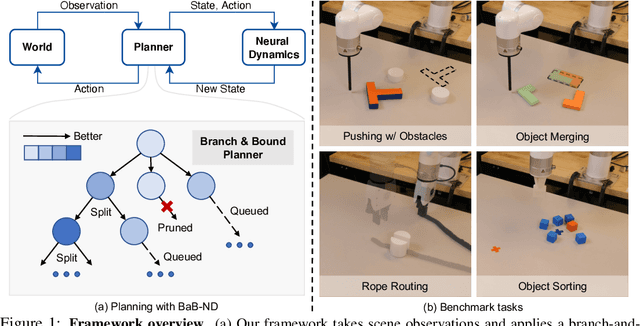
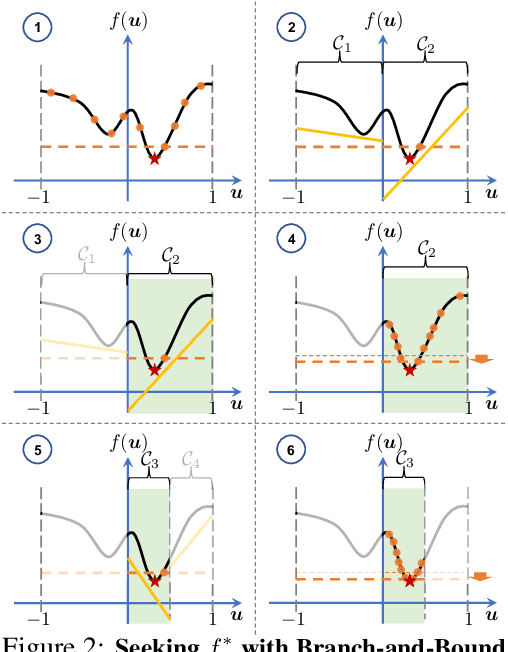
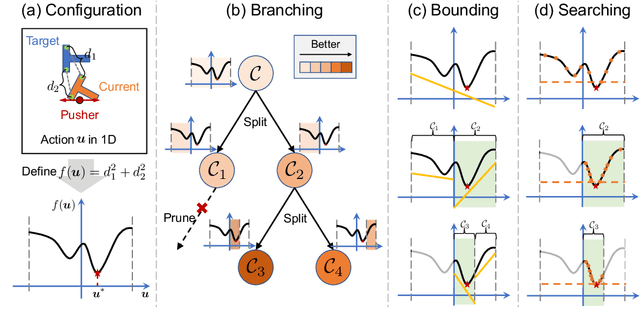
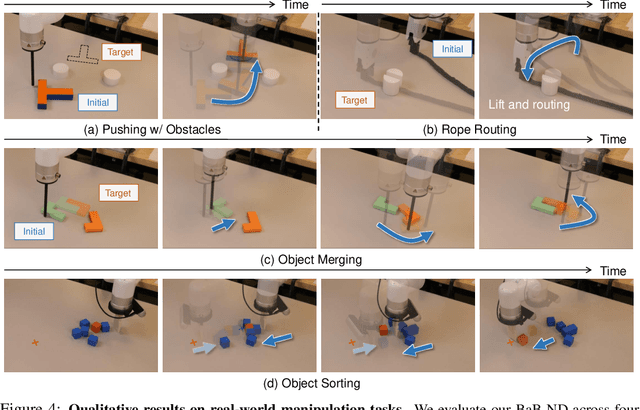
Neural-network-based dynamics models learned from observational data have shown strong predictive capabilities for scene dynamics in robotic manipulation tasks. However, their inherent non-linearity presents significant challenges for effective planning. Current planning methods, often dependent on extensive sampling or local gradient descent, struggle with long-horizon motion planning tasks involving complex contact events. In this paper, we present a GPU-accelerated branch-and-bound (BaB) framework for motion planning in manipulation tasks that require trajectory optimization over neural dynamics models. Our approach employs a specialized branching heuristics to divide the search space into subdomains, and applies a modified bound propagation method, inspired by the state-of-the-art neural network verifier alpha-beta-CROWN, to efficiently estimate objective bounds within these subdomains. The branching process guides planning effectively, while the bounding process strategically reduces the search space. Our framework achieves superior planning performance, generating high-quality state-action trajectories and surpassing existing methods in challenging, contact-rich manipulation tasks such as non-prehensile planar pushing with obstacles, object sorting, and rope routing in both simulated and real-world settings. Furthermore, our framework supports various neural network architectures, ranging from simple multilayer perceptrons to advanced graph neural dynamics models, and scales efficiently with different model sizes.