 Add to Chrome
 Add to Firefox
 Add to Edge
GPU-Parallel Linearization Error Bounds for Real-Time Robust Optimal Control of Nonlinear and Neural Network Dynamics
Jul 01, 2026
This paper studies real-time robust optimal control for uncertain nonlinear systems, where linear time-varying (LTV) approximations make planning tractable but require sound linearization error bounds (LEBs) to guarantee robust constraint satisfaction. We develop tight, differentiable, GPU-parallel LEBs for LTV approximations of nonlinear and neural network (NN) dynamics. For analytic dynamics, we introduce path-based Hessian bounds that are tighter than standard interval methods. For NN dynamics, we derive certified LEBs using NN verifier-generated affine relaxations and local Jacobian corrections. We adapt a GPU-parallel system-level synthesis LTV-based robust control solver to be compatible with these LEBs by extending it to handle right-invertible disturbance matrices and non-zero-centered disturbance sets for tight zonotopic uncertainty propagation. Our method, GPUSLS-LEO, enables online optimization of robust feedback policies that account for linearization error, producing tight, formally verified reachable tubes. On complex nonlinear and NN dynamics up to 168 state dimensions, our method can compute robust control policies on the GPU at rates up to 67 Hz, reducing solve times and conservativeness relative to baselines while preserving formal guarantees and real-time performance.

Pixels to Proofs: Probabilistically-Safe Latent World Model Control via Parallel Conformal Robust MPC
Jun 14, 2026We present SLS^2, a framework for safe feedback motion planning from pixels using robust model predictive control (MPC) in learned latent world models. Our approach trains an action-conditioned joint-embedding world model with compact Markovian latent states, enabling efficient gradient-based trajectory optimization through learned latent dynamics. To enforce safety for the true system despite imperfect latent predictions, we inform a GPU-accelerated system level synthesis (SLS) robust MPC scheme with conformal prediction to obtain calibrated latent error bounds and robust latent-space constraint sets. We further learn and conformalize a latent constraint checker, allowing the SLS planner to impose probabilistic safety constraints during closed-loop execution. We evaluate our method on vision-based control tasks, where it improves both goal-reaching performance and safety over latent world-model and safe-planning baselines.
Safety Beyond the Training Data: Robust Out-of-Distribution MPC via Conformalized System Level Synthesis
Feb 12, 2026We present a novel framework for robust out-of-distribution planning and control using conformal prediction (CP) and system level synthesis (SLS), addressing the challenge of ensuring safety and robustness when using learned dynamics models beyond the training data distribution. We first derive high-confidence model error bounds using weighted CP with a learned, state-control-dependent covariance model. These bounds are integrated into an SLS-based robust nonlinear model predictive control (MPC) formulation, which performs constraint tightening over the prediction horizon via volume-optimized forward reachable sets. We provide theoretical guarantees on coverage and robustness under distributional drift, and analyze the impact of data density and trajectory tube size on prediction coverage. Empirically, we demonstrate our method on nonlinear systems of increasing complexity, including a 4D car and a {12D} quadcopter, improving safety and robustness compared to fixed-bound and non-robust baselines, especially outside of the data distribution.
A Generic Framework for Conformal Fairness
May 22, 2025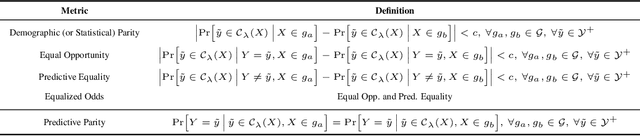
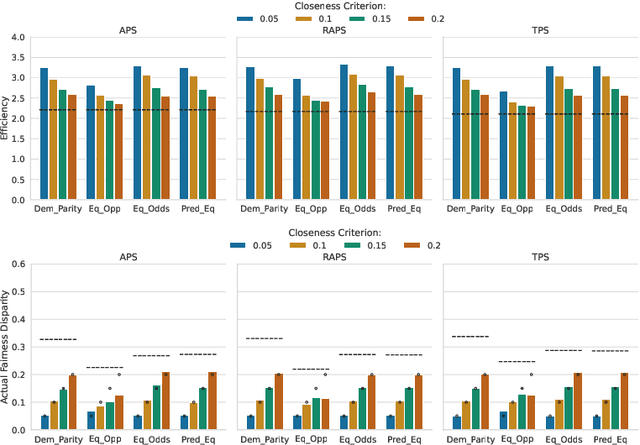
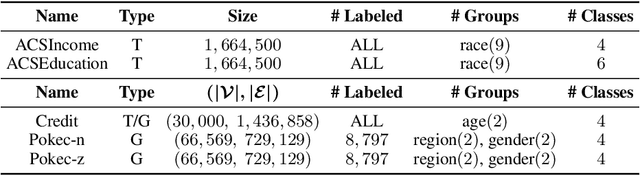
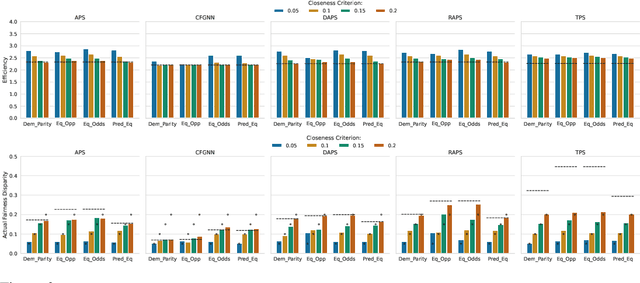
Conformal Prediction (CP) is a popular method for uncertainty quantification with machine learning models. While conformal prediction provides probabilistic guarantees regarding the coverage of the true label, these guarantees are agnostic to the presence of sensitive attributes within the dataset. In this work, we formalize \textit{Conformal Fairness}, a notion of fairness using conformal predictors, and provide a theoretically well-founded algorithm and associated framework to control for the gaps in coverage between different sensitive groups. Our framework leverages the exchangeability assumption (implicit to CP) rather than the typical IID assumption, allowing us to apply the notion of Conformal Fairness to data types and tasks that are not IID, such as graph data. Experiments were conducted on graph and tabular datasets to demonstrate that the algorithm can control fairness-related gaps in addition to coverage aligned with theoretical expectations.
Graph Sparsification for Enhanced Conformal Prediction in Graph Neural Networks
Oct 28, 2024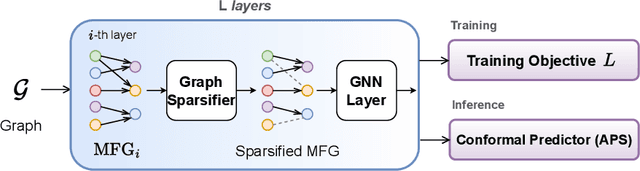
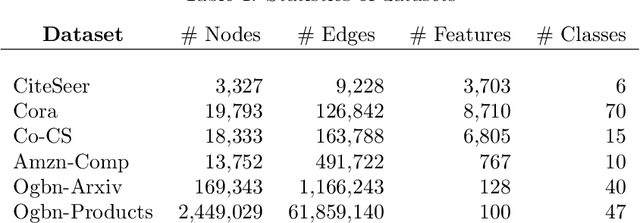
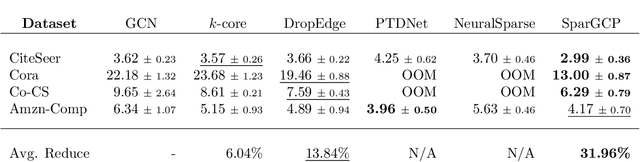

Conformal Prediction is a robust framework that ensures reliable coverage across machine learning tasks. Although recent studies have applied conformal prediction to graph neural networks, they have largely emphasized post-hoc prediction set generation. Improving conformal prediction during the training stage remains unaddressed. In this work, we tackle this challenge from a denoising perspective by introducing SparGCP, which incorporates graph sparsification and a conformal prediction-specific objective into GNN training. SparGCP employs a parameterized graph sparsification module to filter out task-irrelevant edges, thereby improving conformal prediction efficiency. Extensive experiments on real-world graph datasets demonstrate that SparGCP outperforms existing methods, reducing prediction set sizes by an average of 32\% and scaling seamlessly to large networks on commodity GPUs.
Benchmarking Graph Conformal Prediction: Empirical Analysis, Scalability, and Theoretical Insights
Sep 26, 2024

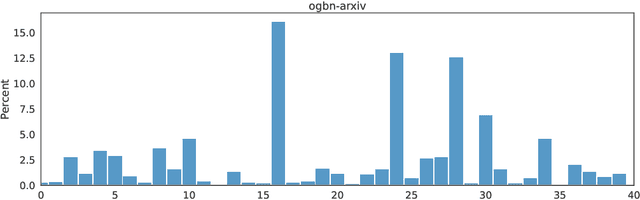
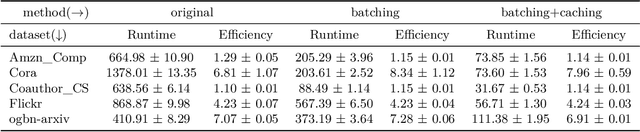
Conformal prediction has become increasingly popular for quantifying the uncertainty associated with machine learning models. Recent work in graph uncertainty quantification has built upon this approach for conformal graph prediction. The nascent nature of these explorations has led to conflicting choices for implementations, baselines, and method evaluation. In this work, we analyze the design choices made in the literature and discuss the tradeoffs associated with existing methods. Building on the existing implementations for existing methods, we introduce techniques to scale existing methods to large-scale graph datasets without sacrificing performance. Our theoretical and empirical results justify our recommendations for future scholarship in graph conformal prediction.