 Add to Chrome
 Add to Firefox
 Add to Edge
FedPDPO: Federated Personalized Direct Preference Optimization for Large Language Model Alignment
Mar 20, 2026
Aligning large language models (LLMs) with human preferences in federated learning (FL) is challenging due to decentralized, privacy-sensitive, and highly non-IID preference data. Direct Preference Optimization (DPO) offers an efficient alternative to reinforcement learning with human feedback (RLHF), but its direct application in FL suffers from severe performance degradation under non-IID data and limited generalization of implicit rewards. To bridge this gap, we propose FedPDPO (Federated Personalized Direct Preference Optimization), a personalized federated framework for preference alignment of LLMs. It adopts a parameter-efficient fine-tuning architecture where each client maintains a frozen pretrained LLM backbone augmented with a Low-Rank Adaptation (LoRA) adapter, enabling communication-efficient aggregation. To address non-IID heterogeneity, we devise (1) the globally shared LoRA adapter with the personalized client-specific LLM head. Moreover, we introduce (2) a personalized DPO training strategy with a client-specific explicit reward head to complement implicit rewards and further alleviate non-IID heterogeneity, and (3) a bottleneck adapter to balance global and local features. We provide theoretical analysis establishing the probabilistic foundation and soundness. Extensive experiments on multiple preference datasets demonstrate state-of-the-art performance, achieving up to 4.80% average accuracy improvements in federated intra-domain and cross-domain settings.

FedAdamW: A Communication-Efficient Optimizer with Convergence and Generalization Guarantees for Federated Large Models
Oct 31, 2025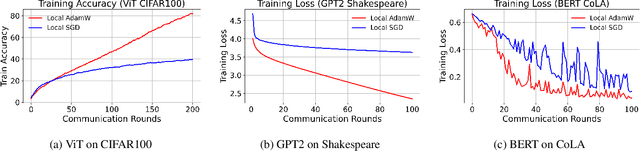
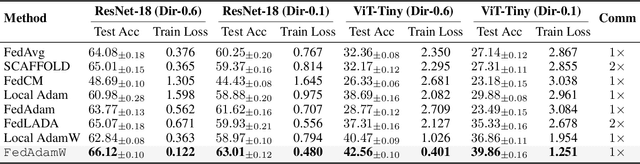
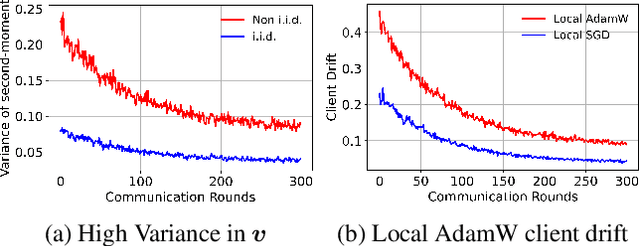
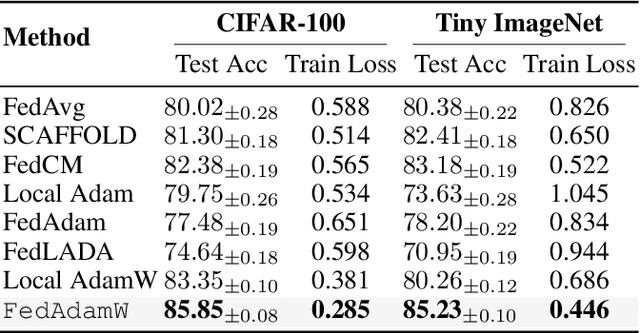
AdamW has become one of the most effective optimizers for training large-scale models. We have also observed its effectiveness in the context of federated learning (FL). However, directly applying AdamW in federated learning settings poses significant challenges: (1) due to data heterogeneity, AdamW often yields high variance in the second-moment estimate $\boldsymbol{v}$; (2) the local overfitting of AdamW may cause client drift; and (3) Reinitializing moment estimates ($\boldsymbol{v}$, $\boldsymbol{m}$) at each round slows down convergence. To address these challenges, we propose the first \underline{Fed}erated \underline{AdamW} algorithm, called \texttt{FedAdamW}, for training and fine-tuning various large models. \texttt{FedAdamW} aligns local updates with the global update using both a \textbf{local correction mechanism} and decoupled weight decay to mitigate local overfitting. \texttt{FedAdamW} efficiently aggregates the \texttt{mean} of the second-moment estimates to reduce their variance and reinitialize them. Theoretically, we prove that \texttt{FedAdamW} achieves a linear speedup convergence rate of $\mathcal{O}(\sqrt{(L \Delta \sigma_l^2)/(S K R \epsilon^2)}+(L \Delta)/R)$ without \textbf{heterogeneity assumption}, where $S$ is the number of participating clients per round, $K$ is the number of local iterations, and $R$ is the total number of communication rounds. We also employ PAC-Bayesian generalization analysis to explain the effectiveness of decoupled weight decay in local training. Empirically, we validate the effectiveness of \texttt{FedAdamW} on language and vision Transformer models. Compared to several baselines, \texttt{FedAdamW} significantly reduces communication rounds and improves test accuracy. The code is available in https://github.com/junkangLiu0/FedAdamW.