 Add to Chrome
 Add to Firefox
 Add to Edge
TileMix: Tile-Centric Mixed-Precision Attention for LLM Inference Acceleration
Aug 18, 2026
Long-context prefill in large language models (LLMs) incurs substantial computation and memory traffic because dense self-attention computes quadratic query-key scores. Existing methods either use a uniform low-precision path or select token interactions, leaving spatial precision routing over hardware-aligned score tiles outside fused dense attention. We introduce TileMix, a tile-centric precision-routing kernel that makes numerical precision an executable spatial decision over score-tile groups within fused dense attention. TileMix partitions the attention matrix into hardware-aligned score tiles, packs routing decisions into compact bitmasks, and dispatches each tile group through FP16 or INT8 score computation while both paths update a shared online-softmax state. Scalable precision grouping lets each routing bit govern multiple adjacent key tiles, preserving hardware-aligned compute tiles and compact metadata at long contexts. By routing all legal tile groups, TileMix preserves dense token connectivity, requires no training, and supports grouped-query attention, variable-length batches, and INT8 key/value caches. Across LongEval, LV-Eval, and A100 prefill benchmarks on LLaMA, Qwen, and Vicuna, TileMix recovers long-context quality lost under uniform INT8 and improves prefill throughput over FP16, yielding a controllable accuracy-efficiency frontier across model families. The implementation is available at https://github.com/HanzhiZhang-Ulrica/TileMix.

Initial Risk Probing and Feasibility Testing of Glow: a Generative AI-Powered Dialectical Behavior Therapy Skills Coach for Substance Use Recovery and HIV Prevention
Feb 08, 2026Background: HIV and substance use represent interacting epidemics with shared psychological drivers - impulsivity and maladaptive coping. Dialectical behavior therapy (DBT) targets these mechanisms but faces scalability challenges. Generative artificial intelligence (GenAI) offers potential for delivering personalized DBT coaching at scale, yet rapid development has outpaced safety infrastructure. Methods: We developed Glow, a GenAI-powered DBT skills coach delivering chain and solution analysis for individuals at risk for HIV and substance use. In partnership with a Los Angeles community health organization, we conducted usability testing with clinical staff (n=6) and individuals with lived experience (n=28). Using the Helpful, Honest, and Harmless (HHH) framework, we employed user-driven adversarial testing wherein participants identified target behaviors and generated contextually realistic risk probes. We evaluated safety performance across 37 risk probe interactions. Results: Glow appropriately handled 73% of risk probes, but performance varied by agent. The solution analysis agent demonstrated 90% appropriate handling versus 44% for the chain analysis agent. Safety failures clustered around encouraging substance use and normalizing harmful behaviors. The chain analysis agent fell into an "empathy trap," providing validation that reinforced maladaptive beliefs. Additionally, 27 instances of DBT skill misinformation were identified. Conclusions: This study provides the first systematic safety evaluation of GenAI-delivered DBT coaching for HIV and substance use risk reduction. Findings reveal vulnerabilities requiring mitigation before clinical trials. The HHH framework and user-driven adversarial testing offer replicable methods for evaluating GenAI mental health interventions.
A Survey on Data Quality Dimensions and Tools for Machine Learning
Jun 28, 2024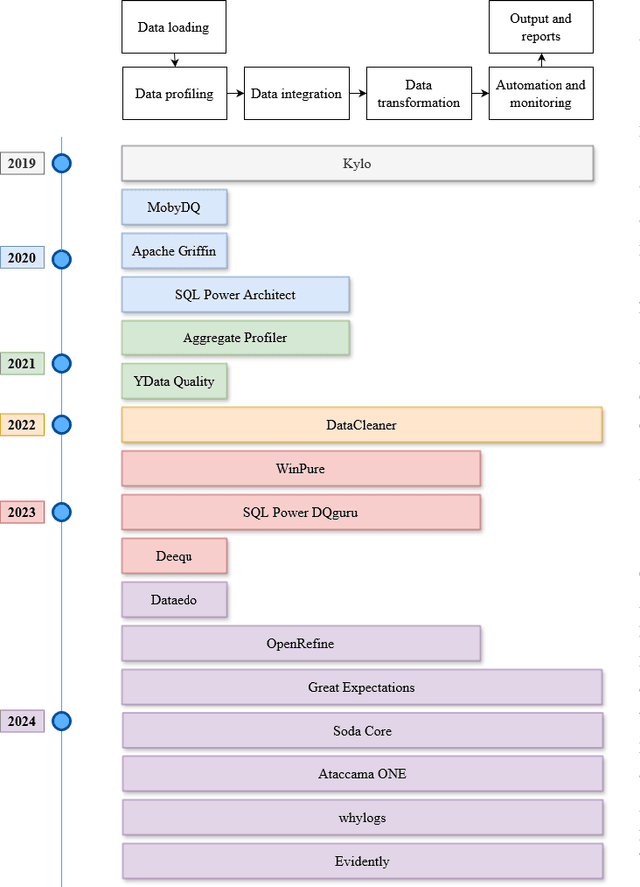
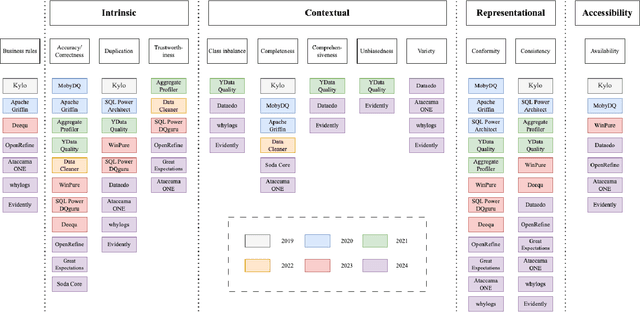
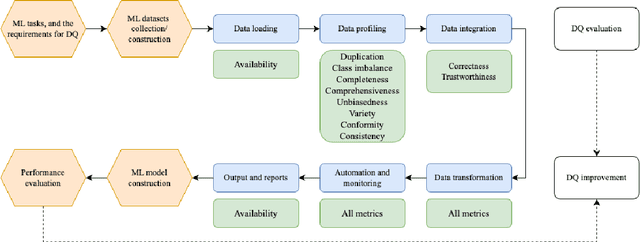
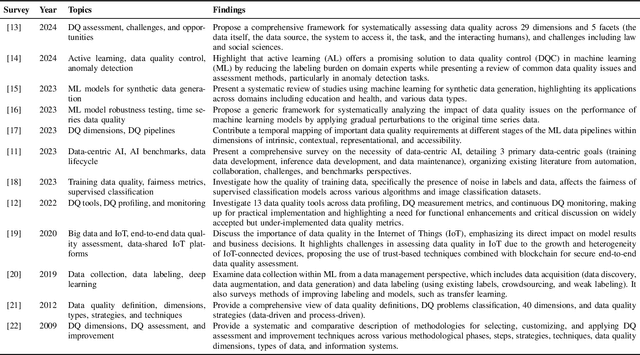
Machine learning (ML) technologies have become substantial in practically all aspects of our society, and data quality (DQ) is critical for the performance, fairness, robustness, safety, and scalability of ML models. With the large and complex data in data-centric AI, traditional methods like exploratory data analysis (EDA) and cross-validation (CV) face challenges, highlighting the importance of mastering DQ tools. In this survey, we review 17 DQ evaluation and improvement tools in the last 5 years. By introducing the DQ dimensions, metrics, and main functions embedded in these tools, we compare their strengths and limitations and propose a roadmap for developing open-source DQ tools for ML. Based on the discussions on the challenges and emerging trends, we further highlight the potential applications of large language models (LLMs) and generative AI in DQ evaluation and improvement for ML. We believe this comprehensive survey can enhance understanding of DQ in ML and could drive progress in data-centric AI. A complete list of the literature investigated in this survey is available on GitHub at: https://github.com/haihua0913/awesome-dq4ml.