 Add to Chrome
 Add to Firefox
 Add to Edge
ARA: Agentic Reproducibility Assessment For Scalable Support Of Scientific Peer-Review
May 04, 2026
Scientific peer review increasingly struggles to assess reproducibility at the scale and complexity of modern research output. Evaluating reproducibility requires reconstructing experimental dependencies, methodological choices, data flows, and result-generating procedures, which often exceeds what human reviewers can provide. Agentic Reproducibility Assessment (ARA) formalizes reproducibility assessment as a structured reasoning task over scientific documents. Given a paper, ARA extracts a directed workflow graph linking sources, methods, experiments, and outputs, then evaluates its reconstructability using structural and content-based scores for reproducibility assessments. Experiments on 213 ReScience C articles - the largest cross-domain benchmark of human-validated computational reproducibility studies considered to date - demonstrate ARA's generalizability and consistent workflow reconstruction and assessment across LLMs, model temperatures, and scientific domains. ARA achieves ~61% accuracy on three benchmarks, and the highest accuracy reported on ReproBench (60.71% vs. 36.84%) and GoldStandardDB (61.68% vs. 43.56%), highlighting its potential to complement human review at scale and enabling next-generation peer review. Code and Data available: https://github.com/AndresLaverdeMarin/agentic_reproducibility_assessment.

Karma Mechanisms for Decentralised, Cooperative Multi Agent Path Finding
Apr 09, 2026Multi-Agent Path Finding (MAPF) is a fundamental coordination problem in large-scale robotic and cyber-physical systems, where multiple agents must compute conflict-free trajectories with limited computational and communication resources. While centralised optimal solvers provide guarantees on solution optimality, their exponential computational complexity limits scalability to large-scale systems and real-time applicability. Existing decentralised heuristics are faster, but result in suboptimal outcomes and high cost disparities. This paper proposes a decentralised coordination framework for cooperative MAPF based on Karma mechanisms - artificial, non-tradeable credits that account for agents' past cooperative behaviour and regulate future conflict resolution decisions. The approach formulates conflict resolution as a bilateral negotiation process that enables agents to resolve conflicts through pairwise replanning while promoting long-term fairness under limited communication and without global priority structures. The mechanism is evaluated in a lifelong robotic warehouse multi-agent pickup-and-delivery scenario with kinematic orientation constraints. The results highlight that the Karma mechanism balances replanning effort across agents, reducing disparity in service times without sacrificing overall efficiency. Code: https://github.com/DerKevinRiehl/karma_dmapf
Great GATsBi: Hybrid, Multimodal, Trajectory Forecasting for Bicycles using Anticipation Mechanism
Aug 20, 2025Accurate prediction of road user movement is increasingly required by many applications ranging from advanced driver assistance systems to autonomous driving, and especially crucial for road safety. Even though most traffic accident fatalities account to bicycles, they have received little attention, as previous work focused mainly on pedestrians and motorized vehicles. In this work, we present the Great GATsBi, a domain-knowledge-based, hybrid, multimodal trajectory prediction framework for bicycles. The model incorporates both physics-based modeling (inspired by motorized vehicles) and social-based modeling (inspired by pedestrian movements) to explicitly account for the dual nature of bicycle movement. The social interactions are modeled with a graph attention network, and include decayed historical, but also anticipated, future trajectory data of a bicycles neighborhood, following recent insights from psychological and social studies. The results indicate that the proposed ensemble of physics models -- performing well in the short-term predictions -- and social models -- performing well in the long-term predictions -- exceeds state-of-the-art performance. We also conducted a controlled mass-cycling experiment to demonstrate the framework's performance when forecasting bicycle trajectories and modeling social interactions with road users.
Hierarchical confusion matrix for classification performance evaluation
Jun 15, 2023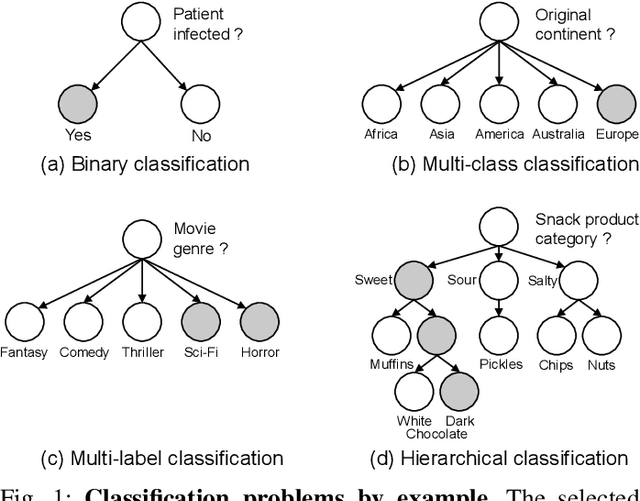
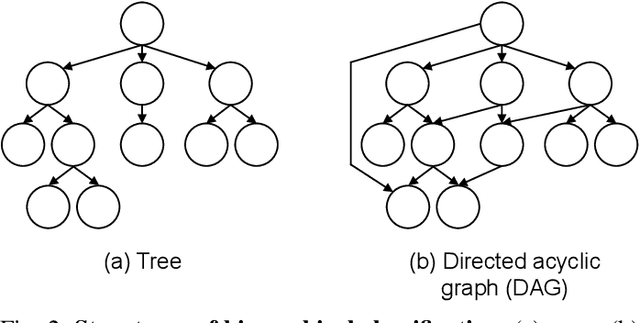
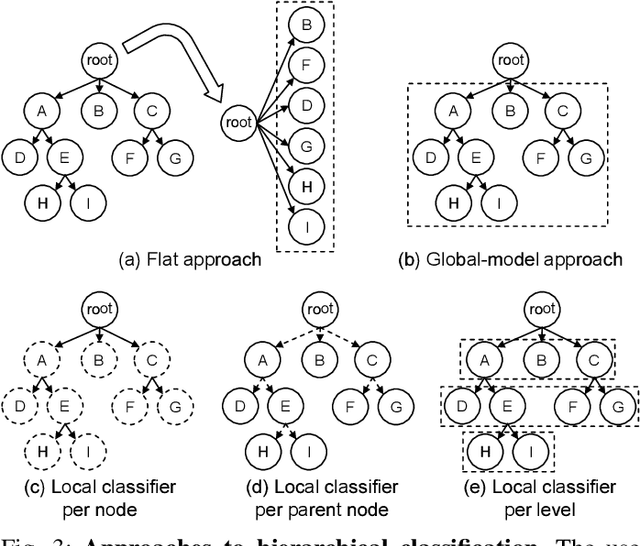
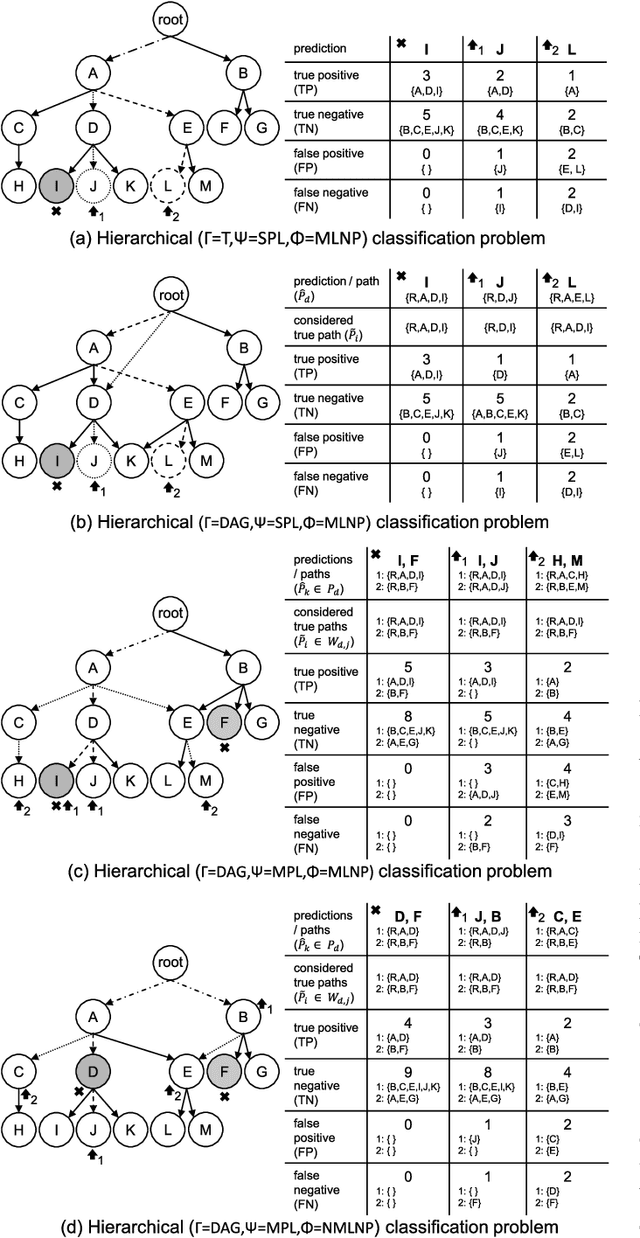
In this work we propose a novel concept of a hierarchical confusion matrix, opening the door for popular confusion matrix based (flat) evaluation measures from binary classification problems, while considering the peculiarities of hierarchical classification problems. We develop the concept to a generalized form and prove its applicability to all types of hierarchical classification problems including directed acyclic graphs, multi path labelling, and non mandatory leaf node prediction. Finally, we use measures based on the novel confusion matrix to evaluate models within a benchmark for three real world hierarchical classification applications and compare the results to established evaluation measures. The results outline the reasonability of this approach and its usefulness to evaluate hierarchical classification problems. The implementation of hierarchical confusion matrix is available on GitHub.