 Add to Chrome
 Add to Firefox
 Add to Edge
MAPLE: Modality-Aware Post-training and Learning Ecosystem
Feb 12, 2026
Multimodal language models now integrate text, audio, and video for unified reasoning. Yet existing RL post-training pipelines treat all input signals as equally relevant, ignoring which modalities each task actually requires. This modality-blind training inflates policy-gradient variance, slows convergence, and degrades robustness to real-world distribution shifts where signals may be missing, added, or reweighted. We introduce MAPLE, a complete modality-aware post-training and learning ecosystem comprising: (1) MAPLE-bench, the first benchmark explicitly annotating minimal signal combinations required per task; (2) MAPO, a modality-aware policy optimization framework that stratifies batches by modality requirement to reduce gradient variance from heterogeneous group advantages; (3) Adaptive weighting and curriculum scheduling that balances and prioritizes harder signal combinations. Systematic analysis across loss aggregation, clipping, sampling, and curriculum design establishes MAPO's optimal training strategy. Adaptive weighting and curriculum focused learning further boost performance across signal combinations. MAPLE narrows uni/multi-modal accuracy gaps by 30.24%, converges 3.18x faster, and maintains stability across all modality combinations under realistic reduced signal access. MAPLE constitutes a complete recipe for deployment-ready multimodal RL post-training.

PrismAvatar: Real-time animated 3D neural head avatars on edge devices
Feb 10, 2025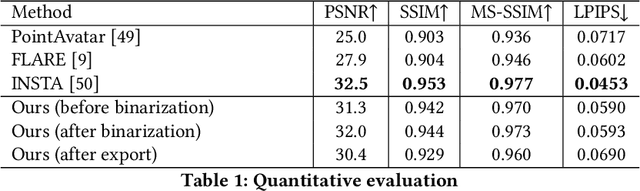
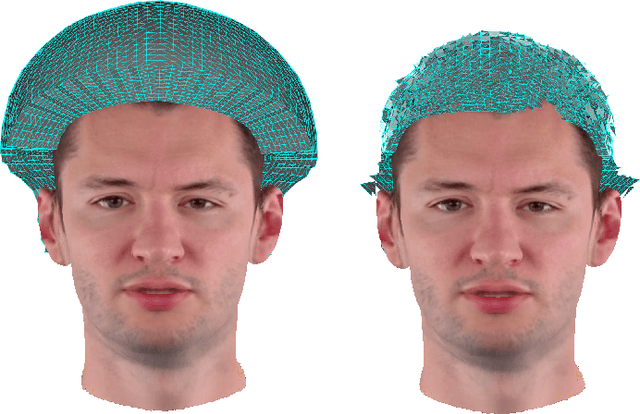
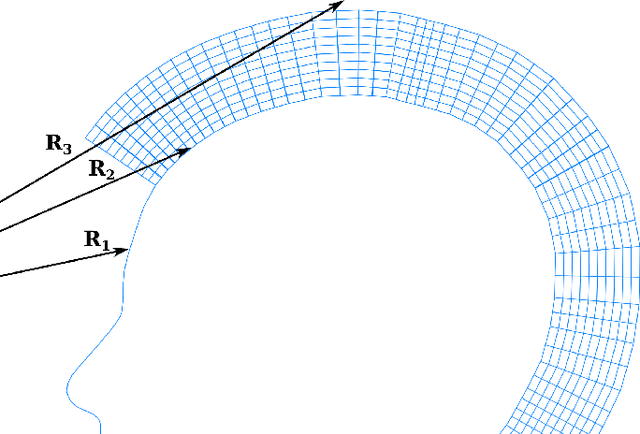
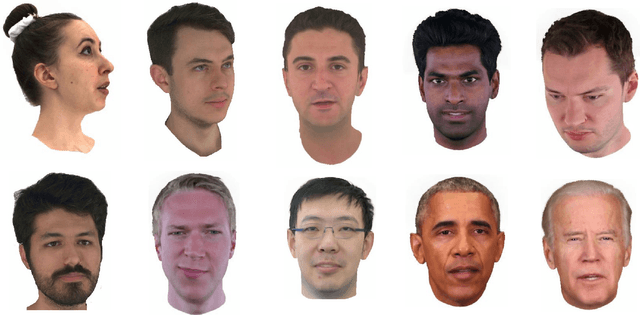
We present PrismAvatar: a 3D head avatar model which is designed specifically to enable real-time animation and rendering on resource-constrained edge devices, while still enjoying the benefits of neural volumetric rendering at training time. By integrating a rigged prism lattice with a 3D morphable head model, we use a hybrid rendering model to simultaneously reconstruct a mesh-based head and a deformable NeRF model for regions not represented by the 3DMM. We then distill the deformable NeRF into a rigged mesh and neural textures, which can be animated and rendered efficiently within the constraints of the traditional triangle rendering pipeline. In addition to running at 60 fps with low memory usage on mobile devices, we find that our trained models have comparable quality to state-of-the-art 3D avatar models on desktop devices.
A Diffusion-based Method for Multi-turn Compositional Image Generation
Apr 05, 2023Multi-turn compositional image generation (M-CIG) is a challenging task that aims to iteratively manipulate a reference image given a modification text. While most of the existing methods for M-CIG are based on generative adversarial networks (GANs), recent advances in image generation have demonstrated the superiority of diffusion models over GANs. In this paper, we propose a diffusion-based method for M-CIG named conditional denoising diffusion with image compositional matching (CDD-ICM). We leverage CLIP as the backbone of image and text encoders, and incorporate a gated fusion mechanism, originally proposed for question answering, to compositionally fuse the reference image and the modification text at each turn of M-CIG. We introduce a conditioning scheme to generate the target image based on the fusion results. To prioritize the semantic quality of the generated target image, we learn an auxiliary image compositional match (ICM) objective, along with the conditional denoising diffusion (CDD) objective in a multi-task learning framework. Additionally, we also perform ICM guidance and classifier-free guidance to improve performance. Experimental results show that CDD-ICM achieves state-of-the-art results on two benchmark datasets for M-CIG, i.e., CoDraw and i-CLEVR.