 Add to Chrome
 Add to Firefox
 Add to Edge
Learning Context-Free Grammars for Grammar-Constrained Decoding via Declarative Agentic Programming with Guarantees
Aug 06, 2026
Language models (LMs) are increasingly used to interact with external services via programs written in domain-specific languages (DSLs). Unfortunately, since DSLs are often low-resource and esoteric, LMs frequently produce syntactically invalid programs in these languages. Grammar-constrained decoding can eliminate such failures, but requires syntactic constraints. These are usually in the form of a context-free grammar for the target language, an artifact that is hard to come by for third-party DSLs. In this work, we define an agent, called Autogrammar, that automatically learns context-free grammars from documentation and execution data. Autogrammar is formalized as a Kripke structure whose nondeterministic choices are resolved by a language model, enabling declarative control of agent behavior via linear temporal logic constraints. We evaluate four versions of Autogrammar on three DSLs (i.e., Amazon CloudWatch Logs Insights, Dynatrace Query Language, and Datadog Search Syntax) and find that it generates grammars that achieve near perfect precision on unseen data; that temporal restrictions reduce execution time by 3.8x without incurring statistically-significant loss in precision; that execution data is crucial while documentation is dispensable; and that grammar-constrained decoding using Autogrammar-generated grammars significantly improves end-to-end LM performance on eight out of ten real tasks, matching or exceeding the performance of a professionally-maintained grammar. In comparison, the context-free grammars generated by existing LM baselines and a state-of-the-art formal technique perform significantly worse over the same evaluation.

Learning to Triage Taint Flows Reported by Dynamic Program Analysis in Node.js Packages
Oct 23, 2025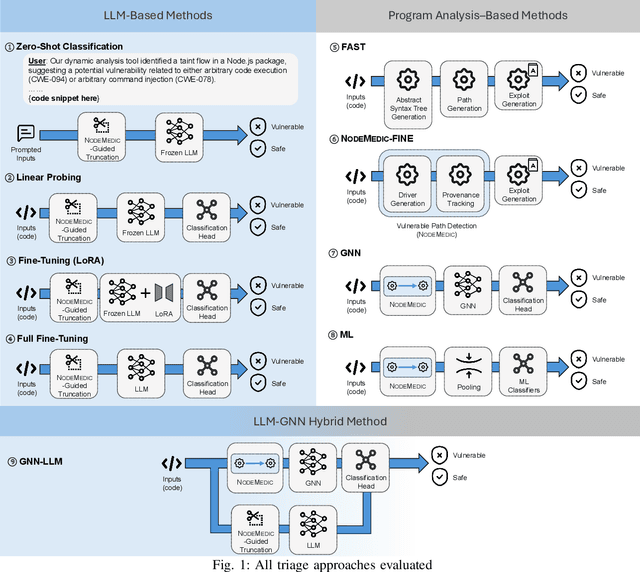
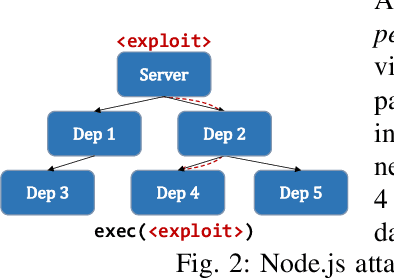
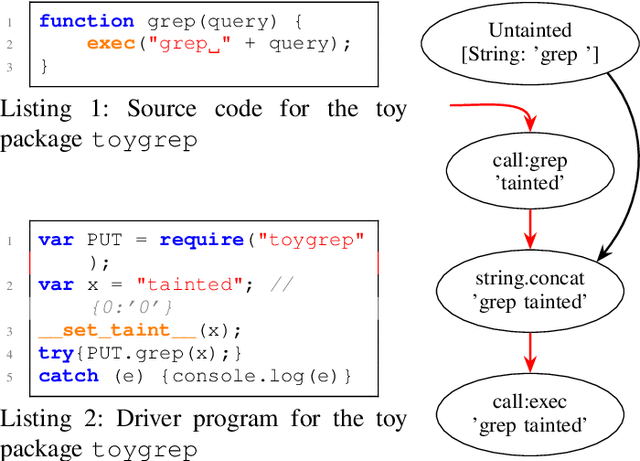
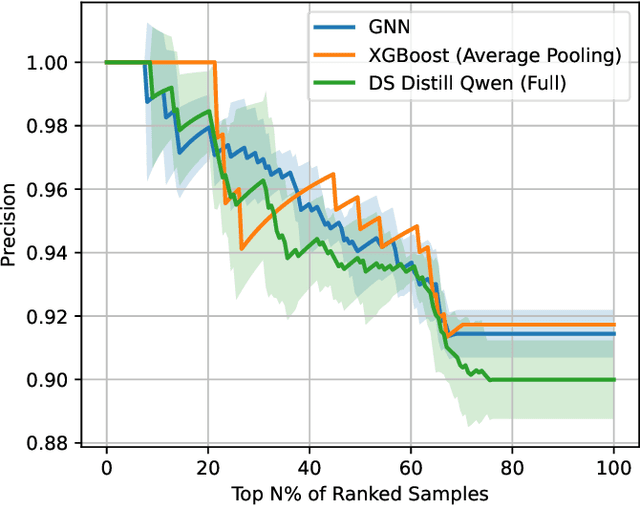
Program analysis tools often produce large volumes of candidate vulnerability reports that require costly manual review, creating a practical challenge: how can security analysts prioritize the reports most likely to be true vulnerabilities? This paper investigates whether machine learning can be applied to prioritizing vulnerabilities reported by program analysis tools. We focus on Node.js packages and collect a benchmark of 1,883 Node.js packages, each containing one reported ACE or ACI vulnerability. We evaluate a variety of machine learning approaches, including classical models, graph neural networks (GNNs), large language models (LLMs), and hybrid models that combine GNN and LLMs, trained on data based on a dynamic program analysis tool's output. The top LLM achieves $F_{1} {=} 0.915$, while the best GNN and classical ML models reaching $F_{1} {=} 0.904$. At a less than 7% false-negative rate, the leading model eliminates 66.9% of benign packages from manual review, taking around 60 ms per package. If the best model is tuned to operate at a precision level of 0.8 (i.e., allowing 20% false positives amongst all warnings), our approach can detect 99.2% of exploitable taint flows while missing only 0.8%, demonstrating strong potential for real-world vulnerability triage.