 Add to Chrome
 Add to Firefox
 Add to Edge
Evaluating Cross-Modal Reasoning Ability and Problem Characteristics with Multimodal Item Response Theory
Mar 03, 2026
Multimodal Large Language Models (MLLMs) have recently emerged as general architectures capable of reasoning over diverse modalities. Benchmarks for MLLMs should measure their ability for cross-modal integration. However, current benchmarks are filled with shortcut questions, which can be solved using only a single modality, thereby yielding unreliable rankings. For example, in vision-language cases, we can find the correct answer without either the image or the text. These low-quality questions unnecessarily increase the size and computational requirements of benchmarks. We introduce a multi-modal and multidimensional item response theory framework (M3IRT) that extends classical IRT by decomposing both model ability and item difficulty into image-only, text-only, and cross-modal components. M3IRT estimates cross-modal ability of MLLMs and each question's cross-modal difficulty, enabling compact, high-quality subsets that better reflect multimodal reasoning. Across 24 VLMs on three benchmarks, M3IRT prioritizes genuinely cross-modal questions over shortcuts and preserves ranking fidelity even when 50% of items are artificially generated low-quality questions, thereby reducing evaluation cost while improving reliability. M3IRT thus offers a practical tool for assessing cross-modal reasoning and refining multimodal benchmarks.

Harnessing the Latent Diffusion Model for Training-Free Image Style Transfer
Oct 02, 2024
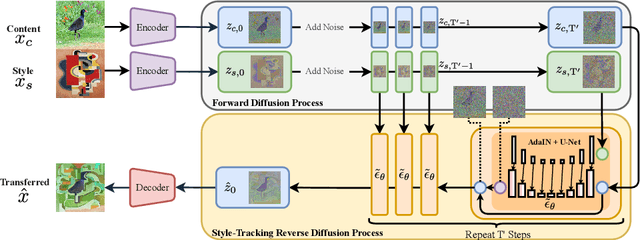
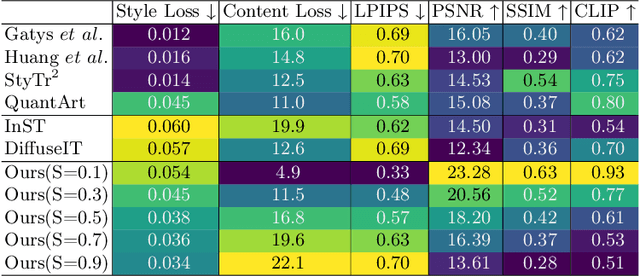
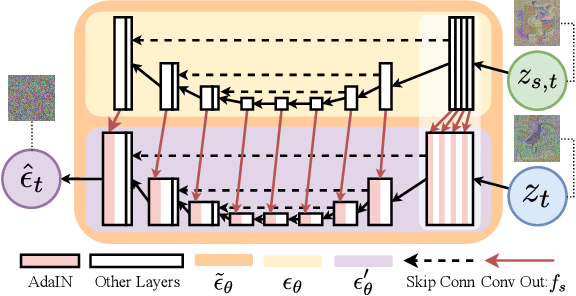
Diffusion models have recently shown the ability to generate high-quality images. However, controlling its generation process still poses challenges. The image style transfer task is one of those challenges that transfers the visual attributes of a style image to another content image. Typical obstacle of this task is the requirement of additional training of a pre-trained model. We propose a training-free style transfer algorithm, Style Tracking Reverse Diffusion Process (STRDP) for a pretrained Latent Diffusion Model (LDM). Our algorithm employs Adaptive Instance Normalization (AdaIN) function in a distinct manner during the reverse diffusion process of an LDM while tracking the encoding history of the style image. This algorithm enables style transfer in the latent space of LDM for reduced computational cost, and provides compatibility for various LDM models. Through a series of experiments and a user study, we show that our method can quickly transfer the style of an image without additional training. The speed, compatibility, and training-free aspect of our algorithm facilitates agile experiments with combinations of styles and LDMs for extensive application.
OpenCOLE: Towards Reproducible Automatic Graphic Design Generation
Jun 12, 2024


Automatic generation of graphic designs has recently received considerable attention. However, the state-of-the-art approaches are complex and rely on proprietary datasets, which creates reproducibility barriers. In this paper, we propose an open framework for automatic graphic design called OpenCOLE, where we build a modified version of the pioneering COLE and train our model exclusively on publicly available datasets. Based on GPT4V evaluations, our model shows promising performance comparable to the original COLE. We release the pipeline and training results to encourage open development.
LayoutFlow: Flow Matching for Layout Generation
Mar 27, 2024Finding a suitable layout represents a crucial task for diverse applications in graphic design. Motivated by simpler and smoother sampling trajectories, we explore the use of Flow Matching as an alternative to current diffusion-based layout generation models. Specifically, we propose LayoutFlow, an efficient flow-based model capable of generating high-quality layouts. Instead of progressively denoising the elements of a noisy layout, our method learns to gradually move, or flow, the elements of an initial sample until it reaches its final prediction. In addition, we employ a conditioning scheme that allows us to handle various generation tasks with varying degrees of conditioning with a single model. Empirically, LayoutFlow performs on par with state-of-the-art models while being significantly faster.