 Add to Chrome
 Add to Firefox
 Add to Edge
TokenSTFormer: A Tokenized Spatial-temporal Attention Model for Holistic Motion Analysis in Adolescent Idiopathic Scoliosis Screening
Aug 17, 2026
Adolescent Idiopathic Scoliosis (AIS) is a prevalent spinal deformity in adolescents that, if left untreated, can result in severe health outcomes. Traditional screening methods are limited by subjective interpretation, reliance on professional expertise and low scalability. To address these challenges, we present ScoliGait dataset, which comprises 1,516 gait video clips paired with corresponding X-ray records. We also introduce TokenSTFormer, a novel model that tokenizes spatial and temporal semantics to enhance feature representation and convergence. Our model achieves state-of-the-art performance, surpassing vanilla Vision Transformer encoder across key metrics, including accuracy of 0.79. This study highlights the potential of leveraging holistic motion features derived from gait video and attention-based models for scalable, cost-effective AIS screening, paving the way for future clinical applications in scoliosis detection.

Bipartite Distance for Shape-Aware Landmark Detection in Spinal X-Ray Images
May 28, 2020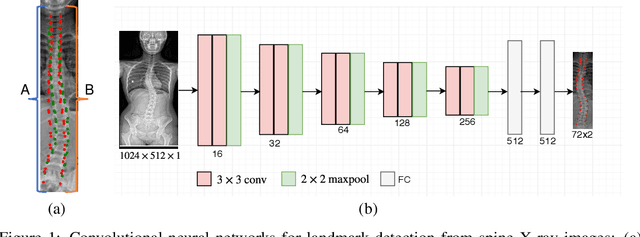
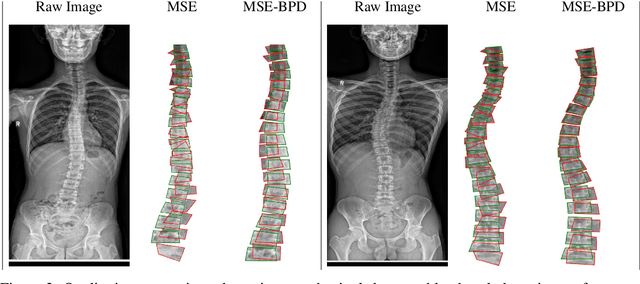
Scoliosis is a congenital disease that causes lateral curvature in the spine. Its assessment relies on the identification and localization of vertebrae in spinal X-ray images, conventionally via tedious and time-consuming manual radiographic procedures that are prone to subjectivity and observational variability. Reliability can be improved through the automatic detection and localization of spinal landmarks. To guide a CNN in the learning of spinal shape while detecting landmarks in X-ray images, we propose a novel loss based on a bipartite distance (BPD) measure, and show that it consistently improves landmark detection performance.
Analysis of Scoliosis From Spinal X-Ray Images
Apr 15, 2020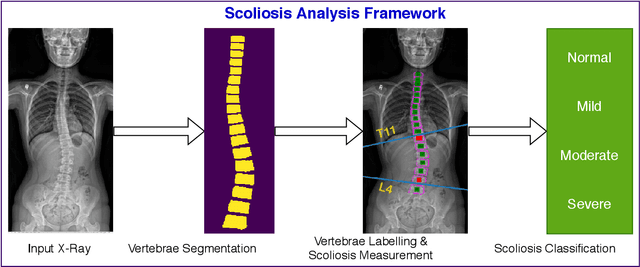
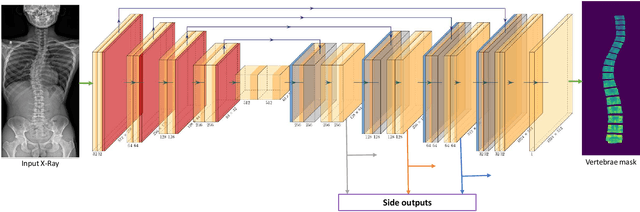
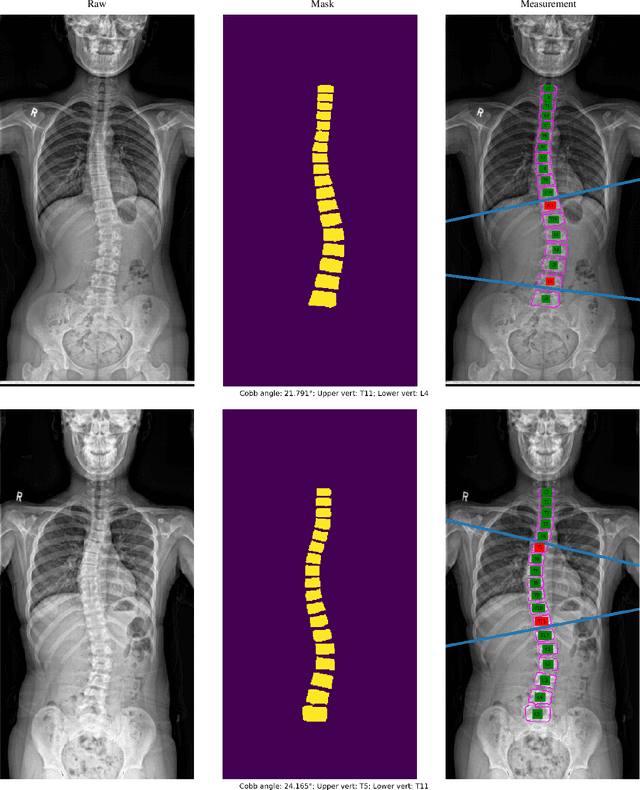
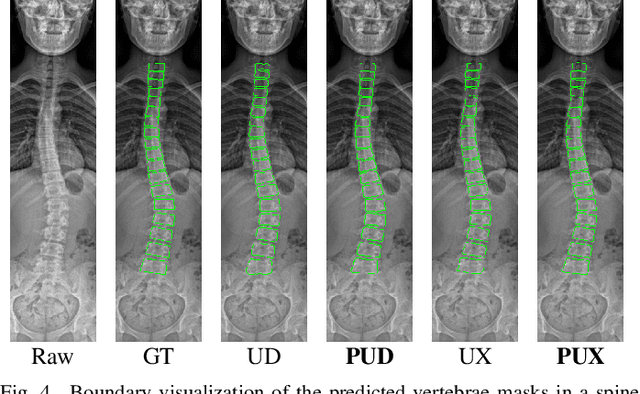
Scoliosis is a congenital disease in which the spine is deformed from its normal shape. Measurement of scoliosis requires labeling and identification of vertebrae in the spine. Spine radiographs are the most cost-effective and accessible modality for imaging the spine. Reliable and accurate vertebrae segmentation in spine radiographs is crucial in image-guided spinal assessment, disease diagnosis, and treatment planning. Conventional assessments rely on tedious and time-consuming manual measurement, which is subject to inter-observer variability. A fully automatic method that can accurately identify and segment the associated vertebrae is unavailable in the literature. Leveraging a carefully-adjusted U-Net model with progressive side outputs, we propose an end-to-end segmentation model that provides a fully automatic and reliable segmentation of the vertebrae associated with scoliosis measurement. Our experimental results from a set of anterior-posterior spine X-Ray images indicate that our model, which achieves an average Dice score of 0.993, promises to be an effective tool in the identification and labeling of spinal vertebrae, eventually helping doctors in the reliable estimation of scoliosis. Moreover, estimation of Cobb angles from the segmented vertebrae further demonstrates the effectiveness of our model.