 Add to Chrome
 Add to Firefox
 Add to Edge
PuYun-LDM: A Latent Diffusion Model for High-Resolution Ensemble Weather Forecasts
Feb 13, 2026
Latent diffusion models (LDMs) suffer from limited diffusability in high-resolution (<=0.25°) ensemble weather forecasting, where diffusability characterizes how easily a latent data distribution can be modeled by a diffusion process. Unlike natural image fields, meteorological fields lack task-agnostic foundation models and explicit semantic structures, making VFM-based regularization inapplicable. Moreover, existing frequency-based approaches impose identical spectral regularization across channels under a homogeneity assumption, which leads to uneven regularization strength under the inter-variable spectral heterogeneity in multivariate meteorological data. To address these challenges, we propose a 3D Masked AutoEncoder (3D-MAE) that encodes weather-state evolution features as an additional conditioning for the diffusion model, together with a Variable-Aware Masked Frequency Modeling (VA-MFM) strategy that adaptively selects thresholds based on the spectral energy distribution of each variable. Together, we propose PuYun-LDM, which enhances latent diffusability and achieves superior performance to ENS at short lead times while remaining comparable to ENS at longer horizons. PuYun-LDM generates a 15-day global forecast with a 6-hour temporal resolution in five minutes on a single NVIDIA H200 GPU, while ensemble forecasts can be efficiently produced in parallel.

Latent Implicit Visual Reasoning
Dec 24, 2025While Large Multimodal Models (LMMs) have made significant progress, they remain largely text-centric, relying on language as their core reasoning modality. As a result, they are limited in their ability to handle reasoning tasks that are predominantly visual. Recent approaches have sought to address this by supervising intermediate visual steps with helper images, depth maps, or image crops. However, these strategies impose restrictive priors on what "useful" visual abstractions look like, add heavy annotation costs, and struggle to generalize across tasks. To address this critical limitation, we propose a task-agnostic mechanism that trains LMMs to discover and use visual reasoning tokens without explicit supervision. These tokens attend globally and re-encode the image in a task-adaptive way, enabling the model to extract relevant visual information without hand-crafted supervision. Our approach outperforms direct fine-tuning and achieves state-of-the-art results on a diverse range of vision-centric tasks -- including those where intermediate abstractions are hard to specify -- while also generalizing to multi-task instruction tuning.
Benchmarking Next-Generation Reasoning-Focused Large Language Models in Ophthalmology: A Head-to-Head Evaluation on 5,888 Items
Apr 15, 2025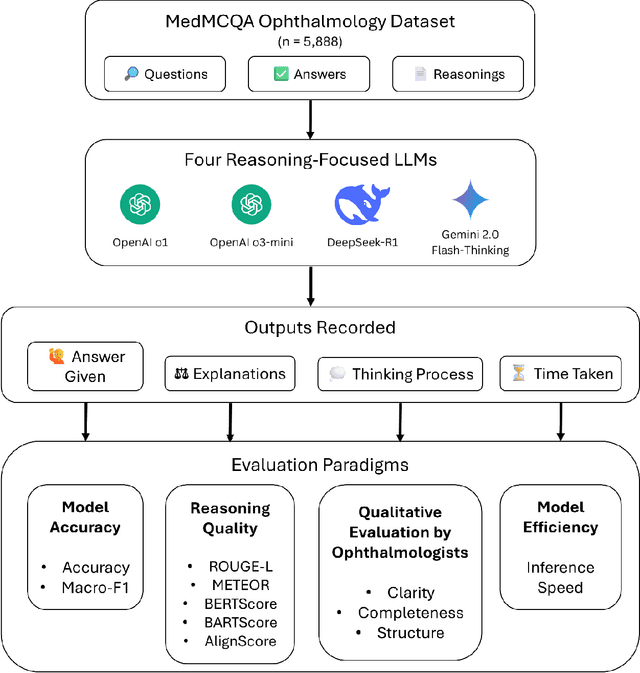
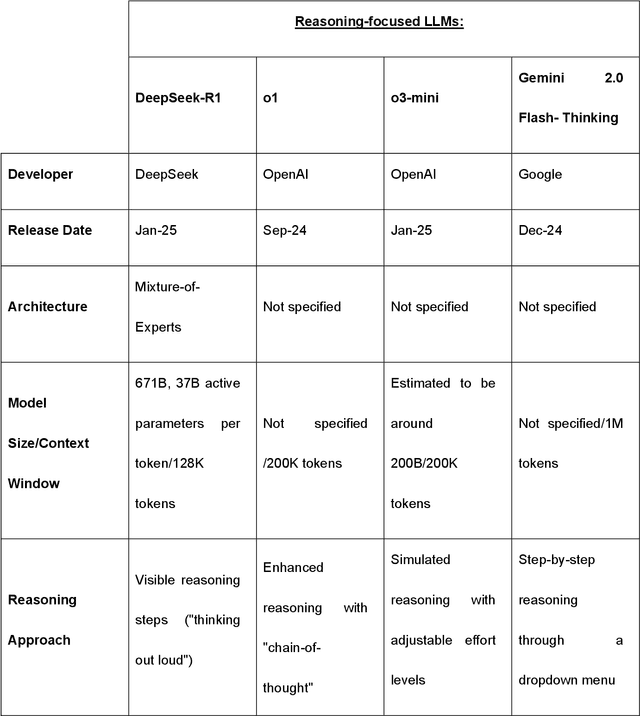
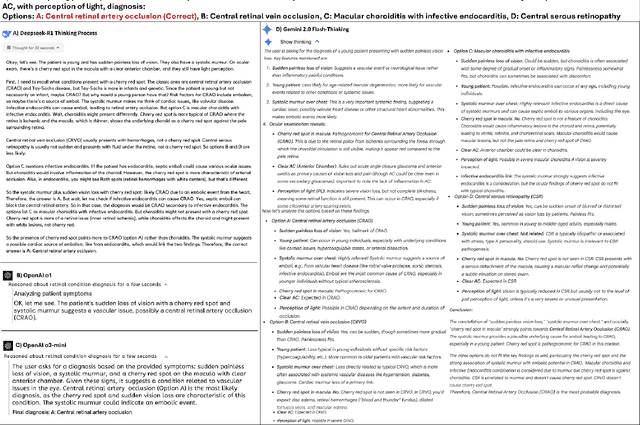
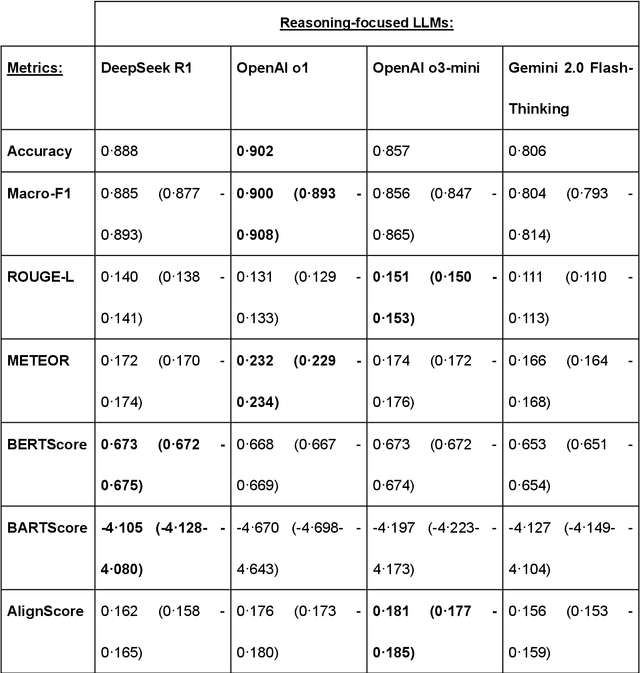
Recent advances in reasoning-focused large language models (LLMs) mark a shift from general LLMs toward models designed for complex decision-making, a crucial aspect in medicine. However, their performance in specialized domains like ophthalmology remains underexplored. This study comprehensively evaluated and compared the accuracy and reasoning capabilities of four newly developed reasoning-focused LLMs, namely DeepSeek-R1, OpenAI o1, o3-mini, and Gemini 2.0 Flash-Thinking. Each model was assessed using 5,888 multiple-choice ophthalmology exam questions from the MedMCQA dataset in zero-shot setting. Quantitative evaluation included accuracy, Macro-F1, and five text-generation metrics (ROUGE-L, METEOR, BERTScore, BARTScore, and AlignScore), computed against ground-truth reasonings. Average inference time was recorded for a subset of 100 randomly selected questions. Additionally, two board-certified ophthalmologists qualitatively assessed clarity, completeness, and reasoning structure of responses to differential diagnosis questions.O1 (0.902) and DeepSeek-R1 (0.888) achieved the highest accuracy, with o1 also leading in Macro-F1 (0.900). The performance of models across the text-generation metrics varied: O3-mini excelled in ROUGE-L (0.151), o1 in METEOR (0.232), DeepSeek-R1 and o3-mini tied for BERTScore (0.673), DeepSeek-R1 (-4.105) and Gemini 2.0 Flash-Thinking (-4.127) performed best in BARTScore, while o3-mini (0.181) and o1 (0.176) led AlignScore. Inference time across the models varied, with DeepSeek-R1 being slowest (40.4 seconds) and Gemini 2.0 Flash-Thinking fastest (6.7 seconds). Qualitative evaluation revealed that DeepSeek-R1 and Gemini 2.0 Flash-Thinking tended to provide detailed and comprehensive intermediate reasoning, whereas o1 and o3-mini displayed concise and summarized justifications.