 Add to Chrome
 Add to Firefox
 Add to Edge
A Pin-Array Structured Climbing Robot for Stable Locomotion on Steep Rocky Terrain
Mar 17, 2026
Climbing robots face significant challenges when navigating unstructured environments, where reliable attachment to irregular surfaces is critical. We present a novel mobile climbing robot equipped with compliant pin-array structured grippers that passively conform to surface irregularities, ensuring stable ground gripping without the need for complicated sensing or control. Each pin features a vertically split design, combining an elastic element with a metal spine to enable mechanical interlocking with microscale surface features. Statistical modeling and experimental validation indicate that variability in individual pin forces and contact numbers are the primary sources of grasping uncertainty. The robot demonstrated robust and stable locomotion in indoor tests on inclined walls (10-30 degrees) and in outdoor tests on natural rocky terrain. This work highlights that a design emphasizing passive compliance and mechanical redundancy provides a practical and robust solution for real-world climbing robots while minimizing control complexity.

LIMBERO: A Limbed Climbing Exploration Robot Toward Traveling on Rocky Cliffs
Mar 17, 2026In lunar and planetary exploration, legged robots have attracted significant attention as an alternative to conventional wheeled robots, which struggle to traverse rough and uneven terrain. To enable locomotion over highly irregular and steeply inclined surfaces, limbed climbing robots equipped with grippers on their feet have emerged as a promising solution. In this paper, we present LIMBERO, a 10 kg-class quadrupedal climbing robot that employs spine-type grippers for stable locomotion and climbing on rugged and steep terrain. We first introduce a novel gripper design featuring coupled finger-closing and spine-hooking motions, tightly actuated by a single motor, which achieves exceptional grasping performance (>150 N) despite its lightweight design (525 g). Furthermore, we develop an efficient algorithm to visualize a geometry-based graspability index on continuous rough terrain. Finally, we integrate these components into LIMBERO and demonstrate its ability to ascend steep rocky surfaces under a 1 G gravity condition, a performance not previously achieved yet for limbed climbing robots of this scale.
Lower Gravity Demonstratable Testbed for Space Robot Experiments
Sep 19, 2023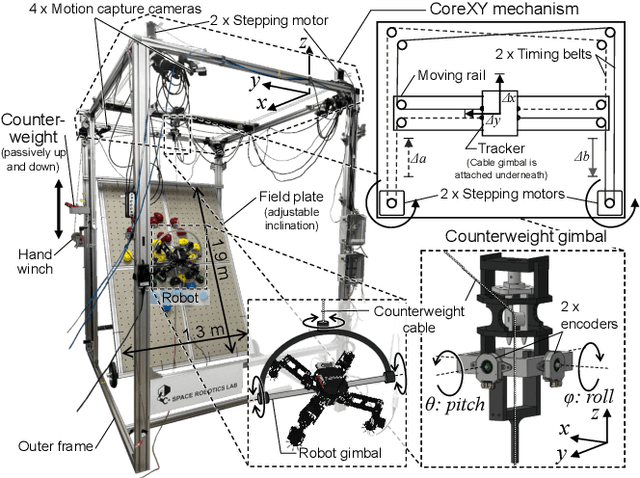
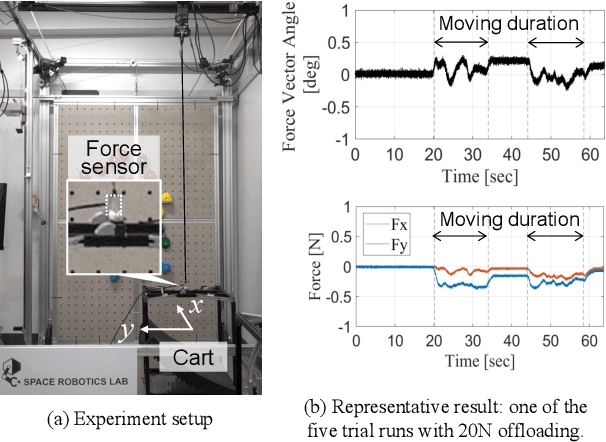
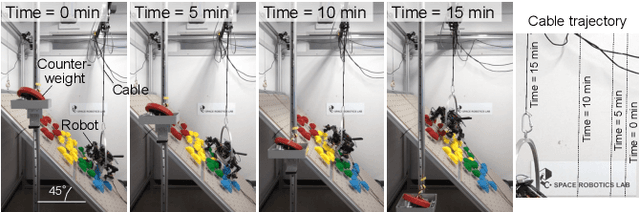
In developing mobile robots for exploration on the planetary surface, it is crucial to evaluate the robot's performance, demonstrating the harsh environment in which the robot will actually be deployed. Repeatable experiments in a controlled testing environment that can reproduce various terrain and gravitational conditions are essential. This paper presents the development of a minimal and space-saving indoor testbed, which can simulate steep slopes, uneven terrain, and lower gravity, employing a three-dimensional target tracking mechanism (active xy and passive z) with a counterweight.