 Add to Chrome
 Add to Firefox
 Add to Edge
LIMBERO: A Limbed Climbing Exploration Robot Toward Traveling on Rocky Cliffs
Mar 17, 2026
In lunar and planetary exploration, legged robots have attracted significant attention as an alternative to conventional wheeled robots, which struggle to traverse rough and uneven terrain. To enable locomotion over highly irregular and steeply inclined surfaces, limbed climbing robots equipped with grippers on their feet have emerged as a promising solution. In this paper, we present LIMBERO, a 10 kg-class quadrupedal climbing robot that employs spine-type grippers for stable locomotion and climbing on rugged and steep terrain. We first introduce a novel gripper design featuring coupled finger-closing and spine-hooking motions, tightly actuated by a single motor, which achieves exceptional grasping performance (>150 N) despite its lightweight design (525 g). Furthermore, we develop an efficient algorithm to visualize a geometry-based graspability index on continuous rough terrain. Finally, we integrate these components into LIMBERO and demonstrate its ability to ascend steep rocky surfaces under a 1 G gravity condition, a performance not previously achieved yet for limbed climbing robots of this scale.

Towards the Automation in the Space Station: Feasibility Study and Ground Tests of a Multi-Limbed Intra-Vehicular Robot
Dec 29, 2025This paper presents a feasibility study, including simulations and prototype tests, on the autonomous operation of a multi-limbed intra-vehicular robot (mobile manipulator), shortly MLIVR, designed to assist astronauts with logistical tasks on the International Space Station (ISS). Astronauts spend significant time on tasks such as preparation, close-out, and the collection and transportation of goods, reducing the time available for critical mission activities. Our study explores the potential for a mobile manipulator to support these operations, emphasizing the need for autonomous functionality to minimize crew and ground operator effort while enabling real-time task execution. We focused on the robot's transportation capabilities, simulating its motion planning in 3D space. The actual motion execution was tested with a prototype on a 2D table to mimic a microgravity environment. The results demonstrate the feasibility of performing these tasks with minimal human intervention, offering a promising solution to enhance operational efficiency on the ISS.
Lower Gravity Demonstratable Testbed for Space Robot Experiments
Sep 19, 2023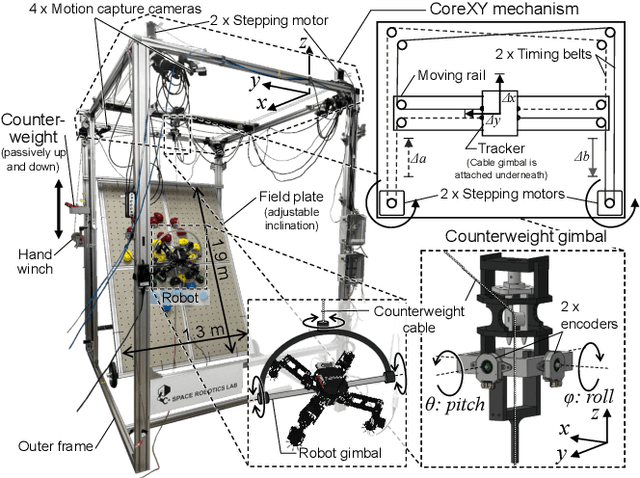
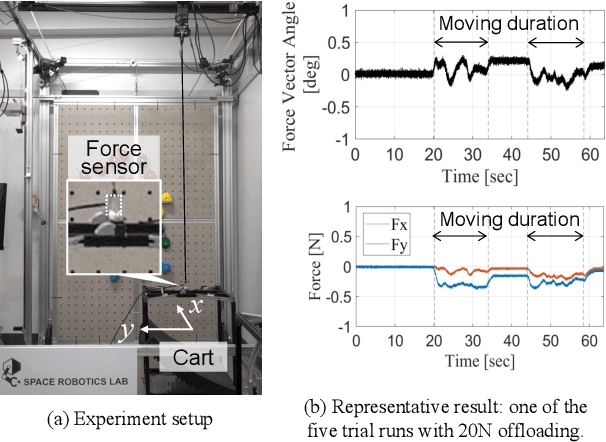
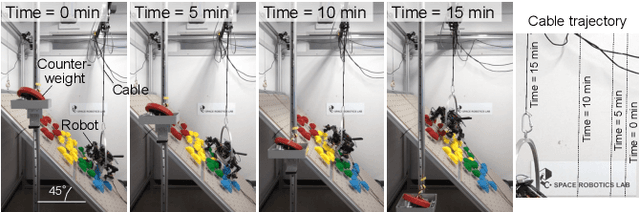
In developing mobile robots for exploration on the planetary surface, it is crucial to evaluate the robot's performance, demonstrating the harsh environment in which the robot will actually be deployed. Repeatable experiments in a controlled testing environment that can reproduce various terrain and gravitational conditions are essential. This paper presents the development of a minimal and space-saving indoor testbed, which can simulate steep slopes, uneven terrain, and lower gravity, employing a three-dimensional target tracking mechanism (active xy and passive z) with a counterweight.