 Add to Chrome
 Add to Firefox
 Add to Edge
MolBioKG: Grounding Out-of-Graph Molecules in Biomedical Knowledge Graphs via Multi-Resolution Structural Anchoring
Aug 07, 2026
Biomedical knowledge graphs (KGs) accelerate drug discovery, but standard pipelines assume query molecules already exist as graph entities, leaving unregistered molecules disconnected. We address this cold-start challenge, termed the out-of-graph molecule problem, by introducing MolBioKG. This two-layer system grounds unseen molecules in biomedical evidence via multi-resolution structural anchoring. It connects an index of 2.74 million molecules (represented by scaffolds, fragments, functional groups, and fingerprints) to a 9.6-million-edge KG. Given only a SMILES string, MolBioKG retrieves structurally related graph entities and traverses their biomedical neighborhoods without task-specific training. It features two inference mechanisms: static multi-anchor retrieval using Reciprocal Rank Fusion, and Adapt-KG, a tool-using LLM policy for adaptive traversal. Evaluated across in-graph link recovery, complex multi-hop reasoning, and out-of-graph generalization, MolBioKG outperforms strong baselines. Notably, it raises Hits@10 from 0.585 to 0.876 in multi-hop reasoning and out-of-graph target recall from 0.145 to 0.269, all while ensuring predictions retain traceable structural anchors and source-attributed KG evidence.

Pepti-drift: Toxicity-Repulsive Drifting for Antigen-Conditioned Discrete Peptide Generation
Jun 29, 2026Peptides are a promising therapeutic modality that combine the chemical tunability of small molecules with the target specificity of macromolecular therapeutics. However, designing antigen-specific binding peptides while avoiding toxicity remains a major challenge for therapeutic peptide discovery. Here, we present Pepti-drift, a toxicity-aware latent refinement framework that generates peptide candidates through a single antigen-conditioned drift step. In a peptide embedding space, Pepti-drift learns to attract generated peptide latents toward antigen-matched binding peptides while repelling them from toxicity-associated regions. This is challenging because binding-promoting physicochemical features often overlap with toxicity-associated features in peptide representation space. To address this, we introduce a warm-up strategy to stabilize this competing objective by first learning binding-oriented attraction and then increasing toxicity repulsion. Pepti-drift achieves highly efficient generation, running 16.2-fold faster than PepMLM and 1,092.0-fold faster than PepTune. Generated peptides show 100% validity, 98.1% uniqueness, the highest sequence diversity, and near-zero cross-antigen reuse. Further evaluation indicates consistently reduced toxicity and hemolysis risk across most peptide-length ranges while retaining target-related predictive binding signal. Pepti-drift thus provides a fast, scalable, and controllable framework for antigen-specific peptide design that directly encodes safe-and-active properties.
Resampling Benchmark for Efficient Comprehensive Evaluation of Large Vision-Language Models
Apr 14, 2025We propose an efficient evaluation protocol for large vision-language models (VLMs). Given their broad knowledge and reasoning capabilities, multiple benchmarks are needed for comprehensive assessment, making evaluation computationally expensive. To improve efficiency, we construct a subset that yields results comparable to full benchmark evaluations. Our benchmark classification experiments reveal that no single benchmark fully covers all challenges. We then introduce a subset construction method using farthest point sampling (FPS). Our experiments show that FPS-based benchmarks maintain a strong correlation (> 0.96) with full evaluations while using only ~1\% of the data. Additionally, applying FPS to an existing benchmark improves correlation with overall evaluation results, suggesting its potential to reduce unintended dataset biases.
Locally Self-Adjustive Smoothing for Measurement Noise Reduction with Application to Automated Peak Detection
Oct 23, 2023Smoothing is widely used approach for measurement noise reduction in spectral analysis. However, it suffers from signal distortion caused by peak suppression. A locally self-adjustive smoothing method is developed that retains sharp peaks and less distort signals. The proposed method uses only one parameter that determines global smoothness, while balancing the local smoothness using data itself. Simulation and real experiments in comparison with existing convolution-based smoothing methods indicate both qualitatively and quantitatively improved noise reduction performance in practical scenarios. We also discuss parameter selection and demonstrate an application for the automated smoothing and detection of a given number of peaks from noisy measurement data.
Rethinking PointNet Embedding for Faster and Compact Model
Jul 31, 2020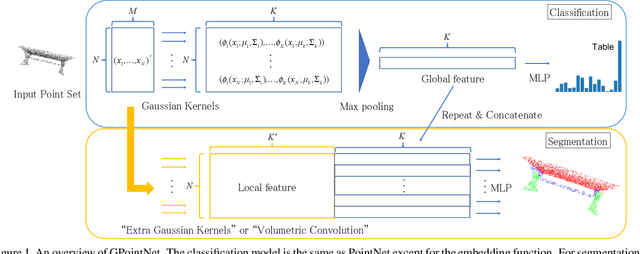
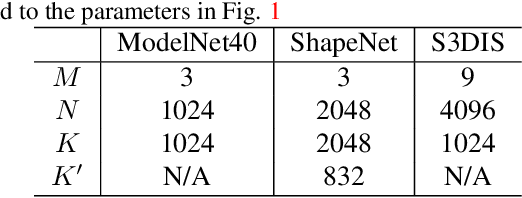
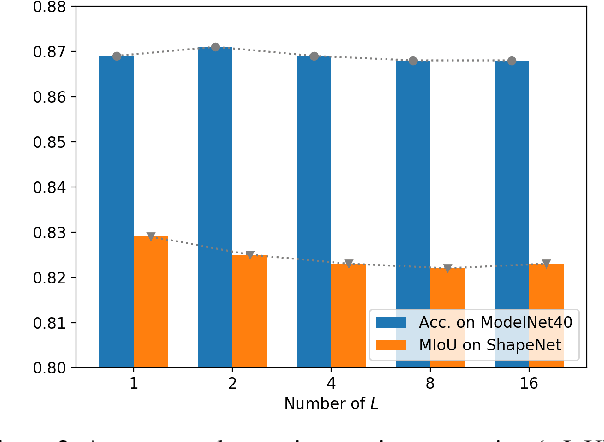
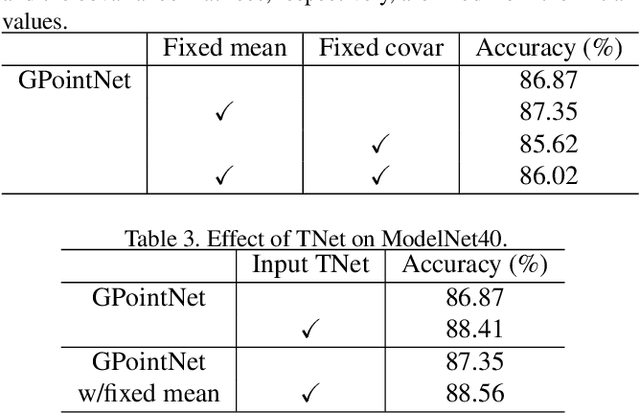
PointNet, which is the widely used point-wise embedding method and known as a universal approximator for continuous set functions, can process one million points per second. Nevertheless, real-time inference for the recent development of high-performing sensors is still challenging with existing neural network-based methods, including PointNet. In ordinary cases, the embedding function of PointNet behaves like a soft-indicator function that is activated when the input points exist in a certain local region of the input space. Leveraging this property, we reduce the computational costs of point-wise embedding by replacing the embedding function of PointNet with the soft-indicator function by Gaussian kernels. Moreover, we show that the Gaussian kernels also satisfy the universal approximation theorem that PointNet satisfies. In experiments, we verify that our model using the Gaussian kernels achieves comparable results to baseline methods, but with much fewer floating-point operations per sample up to 92\% reduction from PointNet.